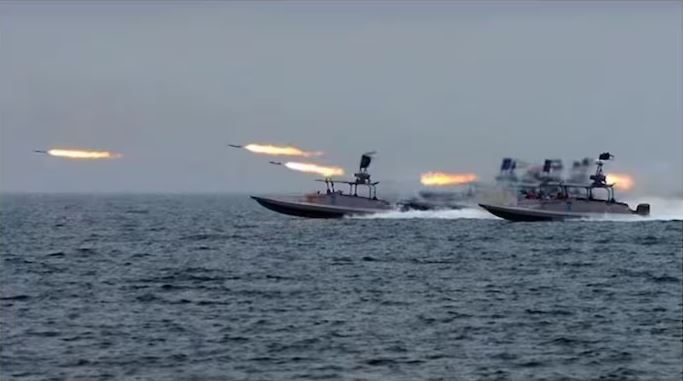
The United States and Iran exchanged their heaviest fire in months this weekend, after Iran's Islamic Revolutionary Guard Corps attacked a container ship in the Strait of Hormuz and declared the waterway closed. US Central Command said it struck roughly 140 targets in Iran overnight, bringing the total across three rounds of strikes this week to more than 300. The renewed violence has shattered a fragile ceasefire and reignited fears over global oil supply through one of the world's most critical shipping corridors.
For a conflict that has already reshaped energy markets once this year, the latest escalation raises a familiar question with fresh urgency. Can diplomacy reopen the strait before prolonged closure forces a deeper economic reckoning.
How the Latest Escalation Unfolded
The renewed clashes began after President Trump declared an earlier ceasefire "over" on Wednesday, prompting both sides to resume strikes for a third consecutive weekend.
The Trigger in the Strait
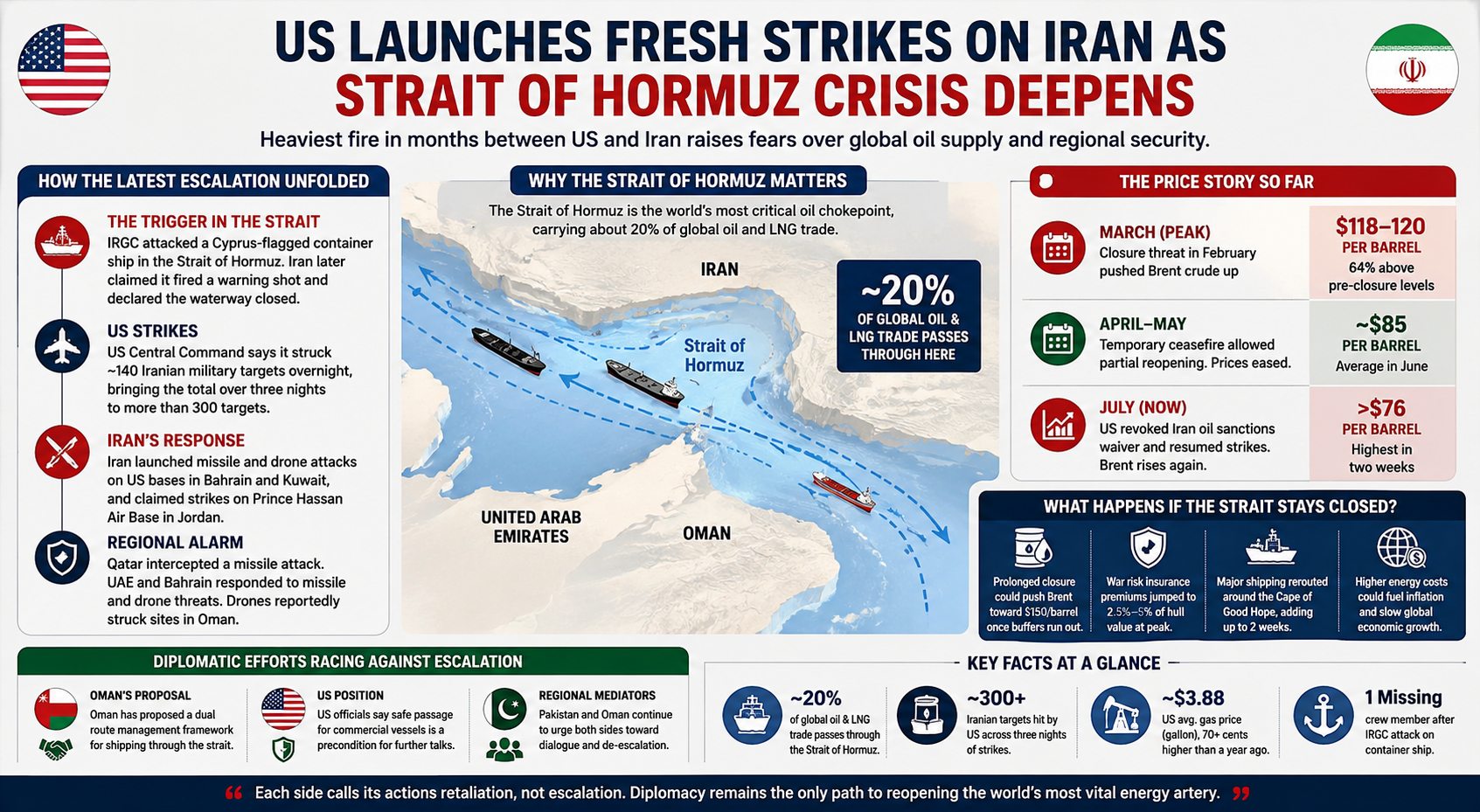
Central Command said the IRGC "blatantly attacked" a Cyprus flagged container ship transiting the strait, leaving one crew member missing and causing significant damage to the vessel's engine room. Iran's account differs. The IRGC said it fired a warning shot at a ship attempting to use an unauthorized route, then used that incident to declare the strait closed to all traffic.
Key developments since the strikes resumed include:
- CENTCOM says it struck approximately 140 Iranian military targets overnight, part of more than 300 targets hit over three nights.
- Iran responded with missile and drone attacks on US bases in Bahrain and Kuwait, according to the IRGC.
- The IRGC claimed retaliatory strikes on Prince Hassan Air Base in Jordan.
- Qatar said it intercepted a missile attack, while the UAE and Bahrain reported responding to missile and drone threats.
Regional Alarm Spreads Beyond Iran
The crisis is no longer contained to the direct combatants. Bahrain activated sirens and told residents to seek shelter, Qatar's Ministry of Defense said it intercepted an incoming missile, and Iranian drones reportedly struck sites in Oman just a day after Omani officials had hosted talks aimed at de-escalation. That timing underscores how quickly diplomatic progress in this conflict has unraveled.
Why the Strait of Hormuz Matters to Global Oil Markets
The Strait of Hormuz carries roughly one fifth of the world's oil and liquefied natural gas trade, making it the single most consequential chokepoint in global energy markets. Iran first moved to block shipping through the strait in late February, triggering what the International Energy Agency has called the largest supply disruption in the history of the oil market.
The Price Story So Far
Oil markets have swung sharply based on how close the conflict comes to fully closing the strait.
- Brent crude peaked near 118 to 120 dollars per barrel in March, roughly 64 percent above pre closure levels.
- Prices eased through April and May as a temporary ceasefire allowed partial reopening, with Brent averaging around 85 dollars per barrel in June.
- Brent rose again above 76 dollars a barrel this week, its highest level in two weeks, after the US revoked a sanctions waiver on Iranian oil and resumed strikes.
What Happens if the Strait Stays Closed
Analysts widely agree that the market's reaction depends less on any single strike and more on how long disruption persists. Global inventories and strategic reserves were built for weeks of disruption, not months. Brookings researchers have modeled that a sustained shortfall could push Brent toward 150 dollars per barrel once temporary buffers run out, a scenario that would ripple through inflation, interest rate policy, and consumer energy costs worldwide.
Shipping data already shows the practical cost of instability. War risk insurance premiums for tankers transiting the strait have jumped from a fraction of a percent of hull value before the crisis to as high as 2.5 to 5 percent at peak, adding millions of dollars per voyage for large crude carriers. Major container lines have rerouted around the Cape of Good Hope, adding thousands of nautical miles and up to two weeks of transit time.
Diplomatic Efforts Racing Against Escalation
Even as strikes continued, mediators pressed forward. Iranian Foreign Minister Abbas Araghchi met his Omani counterpart to discuss a proposal for managing traffic in the strait through two separately controlled routes. Pakistan's deputy foreign minister publicly urged both sides toward dialogue. US officials have said talks with Tehran cannot progress meaningfully until commercial vessels are guaranteed safe passage through the channel.
- Oman has floated a dual route management framework as a possible near term fix.
- US officials maintain that safe passage guarantees are a precondition for further talks.
- Pakistan and Oman continue to serve as primary mediators between Washington and Tehran.
The gap between military escalation and diplomatic proposals remains wide. Each side has framed its recent actions as retaliation rather than escalation, a pattern that has repeated through multiple rounds of strikes since February without producing a durable resolution.