
California lawmakers are weighing a bill that would give ordinary consumers and small businesses a new legal weapon against corporate monopolies. Assembly Bill 1776, known as the COMPETE Act, has cleared the Assembly and now sits before the Senate Appropriations Committee, setting up one of the year's sharpest fights between labor, trial lawyers, and the business lobby.
What The COMPETE Act Would Change
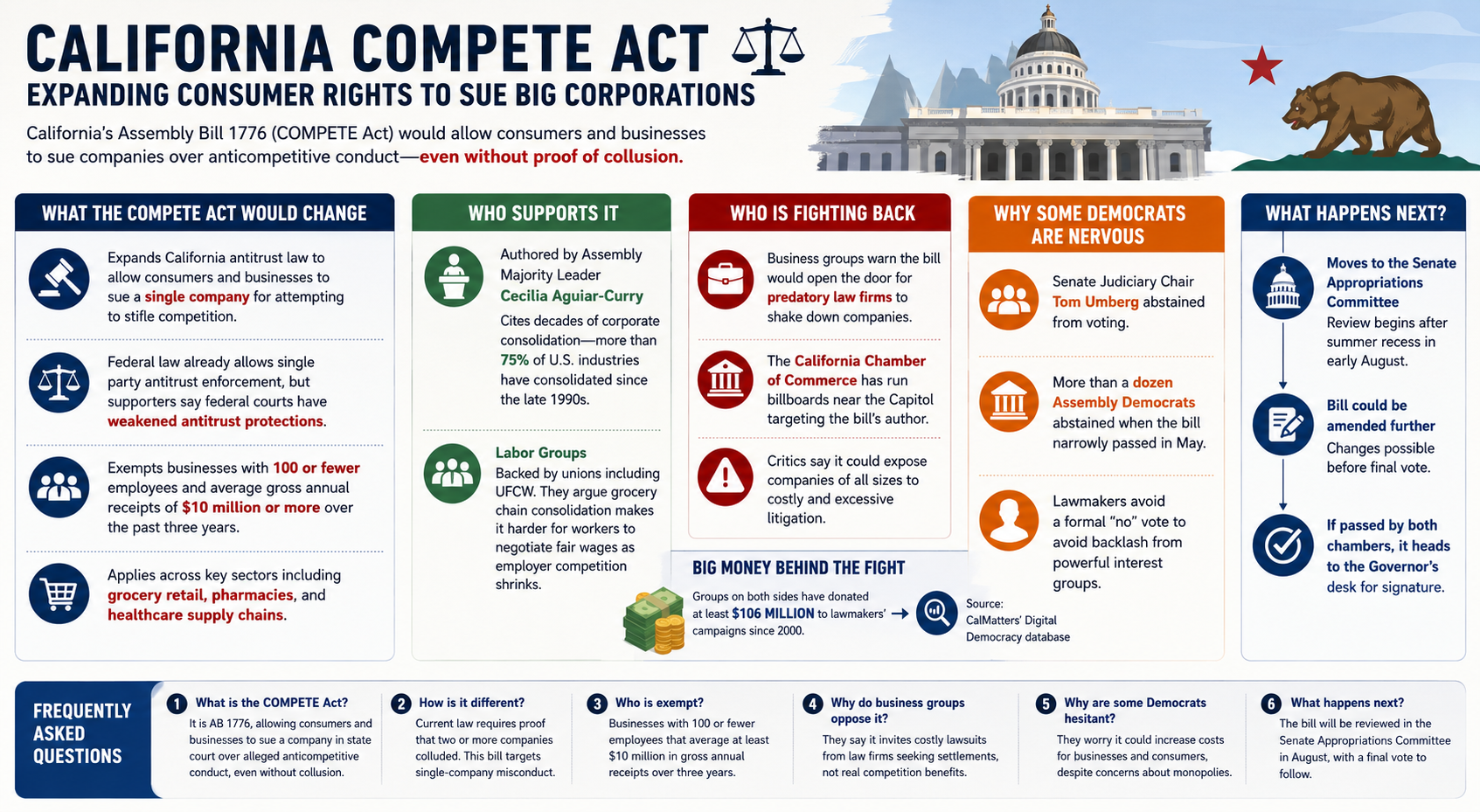
Under current California law, antitrust claims generally require proof that two or more companies colluded to suppress competition. Assembly Bill 1776 would expand California's antitrust law to allow people and businesses that claim they're harmed by a company's attempts to stifle competition to sue in state court, even when only a single firm is accused of anticompetitive conduct.
- Federal law already permits single party antitrust enforcement, but supporters argue federal courts have watered down antitrust law to the point the state needs to chart its own course.
- Smaller companies that have 100 employees or fewer and average 10 million dollars or more in gross annual receipts over the previous three years are exempt.
- The bill would apply to sectors from grocery retail to pharmacies to healthcare supply chains.
Who Supports It And Who Is Fighting Back
The bill's author, Assembly Majority Leader Cecilia Aguiar-Curry, has framed it as a response to decades of corporate consolidation. She has noted that more than 75 percent of U.S. industries have experienced consolidation since the late 1990s, arguing that concentrated market power drives up prices and limits consumer choice.
Labor groups have lined up behind the measure. Mark Ramos of the United Food and Commercial Workers Western States Council said grocery chain consolidation has made it harder for workers to negotiate fair wages as competition among employers shrinks.
Business groups are pushing back hard.
- Business groups say if the measure were signed into law it would open up a new way for predatory law firms to shake down companies.
- The California Chamber of Commerce placed billboards near the Capitol directly targeting the bill's author.
- Critics warn the change could expose companies of every size to costly litigation.
The financial stakes behind the lobbying are significant. Combined, the groups fighting over the bill have given at least 106 million dollars to lawmakers' campaigns since 2000, according to CalMatters' Digital Democracy database.
Why Some Democrats Are Nervous
Despite Democratic control of the legislature, the bill has exposed internal party divisions. Senate Judiciary Committee chair Tom Umberg abstained from voting, joined by more than a dozen Assembly Democrats who declined to cast a vote when the bill narrowly passed in May. Lawmakers frequently avoid a formal no vote on contentious bills to sidestep backlash from powerful interest groups on either side.
The bill now moves to the Senate Appropriations Committee when lawmakers return from summer recess in early August, where further changes are possible before any final vote.