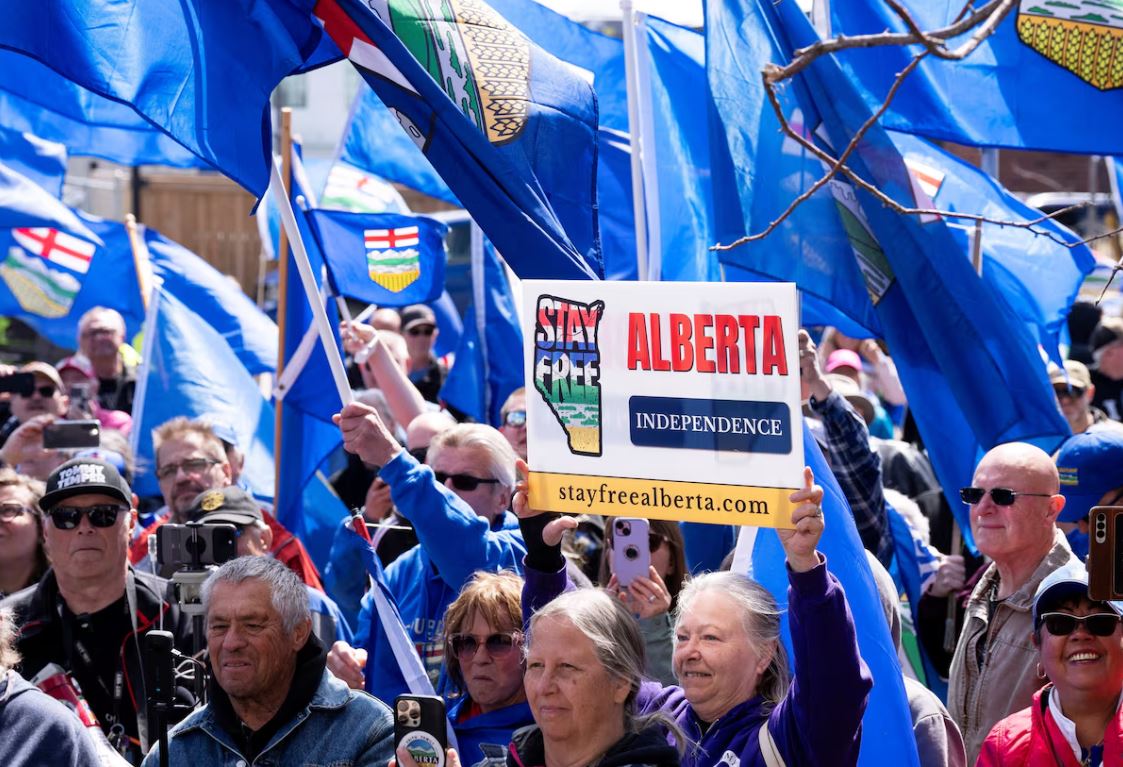
A new body of research points to a coordinated effort by foreign actors to inflate and distort Alberta's separatist movement. Between December 2025 and April 2026, researchers tracked a sharp rise in online activity tied to Russian-aligned networks, American political influencers, and profit-driven content farms, all converging on the same provincial debate at the same time.
The findings come from a joint report, "Decision Making & National Unity Under Threat: Foreign Interference, Cognitive Sovereignty, and the Alberta Referendum," produced by DisinfoWatch, the Canadian Digital Media Research Network, and CASiLabs. It is the most detailed account to date of how a domestic political grievance became an international information target.
What the Report Found
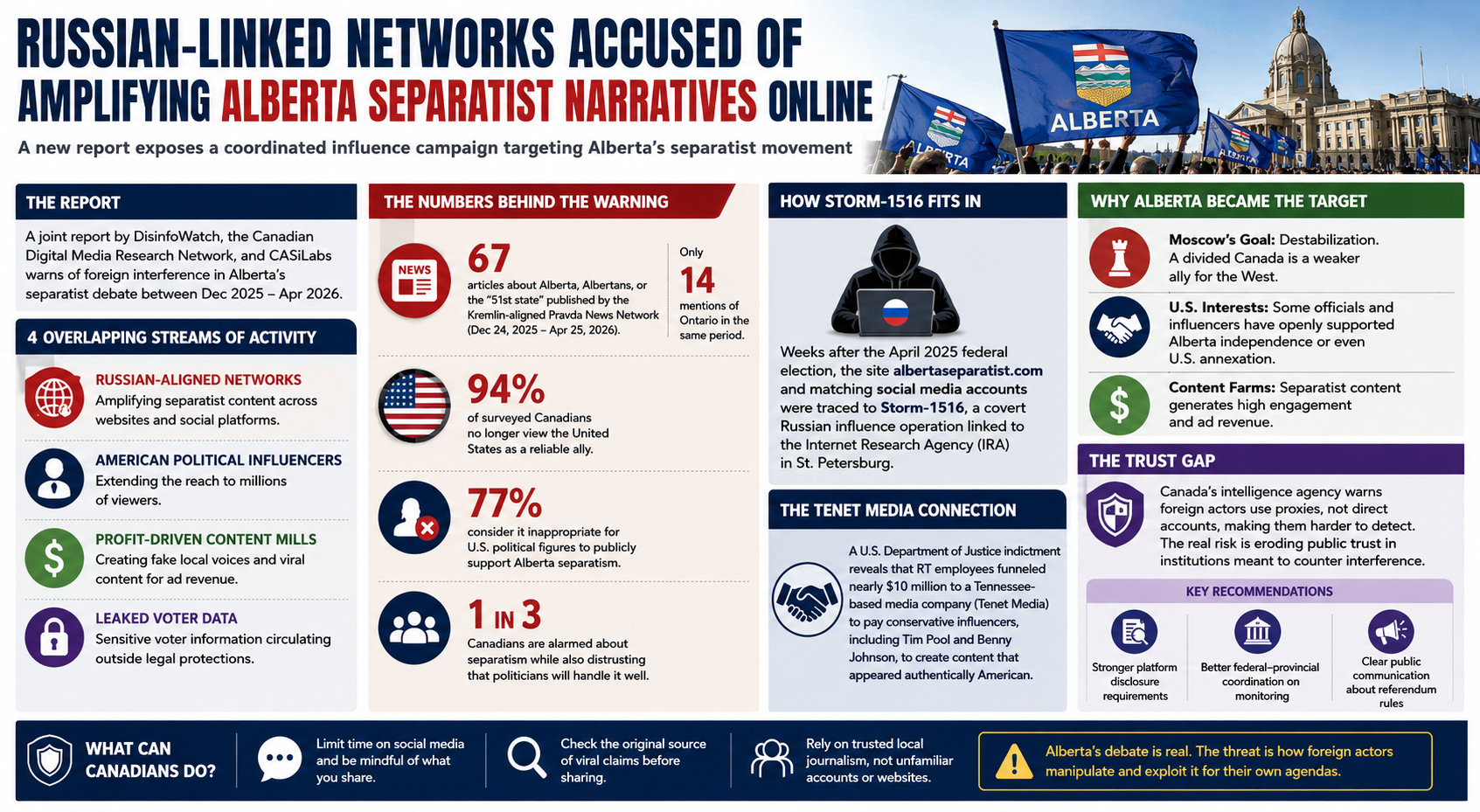
Researchers identified four separate but overlapping streams of activity working on Alberta's separatist debate:
- Russian-aligned networks amplifying separatist content.
- American political influencers extending its reach to millions of viewers.
- Profit-driven content mills manufacturing fake local voices for ad revenue.
- Leaked voter data circulating outside normal legal protections.
Each stream operates independently, but the report argues their combined effect is what matters. Alberta became one of the most discussed Canadian topics across known disinformation networks during the five-month window studied.
The Numbers Behind the Warning
The scale of the activity is documented with specific figures:
- The Kremlin-aligned Pravda News Network ran 67 articles mentioning Alberta, Albertans, or the "51st state" between December 24, 2025, and April 25, 2026, compared with only 14 mentions of Ontario in the same period.
- Roughly 94 percent of surveyed Canadians said they no longer viewed the United States as a reliable ally.
- About 77 percent considered it inappropriate for U.S. political figures to publicly support Alberta separatism.
- One in three Canadians reported being alarmed about separatism while also distrusting that politicians would handle it well, a gap the report says foreign influence campaigns exploit directly.
How Storm-1516 Fits Into the Picture
Weeks after the April 2025 federal election, a website called albertaseparatist.com appeared, along with matching TikTok and YouTube accounts. Digital researchers, including the threat intelligence firm Insikt Group, traced its infrastructure to Storm-1516, a covert Russian influence operation with a documented history of building fictional websites to target foreign audiences. Storm-1516 has been linked to the St. Petersburg-based Internet Research Agency, an organization long associated with election interference in France, Germany, the United States, and the Brexit referendum.
A Familiar Playbook, Applied to a New Target
Brian McQuinn, one of the report's authors, noted that a large majority of Russian-linked disinformation circulating on this topic is not spread by Russian accounts at all. Instead, it is shared by ordinary Canadians who encounter the content and repost it without checking where it came from. That is the design. Foreign material gains a local face, while genuine frustration over federalism and energy policy supplies the emotional pull that makes it spread.
The Tenet Media Connection
The report treats the Tenet Media case as the clearest documented link between Russian funding and American political influencers. According to a U.S. Department of Justice indictment, two employees of Russia's state broadcaster RT ran a covert scheme that funneled nearly ten million dollars to a Tennessee-based media company. That company paid conservative commentators, including Tim Pool and Benny Johnson, to produce content that read as authentically American even though it was directed and financed from Moscow.
Both influencers have said publicly they did not know the money originated with Russia. Regardless of intent, researchers say the arrangement worked exactly as designed: content that looks homegrown is far more persuasive than material that can be traced back to a foreign government.
Why Alberta Became the Target
Alberta's separatist movement is not a foreign invention. Economic grievances over energy policy, equalization payments, and federal relations with the West predate any of this online activity by years. What the report documents is not the creation of a movement but its amplification and distortion by outside actors with unrelated motives.
- Moscow's documented interest is destabilization: a divided, distracted Canada is a weaker member of Western alliances.
- American political figures and influencers have pursued ideological or strategic goals, at times openly discussing Alberta as a potential U.S. partner or even the "51st state."
- Content farms have found that separatist material performs well for advertising revenue, regardless of accuracy.
U.S. Treasury Secretary Scott Bessent has publicly described an independent Alberta as a natural partner for American interests, and separatist leaders have reportedly met with senior U.S. officials on at least three documented occasions since January 2025.
The Trust Gap Domestic Institutions Face
Canada's Security Intelligence Service has separately warned that Russian state-linked actors typically operate through proxies rather than direct accounts, making detection difficult. The report's authors argue the real vulnerability is not the existence of separatist debate itself, which they describe as a legitimate democratic subject, but the erosion of public confidence in institutions tasked with responding to foreign interference.
Their recommendations focus on transparency rather than suppression: stronger platform disclosure requirements, closer coordination between federal and provincial monitoring bodies, and clearer public communication about referendum rules before misleading claims take hold.