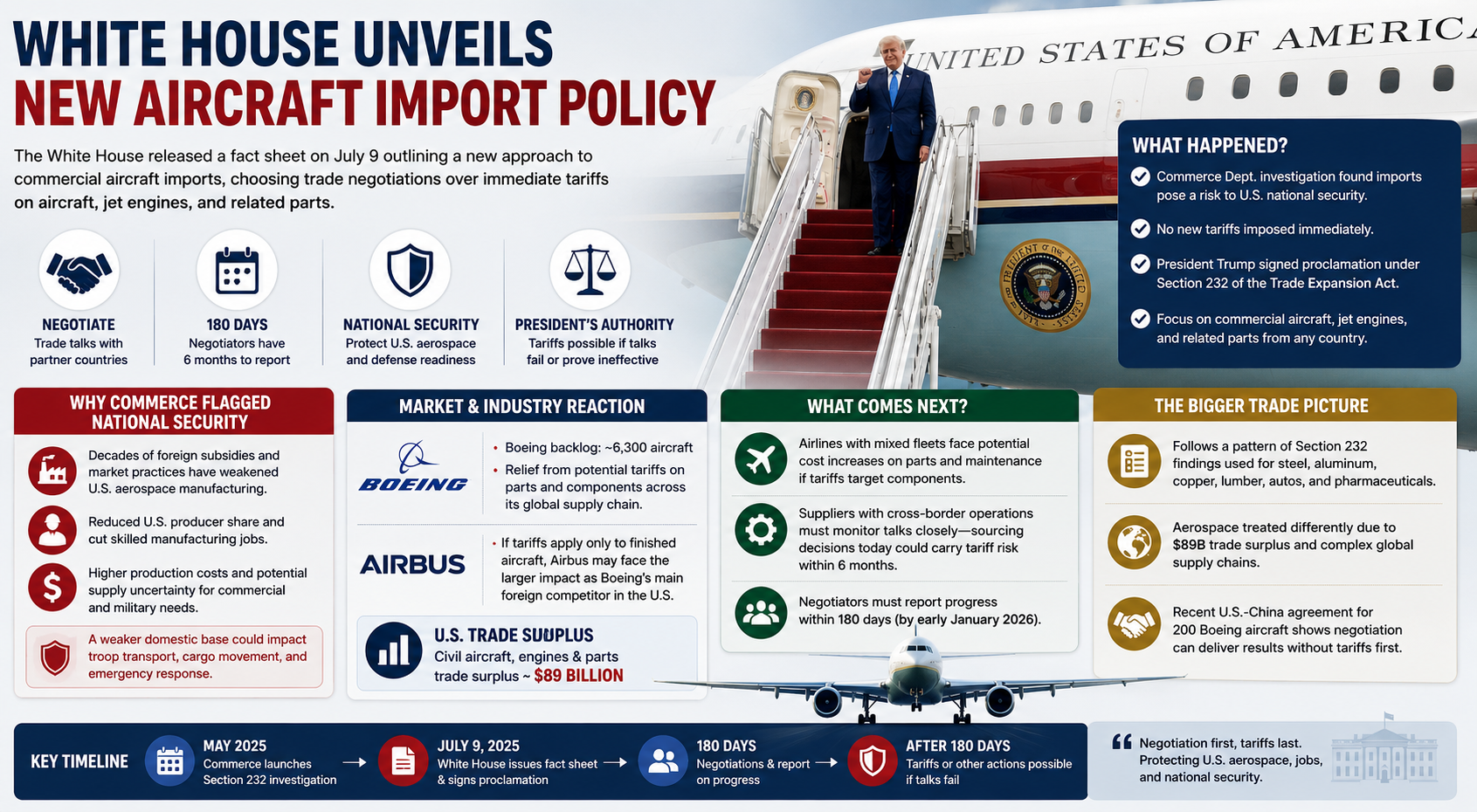
The White House released a fact sheet on July 9 outlining a new approach to commercial aircraft imports, directing federal agencies to negotiate with trading partners rather than impose immediate tariffs. The move follows a Commerce Department investigation that found imports of commercial aircraft, jet engines, and related parts pose a risk to national security, yet stopped short of triggering the duties many in the aerospace sector had braced for.
For an industry with a global supply chain and a combined order backlog running into the thousands of planes, the decision buys time. It does not remove the underlying risk. Companies now have a six month window to watch trade talks unfold, with tariffs still on the table if those talks stall.
What the Proclamation Actually Does
President Trump signed the proclamation under Section 232 of the Trade Expansion Act of 1962, the same authority used earlier for tariffs on steel, aluminum, copper, and automobiles. This time, the administration chose negotiation over immediate duties.
The Core Directive
The proclamation instructs the Secretary of Commerce and the U.S. Trade Representative to jointly pursue agreements with trading partners covering commercial aircraft, jet engines, and associated parts from any country. Key elements include:
- Commerce Secretary Howard Lutnick's investigation concluded that import volumes threaten to impair U.S. national security.
- No new tariffs take effect immediately, despite that finding.
- Negotiators have 180 days to report back on progress.
- The President retains authority to impose tariffs later if agreements are not reached or prove ineffective.
Why Commerce Flagged National Security
The investigation, opened in May 2025, examined whether foreign subsidies and market practices had weakened domestic aerospace manufacturing capacity. Commerce concluded that decades of foreign government intervention had reduced the U.S. producer share, cut skilled manufacturing jobs, and raised production costs. The administration argues a weaker domestic base could eventually create supply uncertainty for both commercial carriers and the military, which relies on commercial aircraft for troop transport, cargo movement, and emergency response.
Market and Industry Reaction
Markets read the decision as a reprieve rather than a resolution. Boeing carries a backlog of roughly 6,300 aircraft, and much of its supply chain, including engines and major components, comes from foreign suppliers. Immediate tariffs on parts would have raised costs across that entire pipeline.
Airbus faces a different exposure. Analysts note that if tariffs eventually apply only to finished aircraft rather than components, Airbus would likely absorb the larger hit, since it is Boeing's main foreign competitor in the U.S. market.
- U.S. civil aircraft, engines, and parts currently run a trade surplus of about $89 billion, a detail that sets this investigation apart from earlier Section 232 cases in steel and autos.
- The proclamation leaves open whether any future action would target finished planes, components, or both.
- A prior WTO dispute over aircraft subsidies between the U.S. and EU remains a factor shaping the negotiations ahead.
What Comes Next for Airlines and Suppliers
Airlines that operate mixed Boeing and Airbus fleets are watching closely, since a shift toward component tariffs would raise maintenance and parts costs across their entire fleet, not just new deliveries. Suppliers with cross-border operations face a similar wait and see period, since sourcing decisions made now could carry tariff exposure within six months.
The Bigger Trade Picture
This proclamation fits a pattern the administration has used repeatedly since returning to office. Section 232 findings have preceded tariffs on steel, aluminum, copper, lumber, and pharmaceuticals, but aerospace is being treated differently given its trade surplus and the complexity of splitting domestic and foreign content across a single aircraft.
The administration has also pointed to a recent agreement with China, under which Chinese airlines approved an initial purchase of 200 Boeing aircraft, as evidence that negotiation can produce results without resorting to tariffs first.