Meta's decision to scale back content moderation is now under global scrutiny. Civil society groups, shareholders, and lawmakers say the policy change has coincided with a measurable rise in hate speech and threats against public figures. This report examines the numbers, the reactions, and what comes next.
How the Policy Shift Unfolded
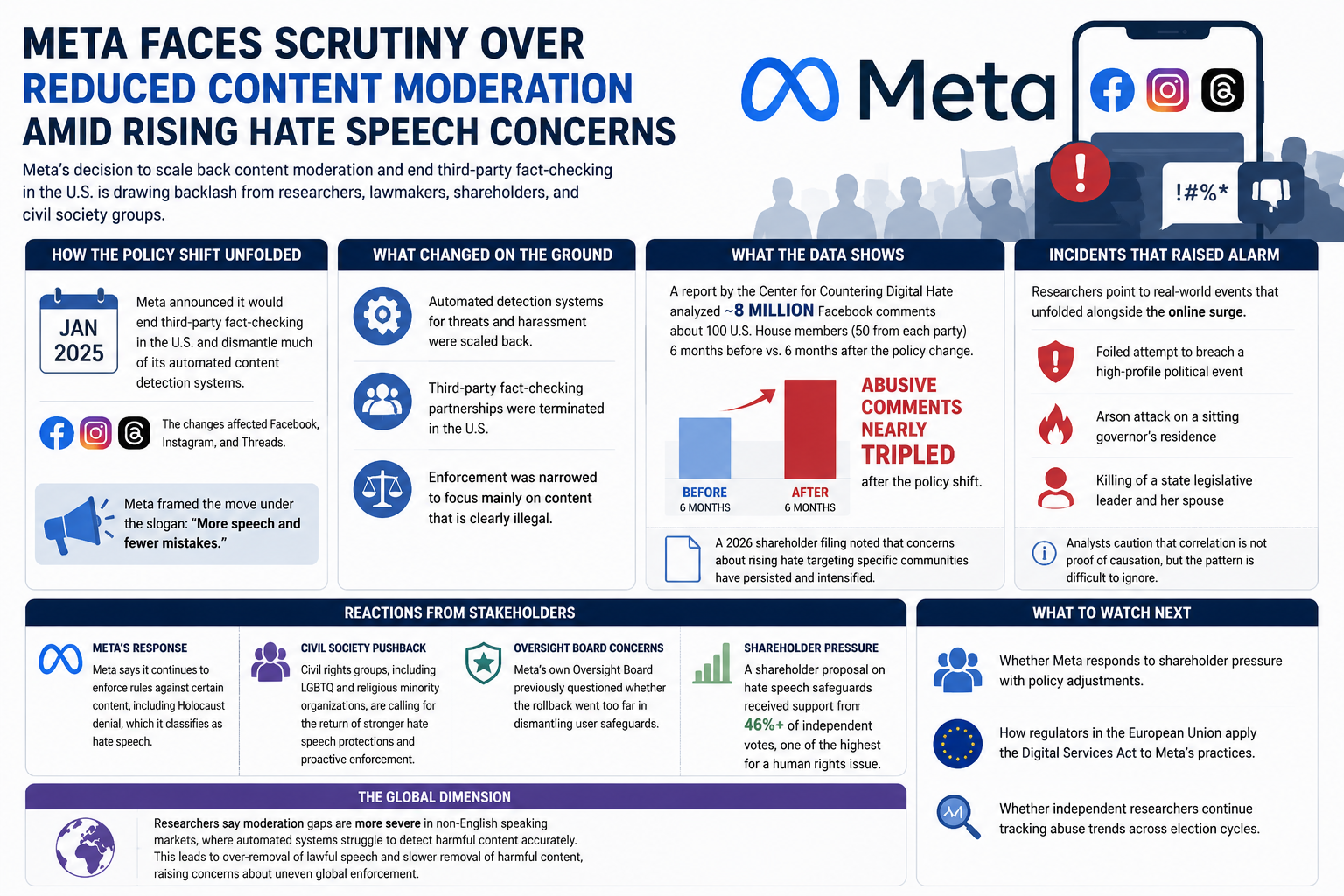
In January 2025, Meta announced it would end third party fact checking in the United States and dismantle much of the automated system it once used to detect harmful content. The company framed the move under the banner of more speech and fewer mistakes.
The shift affected Facebook, Instagram, and Threads. It marked one of the most significant retreats from proactive moderation by a major platform in recent years.
What Changed on the Ground
- Automated detection systems for threats and harassment were scaled back.
- Third party fact checking partnerships were terminated in the US.
- Enforcement was narrowed to focus mainly on content that is clearly illegal.
What the Data Shows
Independent researchers have since tried to measure the real world impact. A recent report from the Center for Countering Digital Hate, titled Safety Off, analyzed close to 8 million Facebook comments directed at 100 members of the US House of Representatives, split evenly between both parties. The comments were studied for six months before and six months after the policy change.
The findings, validated manually with roughly 79 percent accuracy, indicate that abusive comments on the platform nearly tripled following the shift. Separately, Meta's own shareholders have flagged the issue. A 2026 filing noted that concerns raised a year earlier about rising hate targeting specific communities have persisted and, in some respects, intensified.
Incidents That Raised Alarm
Researchers point to a string of real world events that unfolded alongside the online surge, including a foiled attempt to breach a high profile political event, an arson attack on a sitting governor's residence, and the killing of a state legislative leader and her spouse. Analysts caution that correlation is not proof of causation, but they argue the pattern is difficult to ignore.
Reactions From Stakeholders
Meta has defended its approach. Company officials have pointed to targeted efforts, such as continued restrictions on Holocaust denial content, as evidence that the platform still draws clear lines against certain categories of hate speech.
Civil rights organizations disagree with the overall direction. Groups representing LGBTQ communities and religious minorities have called for the reinstatement of stronger hate speech protections and the return of proactive enforcement mechanisms. Meta's own Oversight Board had earlier questioned whether the rollback went too far in dismantling user safeguards.
Shareholder support for stronger action has also grown. A recent proposal on the issue drew backing from more than 46 percent of independent votes cast, among the highest levels of support for a human rights related shareholder resolution at a major American company in recent years.
The Global Dimension
The debate extends beyond the United States. Researchers studying content moderation in the Global South note that automated systems often struggle with non English languages, leading to both over removal of lawful speech and slow removal of genuinely harmful content. This uneven enforcement has drawn criticism in markets where moderation resources are comparatively thin.
What to Watch Next
- Whether Meta responds to shareholder pressure with policy adjustments.
- How regulators in the European Union apply the Digital Services Act to Meta's practices.
- Whether independent researchers continue tracking abuse trends across election cycles.