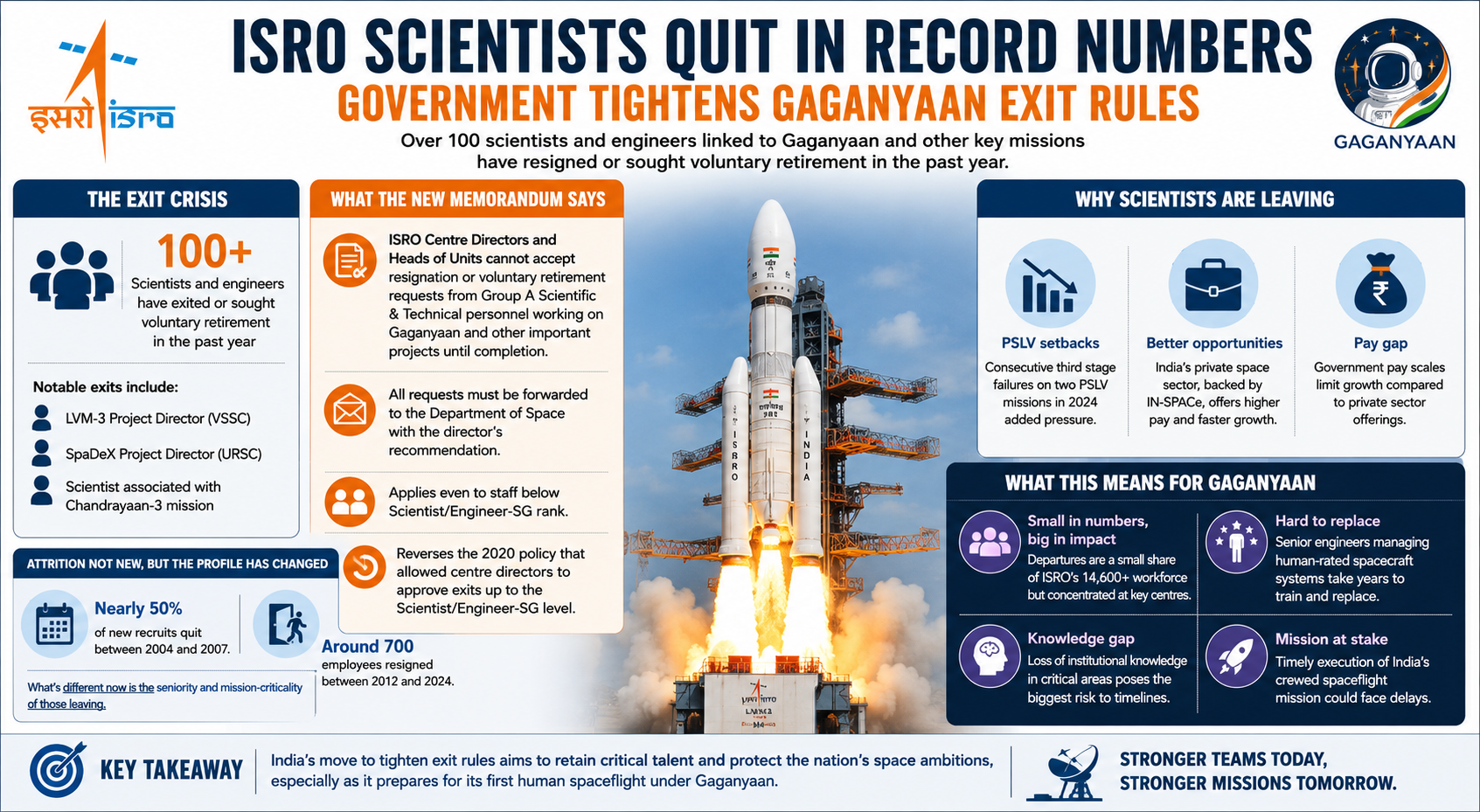
India's space agency is facing an unusual staffing crisis. More than 100 scientists and engineers tied to the Gaganyaan human spaceflight programme and other flagship missions have resigned or sought voluntary retirement over the past year. In response, the Department of Space has moved to restrict how easily these exits get approved.
What The New Memorandum Says
An internal memo dated July 14, 2026 directs ISRO's Centre Directors and Heads of Units not to accept voluntary retirement or resignation requests from Scientific and Technical personnel in Group A who are associated with the Gaganyaan mission or other important projects until those missions are completed.
Key points from the order include:
- Requests must now be forwarded to the Department of Space with the director's recommendation attached.
- The rule applies even to staff below the Scientist or Engineer-SG rank.
- The order reverses a 2020 change that had let centre directors approve such exits directly for staff up to the Scientist or Engineer-SG level.
Who Has Left
The departures are not limited to junior staff. Reported exits include the LVM-3 Project Director from VSSC, the SpaDeX Project Director from URSC, and a scientist who worked on the Chandrayaan-3 mission. ISRO's chairman, V Narayanan, has acknowledged the departures and said the agency is prepared to manage them.
Why Scientists Are Leaving
The exits come as ISRO's launch schedule has faced strain after consecutive third stage failures on two PSLV missions earlier this year. At the same time, India's expanding private space sector, supported by the regulator IN-SPACe, has opened new career paths that offer higher pay and faster growth than government pay scales allow.
Attrition is not new for ISRO. Nearly half of new recruits quit between 2004 and 2007, and around 700 employees resigned between 2012 and 2024. What is different now is the seniority and mission-criticality of those leaving.
What This Means For Gaganyaan
The recent departures are a small share of ISRO's total workforce of more than 14,600, but they are concentrated at strategically important centres. Replacing senior engineers who manage human-rated spacecraft systems takes years of training, not months. That gap in institutional knowledge is the real risk facing India's crewed spaceflight timeline.