
What the New Research Found and Why It Matters
Researchers in Brazil have found that a simple vitamin D supplement may help chemotherapy work better in women with breast cancer. The study, carried out at the Botucatu School of Medicine at São Paulo State University (FMB-UNESP), suggests that low doses of the vitamin could improve treatment outcomes and potentially serve as a more accessible option compared to certain expensive or hard-to-obtain drugs designed to enhance chemotherapy response.
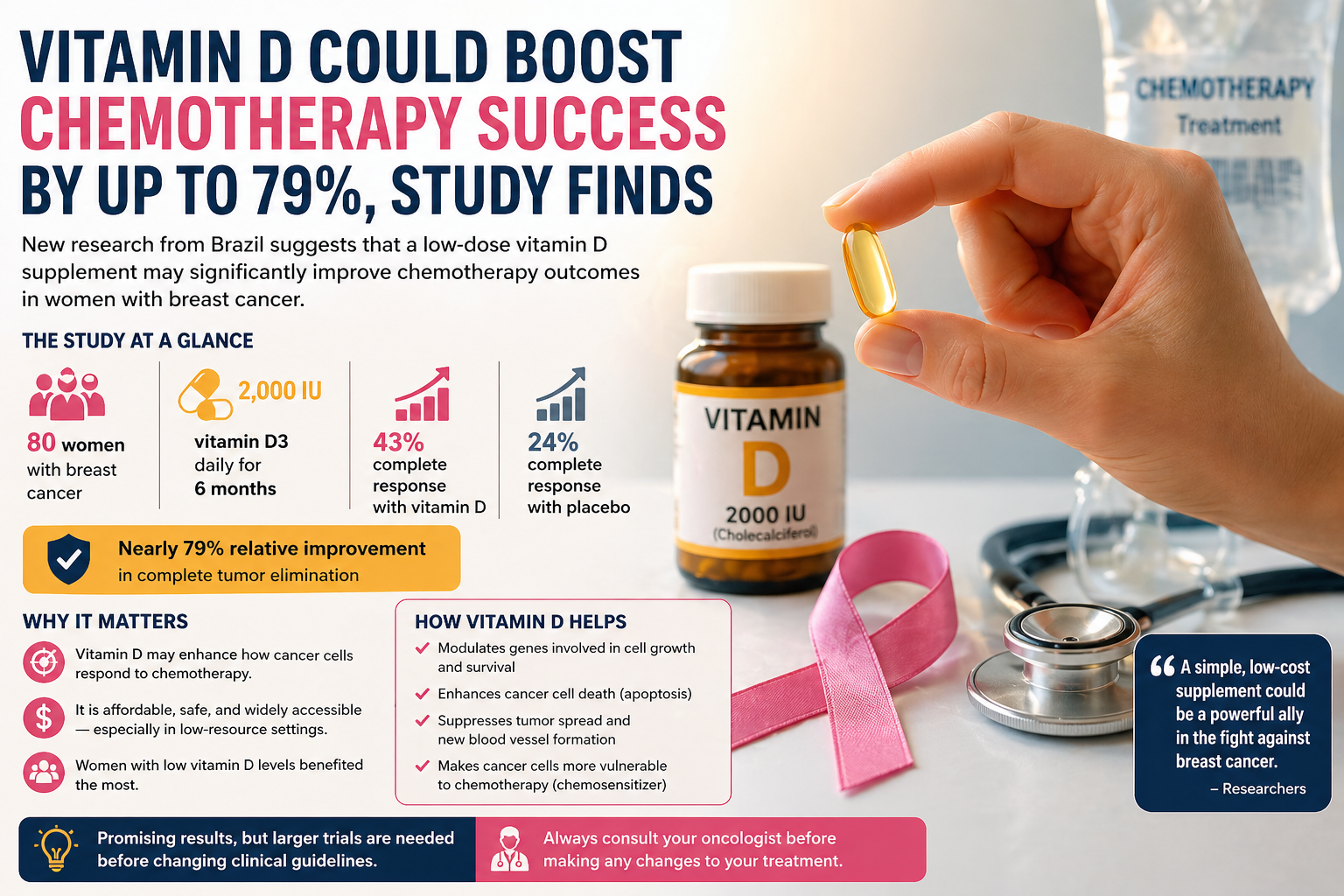
The study involved 80 women over the age of 45 diagnosed with breast cancer. The findings represent a relative response improvement of nearly 79%, a figure that is reshaping expectations in oncology.
That number deserves some unpacking, because what it actually measures is not simply tumor shrinkage. It measures whether cancer disappeared entirely after treatment, which in oncology is considered the gold standard of chemotherapy success.
Who Conducted This Research and How It Was Designed
The randomized clinical trial was conducted with 80 women aged 45 and older with breast cancer who were eligible for neoadjuvant chemotherapy. Women were randomized into two groups: a vitamin D group receiving daily supplementation with 2,000 IU of cholecalciferol, and a placebo group, each containing 40 participants, for a duration of six months.
The study received ethical approval from the Research Ethics Committee of Botucatu Medical School, São Paulo State University, and was registered with the Brazilian Clinical Trials Registry. All participants provided written informed consent before enrollment.
The trial design matters here. Randomized clinical trials, where participants are assigned by chance to treatment or placebo, represent the highest standard of evidence in medicine. This is not an observational study where results could be explained by other lifestyle factors. It is a controlled experiment, and that distinction is what makes its findings so scientifically significant.
What Is Pathological Complete Response and Why Oncologists Track It
Before examining the results, it helps to understand what the researchers were measuring.
A pathological complete response means no detectable cancer remains in breast tissue after treatment. Achieving this outcome is considered a biomarker indicating enhanced overall survival for breast cancer patients undergoing chemotherapy before surgery.
In plain terms: when a patient achieves pathological complete response, surgeons who remove tissue after chemotherapy find no living cancer cells remaining. It is the clearest possible sign that treatment worked, and patients who reach this threshold consistently have better long-term outcomes.
What the Results Showed: A Near-Doubling of Tumor Elimination
After six months of cancer treatment and supplementation, 43% of participants using vitamin D saw their disease disappear with the use of chemotherapy, compared to 24% of the placebo group.
Women with blood vitamin D levels above 20 nanograms per milliliter were over three times more likely to reach this complete tumor response, regardless of other clinical factors. This highlights that even moderate vitamin D sufficiency can potentially boost chemotherapy effectiveness.
The researchers also tracked blood levels throughout the trial to verify what was happening biologically.
At the start of the study, most participants had low vitamin D levels, defined as less than 20 nanograms per milliliter of blood. The Brazilian Society of Rheumatology recommends maintaining levels between 40 and 70 nanograms per milliliter.
After the intervention, the supplemented group reached average levels of 28 nanograms per milliliter, significantly higher than the 20 nanograms per milliliter in the placebo group.
Researcher Eduardo Carvalho-Pessoa noted that with supplementation, levels increased throughout chemotherapy treatment, which reinforces a possible contribution to the patients' recovery.
How Vitamin D Works Against Cancer Cells at the Biological Level
This is where the science gets genuinely fascinating. Vitamin D is not simply a bone health nutrient. It functions as a hormone with receptors throughout the body, including in breast tissue, and it interacts directly with the mechanisms that cancer cells use to survive and spread.
Vitamin D modulates genes involved in cell proliferation, programmed cell death (apoptosis), and preventing tumor spread. It can also enhance how cancer cells respond to chemotherapy agents like anthracyclines and taxanes, which are common drugs in breast cancer treatment.
The active form of vitamin D has been shown to induce cell cycle arrest, cell apoptosis, and autophagy, and to suppress angiogenesis and metastatic progression in the tumor microenvironment via various signal transduction pathways. Research has focused on its ability to enhance the antitumor activity of some cancer drugs, suggesting its potential role as a chemosensitizer in breast cancer therapy.
A chemosensitizer is a substance that makes cancer cells more vulnerable to the effects of chemotherapy drugs. The working hypothesis is that vitamin D primes tumor cells in ways that allow standard chemotherapy agents to kill them more effectively, rather than leaving behind the resistant cells that cause relapse.
Who Is Most Likely to Benefit From This Finding
Women With Low Baseline Vitamin D Levels
At the start of the study, both groups showed average blood vitamin D levels of 19 to 21 nanograms per milliliter, indicating deficiency. This is a critically important detail: the benefit was observed in a population that was already deficient, which describes a very large proportion of breast cancer patients globally.
Vitamin D deficiency is common worldwide, particularly in older women, people with darker skin tones, those who spend limited time outdoors, and individuals in northern latitudes with reduced sunlight exposure. Many of the women most at risk of breast cancer overlap directly with the populations most likely to be deficient.
Patients in Lower-Resource Healthcare Settings
Researcher Carvalho-Pessoa emphasized that vitamin D is an accessible and inexpensive option compared to other drugs used to improve chemotherapy response, some of which are not even included in the list of Brazil's Unified Health System. The findings suggest it could be an alternative for patients in countries with limited access to high-cost medications.
This framing matters enormously. Many of the drugs currently used as chemotherapy adjuvants cost thousands of dollars per treatment cycle. A daily dose of 2,000 IU vitamin D, by contrast, costs cents. If the findings hold in larger trials, the global health equity implications would be substantial.
What the Dosage Used Tells Us About Safety and Accessibility
One of the most striking details in this study is how modest the vitamin D dose actually was.
The dosage used in the research, at 2,000 IU per day, is far below the target dose for correcting vitamin D deficiency, which is usually 50,000 IU per week, according to study co-author Eduardo Carvalho-Pessoa, president of the São Paulo Regional Brazilian Society of Mastology.
At 2,000 IU per day, this sits within the range that most physicians consider safe for long-term supplementation in adults. The National Institutes of Health tolerable upper intake level for adults is 4,000 IU per day, meaning the study dose has a comfortable safety margin well below the threshold where adverse effects become a clinical concern.
The fact that statistically significant results were observed at a dose this conservative is scientifically notable. It suggests the mechanism at work is not simply a high-dose pharmacological effect but something that activates even when vitamin D levels move from deficient to modestly sufficient.
What the Broader Research Landscape Says About Vitamin D and Cancer
This Brazilian trial does not exist in isolation. A growing body of evidence has been examining the relationship between vitamin D status and cancer outcomes.
A meta-analysis examining vitamin D levels and response to neoadjuvant chemotherapy in breast cancer found that adequate baseline vitamin D levels are associated with a 22% reduction in the risk of a non-response to chemotherapy and a 35% reduction in the risk of disease progression. These results suggest a new potential role for vitamin D as a prognostic biomarker of progression-free survival and therapeutic response.
A separate prospective randomized clinical trial published in 2025, conducted in Turkey with 227 breast cancer cases, investigated higher-dose supplementation during chemotherapy and also found improvements in pathological complete response rates.
That trial noted that preclinical evidence shows vitamin D influences the control of cancer cell proliferation and exhibits protective properties against cancer through the induction of apoptosis, stimulation of cell differentiation, and anti-inflammatory and anti-proliferative effects, as well as the inhibition of angiogenesis, invasion, and metastasis. Researchers also emphasized that vitamin D enhances the antitumor effect of drugs like doxorubicin, paclitaxel, and tamoxifen.
What This Study Cannot Yet Tell Us and Where Research Must Go Next
Scientific integrity requires naming the limitations clearly. This was a small trial involving 80 women at a single hospital in Brazil. The results are promising and statistically significant, but they are not yet the basis for changing clinical treatment protocols.
Large-scale studies such as VITAL and WHI, aimed at cancer prevention, did not find significant reductions in cancer incidence or mortality with routine supplementation. Therefore, these results should be considered emerging evidence in a therapeutic context, not a preventive cure.
The lead researcher is equally measured.
Carvalho-Pessoa stated that these are encouraging results that justify a new round of studies with a larger number of participants. A larger study would allow a greater understanding of the role of vitamin D in increasing the response to chemotherapy treatment and, consequently, in the greater likelihood of breast cancer remission.
What is needed now are phase III randomized trials with hundreds or thousands of participants, across diverse populations, cancer subtypes, and chemotherapy regimens. The UNESP study has provided a compelling hypothesis. Larger trials must now test whether that hypothesis holds at scale.