What Happened in Kolathur on May 4, 2026
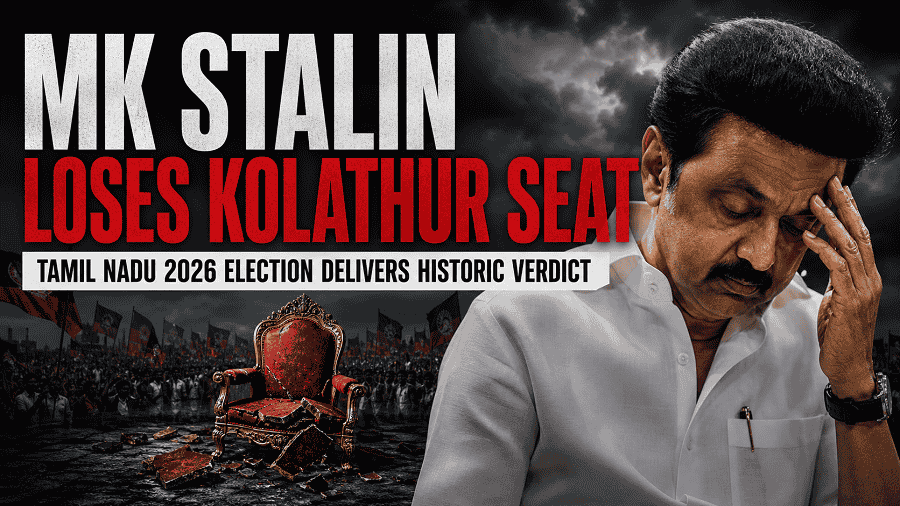
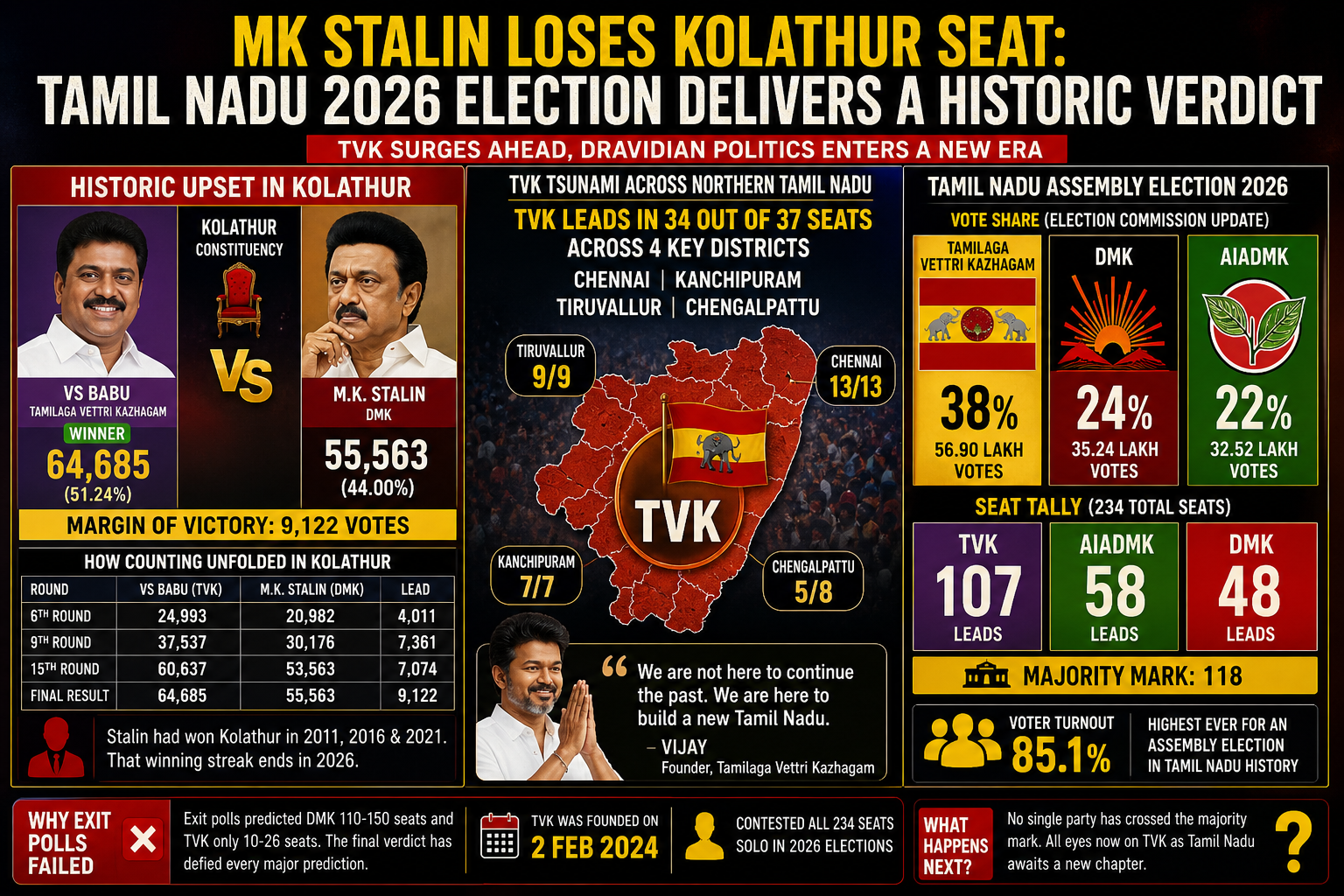
In one of the most consequential results in Tamil Nadu's modern political history, Chief Minister M.K. Stalin has lost his Kolathur assembly seat to Tamilaga Vettri Kazhagam candidate VS Babu. In Kolathur, Chief Minister MK Stalin lost to TVK's VS Babu by 9,122 votes. The defeat is not merely personal. It is a political thunderclap that reverberates across five decades of Dravidian dominance in the state.
The constituency has been a stronghold for Stalin, who had won from Kolathur in three consecutive Assembly elections in 2011, 2016, and 2021. That streak is now broken, and broken emphatically, by a first-time candidate from a party that did not exist four years ago.
Who Is VS Babu and Why Does His Win Matter
VS Babu is a Tamilaga Vettri Kazhagam (TVK) functionary contesting his first Assembly election. His win over a three-term sitting MLA who also happens to be the state's Chief Minister is without precedent in recent Tamil Nadu political memory. TVK's VS Babu set for a dramatic debut as Kolathur awaits a new MLA after 15 years.
What makes this result structurally significant is that Babu's victory is not an outlier. It is part of a pattern. Across the four districts of Chennai, Kanchipuram, Tiruvallur, and Chengalpattu, the TVK is leading in 34 out of 37 constituencies. Stalin did not lose Kolathur because of a local factor. He lost it because the electorate in his own urban base has shifted.
How the Counting Unfolded in Kolathur
The result was not a sudden late swing. The writing was on the wall from the very first round of counting.
At the end of the sixth round of counting in the Kolathur constituency, TVK candidate VS Babu was leading with 24,993 votes, while Chief Minister MK Stalin was trailing with 20,982 votes. By the ninth round, the gap had widened further. TVK candidate VS Babu was leading with 37,537 votes, while Chief Minister MK Stalin was trailing with 30,176 votes.
After the 15th round of counting in the Kolathur constituency, TVK candidate VS Babu led with 60,637 votes, a margin of 7,074 over DMK president and Chief Minister MK Stalin, who had 53,563 votes. The final declared margin was 9,122 votes, confirming what the early trends had strongly suggested throughout the morning.
For a constituency Stalin had won in 2021 by a commanding margin of 41 percent over his nearest rival, this reversal is staggering in its scale and speed.
What the Overall Tamil Nadu 2026 Result Looks Like
The Kolathur result cannot be read in isolation. It must be understood against the backdrop of a statewide electoral realignment that few observers, and almost no exit polls, had predicted with accuracy.
According to the latest update from the Election Commission, Tamilaga Vettri Kazhagam has secured more than 38 percent of the vote share, roughly 56.90 lakh votes, while the DMK has received 24 percent with 35.24 lakh votes, and the AIADMK 22 percent with 32.52 lakh votes.
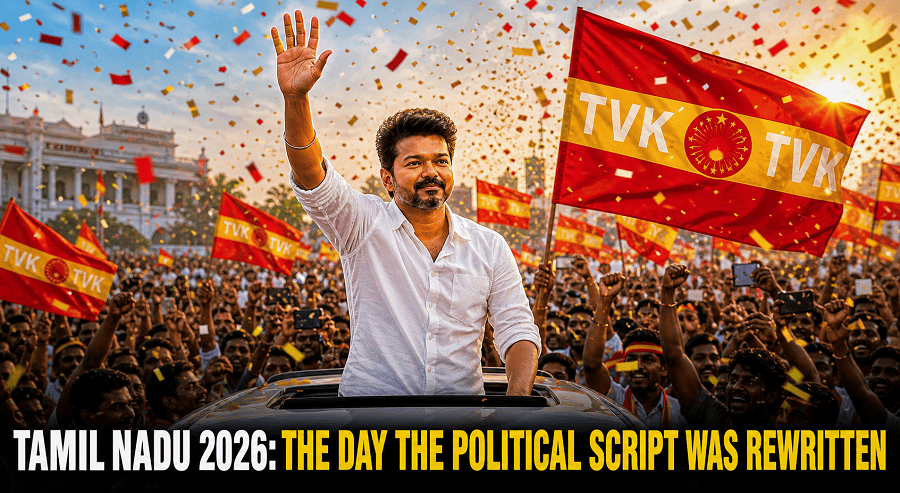
Actor-politician Vijay's TVK is delivering a political earthquake in the Tamil Nadu Assembly Election 2026, leading in 107 constituencies and emerging ahead of both Dravidian heavyweights DMK and AIADMK. With the majority mark at 118 in the 234-member Assembly, TVK appears poised to either form a government or become the decisive force in government formation.
The DMK, which governed Tamil Nadu since 2021 with 159 seats, has seen its vote share collapse by roughly half. The scale of the swing suggests deep structural discontent rather than routine anti-incumbency.
Why This Result Defied Every Major Exit Poll
Several exit polls predicted that the ruling DMK would return to power in Tamil Nadu. Most projections put the DMK at about 110 to 150 seats in the 234-member Assembly, and the principal opposition AIADMK trailing with about 60 to 120 seats. The TVK was projected in most surveys to win somewhere between 10 and 26 seats. It is instead leading in more than 100.
This is a polling failure of significant magnitude. Voter sentiment, particularly among young and first-time voters, appears to have crystallized in a direction that conventional survey methodology failed to detect. This election had recorded a voter turnout of 85.1 percent, considered the highest ever for an assembly election in the state. That exceptional turnout number, now visible in hindsight, was the signal that something seismic was building. It was not read correctly.
Who Is Vijay and What Is TVK
On 2 February 2024, actor Vijay announced the formation of his political party, Tamilaga Vettri Kazhagam (TVK), stating that it would contest the 2026 elections. On 18 March 2026, Vijay announced that the TVK would contest solo in all 234 constituencies. No alliance, no seat-sharing arrangement, no established party backing. That solo decision, widely criticized at the time as strategically naive, has now produced one of the most dramatic debuts in Indian state election history.
If the trends hold, Vijay could pull off one of the biggest electoral upsets in Tamil Nadu history, echoing the watershed elections of 1967 and 1977. In 1967, C.N. Annadurai led the first non-Congress government in the state after Independence. A decade later, M.G. Ramachandran formed the first AIADMK government after unseating the DMK. A TVK government in 2026 would complete that triad of defining disruptions.
What MK Stalin's Defeat Means for the DMK and Dravidian Politics
MK Stalin has been elected to the Tamil Nadu Legislative Assembly eight times. He has served as the eighth Chief Minister of Tamil Nadu since 2021 and became president of Dravida Munnetra Kazhagam on 28 August 2018. His personal defeat in Kolathur does not automatically remove him as Chief Minister, since government formation depends on overall seat counts. However, an incumbent Chief Minister losing his own constituency is constitutionally and politically untenable in the medium term.
The DMK came to power in 2021 riding a strong wave of welfare politics and Dravidian identity consolidation. Its 2024 general election performance, where the alliance swept all 39 Lok Sabha seats in Tamil Nadu, created a false ceiling of confidence. The state Assembly result tells a sharply different story about where the electorate's allegiance was actually moving.
Since 1967, power in the state has largely alternated between the DMK and AIADMK. A strong TVK breakthrough would break that binary and establish Vijay as a disruptive new force in the state's political order.
What Happens Next: Government Formation in Tamil Nadu
As of vote counting on May 4, 2026, no single party has reached the 118-seat majority mark. Tamilaga Vettri Kazhagam leads with 107 seats, AIADMK follows with 58, while DMK drops to third with 48 seats amid ongoing counting. The final numbers are still being declared, but the trajectory makes it clear that the next government will either be a TVK-led administration or one requiring significant post-result negotiations.
Vijay has repeatedly positioned TVK as an ideologically distinct force from both the DMK and AIADMK, making formal alliances with either legacy party politically complicated. The coming days will test whether that ideological positioning holds under the pressure of actual power.