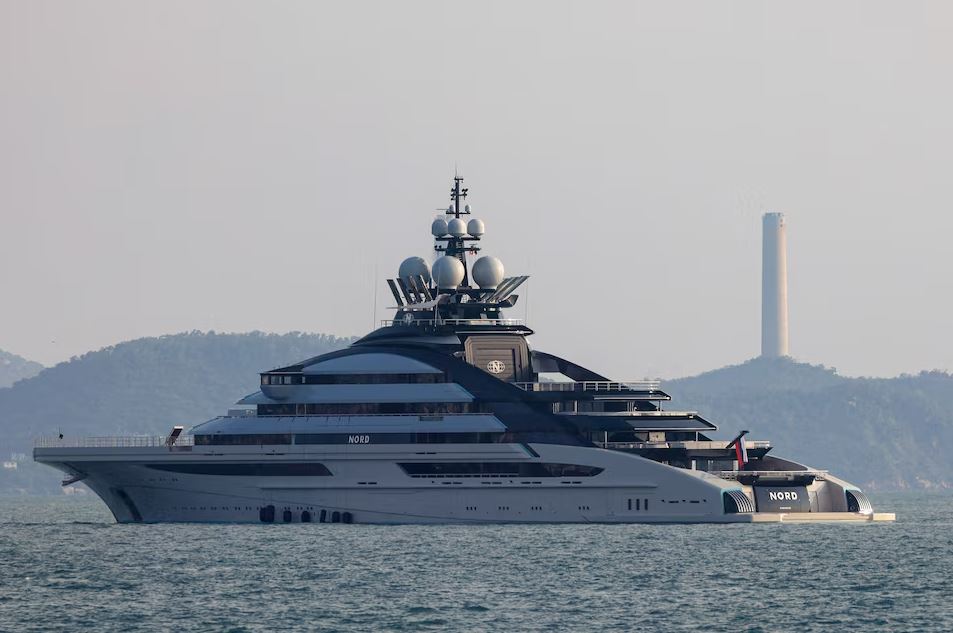
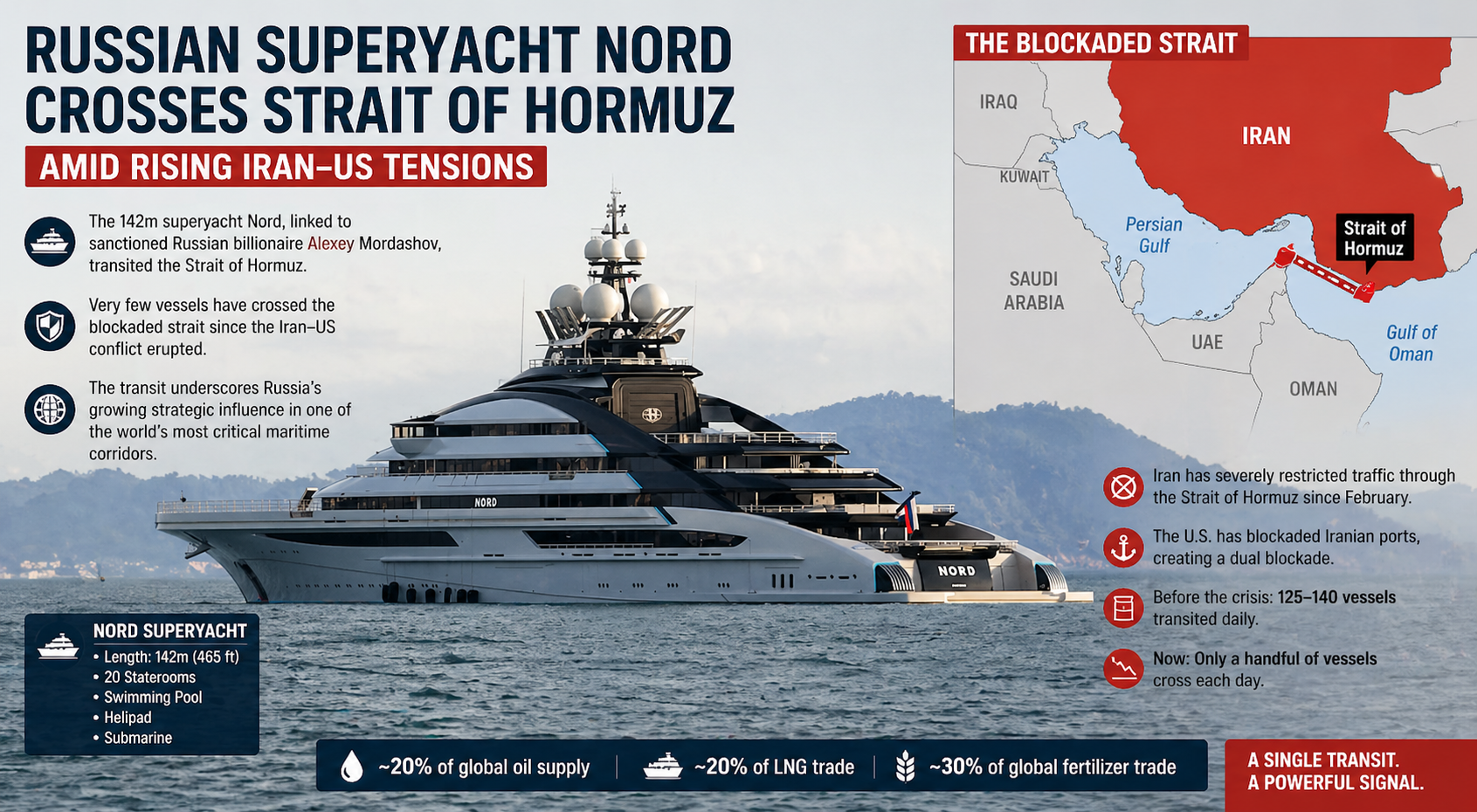
On Saturday, the 142-meter (465-foot) superyacht Nord, linked to sanctioned Russian billionaire Alexey Mordashov, sailed through the Strait of Hormuz. According to data on the MarineTraffic platform, it departed a Dubai marina around 1400 GMT on Friday, crossed the strait Saturday morning, and arrived in Muscat early Sunday.
This transit is notable because very few vessels have crossed the blockaded strait since the Iran-U.S. conflict erupted, underscoring how ongoing geopolitical tensions continue to reshape access to one of the world's most critical maritime corridors.
It remains unclear how the multi-deck pleasure vessel obtained permission to use the route. Since February, Iran has severely restricted traffic through the strait, which typically handles around one-fifth of the world's oil supply.
Who Owns the Nord and Why That Matters Geopolitically
Mordashov is not officially listed as the owner of Nord. However, shipping data and Russian corporate records from 2025 show the vessel was registered to a Russian firm owned by his wife in 2022, registered in the Russian town of Cherepovets, where Mordashov's steelmaker Severstal is also based.
Mordashov is known to be close to Putin and was among the Russians sanctioned by the United States and European Union following Russia's invasion of Ukraine due to their links to the Kremlin.
One of the largest yachts in the world, Nord features 20 staterooms, a swimming pool, a helipad, and a submarine. Its passage through what is effectively a war zone is not a routine maritime event. It is a geopolitical statement.
How Did the Strait Become Blockaded in the First Place
Shipping traffic through the Strait of Hormuz has been largely blocked by Iran since February 28, 2026, when the United States and Israel launched an air campaign against Iran and assassinated its Supreme Leader, Ali Khamenei. In retaliation, Iran launched missile and drone attacks on Israel, U.S. military bases, and U.S.-allied Gulf states.
The Iranian Revolutionary Guard Corps issued warnings forbidding passage through the strait, boarded and attacked merchant ships, and laid sea mines in the waterway. Since April 13, the U.S. has blockaded Iranian ports, creating what analysts now describe as a dual blockade of the strait.
Before the Iran war began in February, between 125 and 140 vessels transited daily. Now only a handful of mainly merchant vessels make the crossing each day. This collapse in shipping volume has sent energy markets and global fertilizer supply chains into significant stress.
Why Russia's Diplomatic Position Makes This Transit Possible
Russia and Iran are longstanding allies who have grown considerably closer in recent years, including through a 2025 treaty that strengthened intelligence and security cooperation between Moscow and Tehran.
On March 26, Iran's Foreign Minister Abbas Araghchi announced that ships owned by five nations, including China, Russia, India, Iraq, and Pakistan, would be allowed to transit the Strait of Hormuz. This list of "permitted flag states" is not a coincidence. It maps almost perfectly onto Iran's current diplomatic and strategic alliance structure.
Iranian Foreign Minister Abbas Aragchi arrived in Russia to meet President Vladimir Putin on Monday, following discussions with mediators in Pakistan and Oman over the weekend. The timing of the Nord's transit and this high-level diplomatic engagement should not be read as separate events.
What This Means for the Broader Gulf Power Dynamic
Russia's Role as a Quiet Broker
Moscow is demonstrating something important here: its vessels move while Western-flagged ships cannot. This is not simply about maritime access. It is a projection of Russia's diplomatic relevance in a conflict it did not start but is actively shaping behind the scenes. A Putin-linked superyacht transiting unmolested through a militarized strait is a choreographed signal to Washington, to the Gulf states, and to the broader non-Western world about who holds leverage in this crisis.
Iran's Selective Enforcement Strategy
Traders are reading the yacht's passage through an Iran-declared safe lane as selective enforcement, which may signal a softening of Iran's position. The superyacht's transit follows similar crossings by Chinese and Greek vessels, suggesting a possible emerging pattern. Tehran is not simply blocking the strait indiscriminately. It is using access as a precision diplomatic instrument, rewarding friends, excluding adversaries, and keeping the world guessing about when and on what terms traffic might fully normalize.
The Sanctions Dimension
The fact that a vessel linked to a sanctioned Russian oligarch crossed a blockaded strait with apparent Iranian permission, while Washington maintains its own port blockade of Tehran, illustrates the limits of Western sanctions architecture. Sanctioned individuals operating in sanctioned corridors, with the tacit blessing of a sanctioned government, is a scenario that current enforcement frameworks are not designed to address.
Who Is Affected Most by the Strait's Continued Disruption
The Persian Gulf accounts for roughly 30 to 35 percent of global urea exports and around 20 to 30 percent of ammonia exports in the 2020s. Overall, up to 30 percent of internationally traded fertilizers normally transit the Strait of Hormuz. This means the disruption is not only an energy story. It is a food security story with real consequences for agricultural economies across Asia and Africa.
Iran agreed on March 27 to a UN request allowing humanitarian and fertilizer shipments through the strait to address disruptions to fertilizer supply during the spring planting season. Even in the middle of a regional war, the economic pressure to keep some lanes open is enormous.