What the Kerala 2026 Verdict Means for Indian Politics
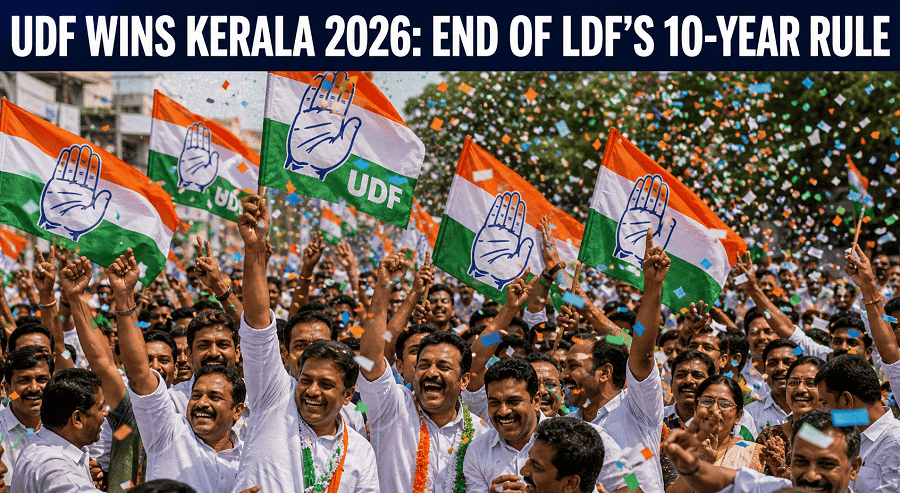
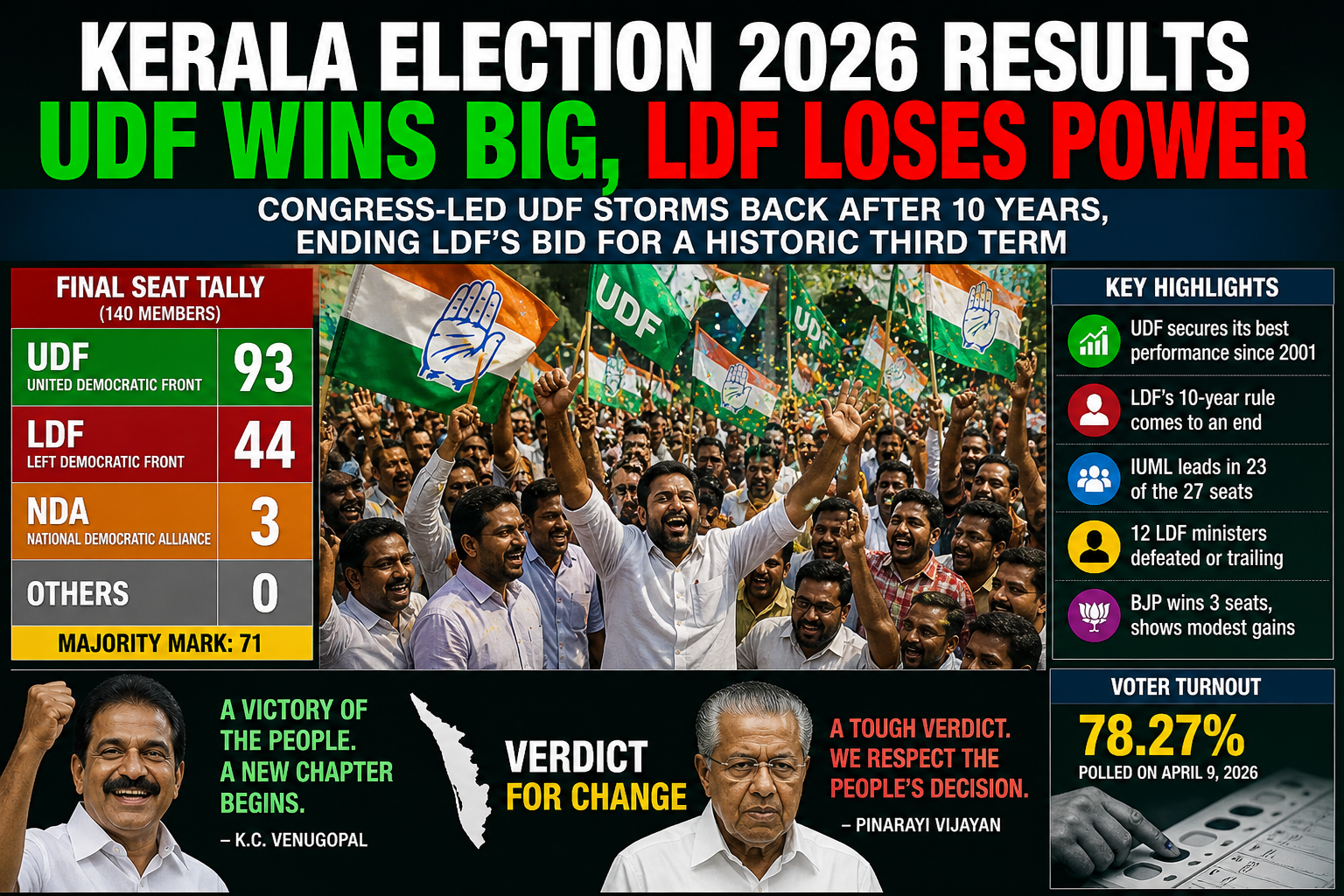
The results of the 2026 Kerala Assembly election, declared on Monday, May 4, have delivered one of the clearest mandates the state has produced in two decades. The Congress-led United Democratic Front has swept back into power, ending a ten-year run by the Left Democratic Front and definitively closing the door on what would have been an unprecedented third consecutive term for Chief Minister Pinarayi Vijayan and the CPI(M).
The Kerala election was being closely watched as a high-stakes contest between the ruling LDF, which was seeking a rare third consecutive term, and the UDF, which was aiming to return to power after nearly a decade. In the end, it was not a close contest. The UDF's massive Kerala victory has sparked a fierce Congress internal battle over the Chief Minister post, with VD Satheesan and KC Venugopal emerging as key contenders.
How the Counting Unfolded Across 140 Constituencies
Voting in the 2026 Kerala Assembly election was held on April 9 in a single phase across all 140 constituencies. The state recorded a voter turnout of 78.27 percent in the single-phase polling. Counting began at 8 AM on May 4 with postal ballots, followed by multiple rounds of Electronic Voting Machine tabulation.
A total of 15,465 counting personnel were deployed for the exercise, while 32,301 police personnel, including 20 companies of Central Armed Police Forces, were deployed for security at counting centres.
From the very first hour, the direction of the verdict was visible. The UDF was leading with 35 seats in early trends while the LDF was at second spot with 22 seats, with the NDA leading at only a single seat. As counting progressed through the morning, the UDF lead widened steadily and decisively. At 12.25 PM, the UDF was leading in 92 seats while the ruling Left Democratic Front was ahead in 40, with a party or alliance needing 71 seats in the 140-member Assembly to secure a majority.
What the Final Seat Count Shows
By mid-afternoon, the trend had hardened into a verdict. The Congress-led United Democratic Front is currently at its best show since the 2001 Assembly election, when the UDF secured 99 seats, its highest ever.
The Congress party's own internal account of the outcome was unambiguous. The Congress in Kerala on Monday thanked the people of the state for what it termed a thumping victory, as trends in the April 9 Assembly polls indicated a decisive edge for the UDF. The IUML, the UDF's most important coalition partner, contributed significantly to the final tally. The Indian Union Muslim League is leading in 23 of the 27 seats it contested in the Assembly polls.
What Happened to Pinarayi Vijayan in Dharmadam
The personal trajectory of Chief Minister Pinarayi Vijayan through the counting day encapsulates the broader drama of this election. Pinarayi Vijayan was trailing in the Dharmadam Assembly constituency in the early stages of counting, with Congress candidate VP Abdul Rasheed leading by 2,812 votes.
Vijayan subsequently recovered. The CPI(M) leader was ahead of Congress's VP Abdul Rasheed by 3,559 votes at the end of eight rounds of counting, having been trailing the Congress candidate earlier in the day. Pinarayi Vijayan ultimately won in Dharmadam by 11,800 votes after 13 rounds of counting. His personal seat survival, however, offers little comfort against the scale of his government's defeat across the state.
Which LDF Ministers Lost Their Seats
The collapse of the LDF was not confined to marginal constituencies. It penetrated deep into the cabinet itself. At least 12 ministers in the CPI(M)-led LDF cabinet were trailing during counting, including Veena George, MB Rajesh, OR Kelu, R Bindhu, J Chinchurani, P Rajeev, KB Ganesh Kumar, VN Vasavan, V Sivankutty, V Abdurahiman, AK Saseendran and Roshy Augustine.
When an incumbent government loses a dozen sitting ministers in a single election, it signals not anti-incumbency but a comprehensive repudiation. Voters did not simply want a change at the top. They voted to dismantle the government's entire legislative representation.
Why the UDF Won: The Anti-Incumbency Argument
Congress MP KC Venugopal said the alliance's performance was backed by prevailing anti-incumbency sentiment against the ruling LDF government. The UDF campaign focused heavily on anti-incumbency against the LDF government, hoping to capitalise on voter dissatisfaction.
The LDF came into this election defending what was, by Kerala's historical standards, an anomaly. Kerala usually switches between the LDF and UDF governments. This changed in the 2021 election when Pinarayi Vijayan led the LDF to win two terms in a row, ending the state's long history of alternating governments. Vijayan's 2021 win was built on his COVID-19 crisis management, infrastructure momentum, and a personal brand of administrative authority that crossed traditional ideological boundaries. That brand aged poorly in office. By 2026, fiscal pressures, governance controversies, and the accumulated weight of a ten-year incumbency had eroded the LDF's electoral coalition faster than its leadership anticipated.
What the BJP Performance Tells Us About Kerala's Changing Political Map
The 2026 election marks a genuine, if still modest, breakthrough for the BJP in Kerala. In Nemom, BJP state president Rajeev Chandrasekhar won by a margin of over 3,000 votes. The former Union Minister, who shifted from national politics to spearhead the party's campaign in Kerala, reclaimed the seat the BJP had lost in 2021, banking on a development-focused pitch.
In Chathannoor, BJP candidate BB Gopakumar won by a margin of over 4,000 votes. In Kazhakkoottam, BJP leader and former Union Minister V Muraleedharan defeated LDF's Kadakampally Surendran, securing a narrow victory by over 200 votes.
Not everything went the BJP's way. In Palakkad, Congress candidate and actor Ramesh Pisharody defeated Sobha Surendran by over 12,000 votes in a constituency where the party has historically performed well. The BJP has not even opened its account in North and Central Kerala, with UDF leading across all three regions.
The BJP's performance indicates directional growth without yet achieving decisive scale. Three to four seats in a 140-member assembly is a presence, not a power base. But the BJP is now competitive in constituencies it could not win a decade ago, and that structural shift matters for the long-term realignment of Kerala's political landscape.
What This Means for Congress and the UDF Nationally
The Kerala result arrives at a moment when the Congress party is navigating a complex national opposition landscape. A landslide state victory, particularly one that exceeds the party's own 2001 benchmark performance, strengthens Rahul Gandhi's position in the national opposition narrative. It also reinforces the Congress argument that alliance politics anchored on strong state-level leadership can defeat incumbents even where the Left has deep organisational roots.
Top Congress leaders including KC Venugopal, Ramesh Chennithala, Sunny Joseph, and Shashi Tharoor met at the party office in Thiruvananthapuram to celebrate as the UDF took a solid lead. The internal question of who becomes the next Chief Minister of Kerala is now the most consequential political decision the UDF must make. VD Satheesan and KC Venugopal have emerged as key contenders for the Chief Minister post following the UDF's massive victory.