India Is Burning. And the World Is Watching.
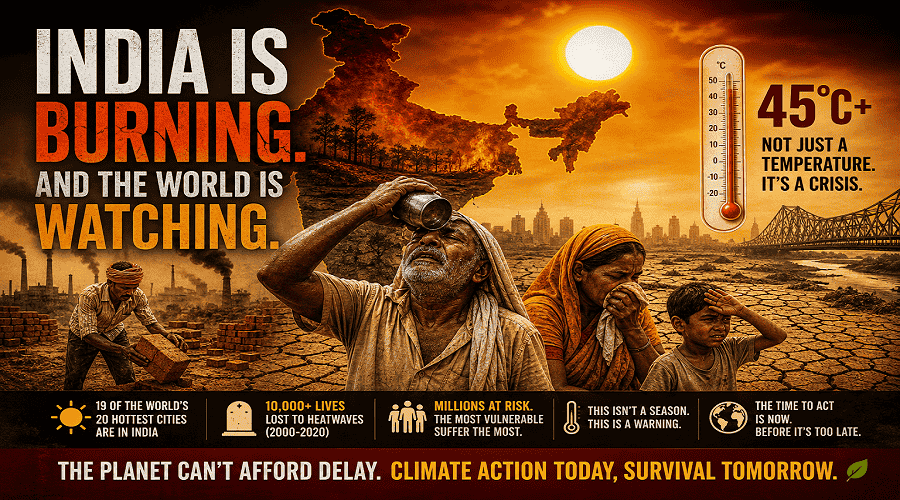
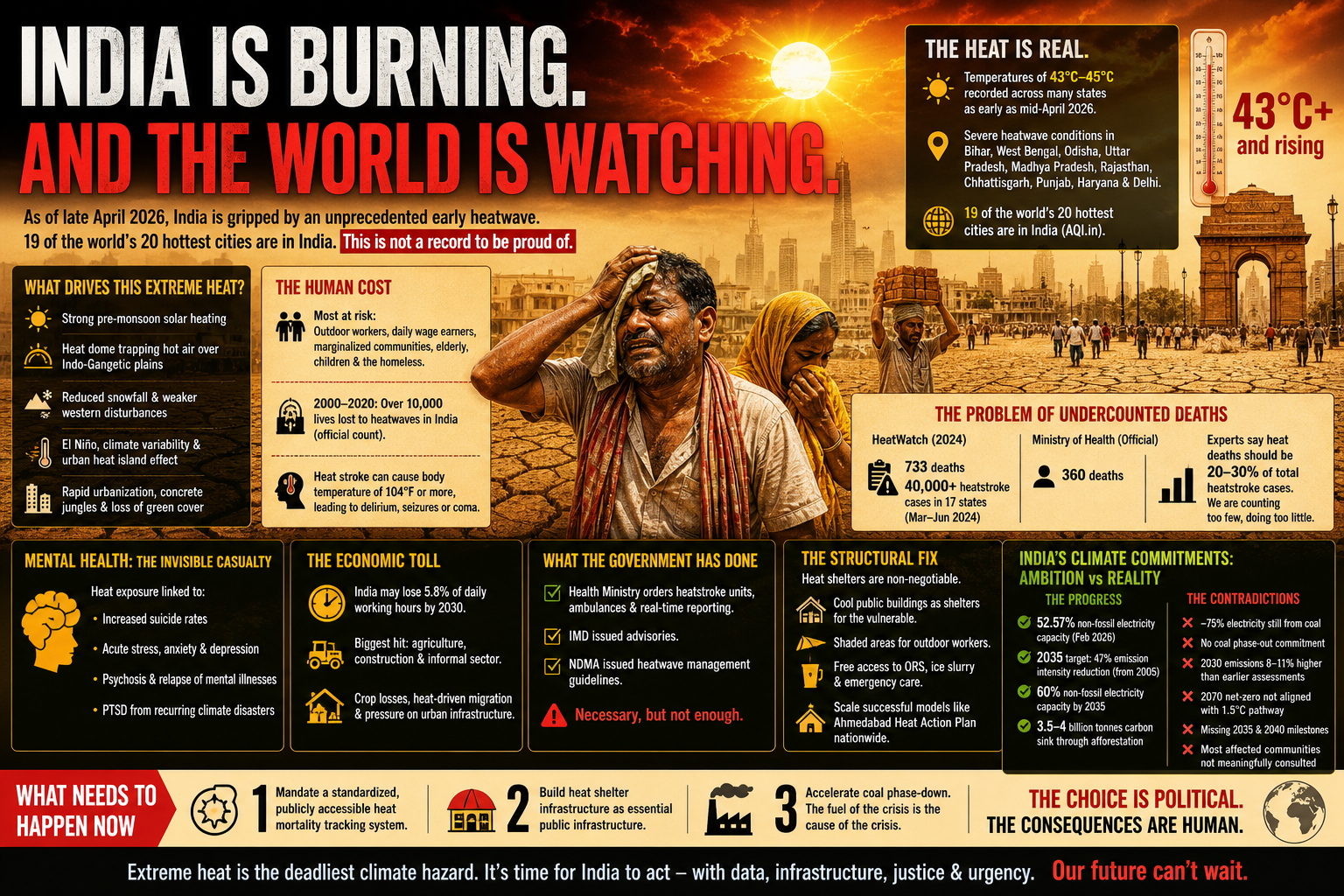
As of late April 2026, India is experiencing widespread extreme heat across northern, central, and eastern regions, with Bihar, West Bengal, Odisha, Uttar Pradesh, Madhya Pradesh, Rajasthan, Chhattisgarh, Punjab, Haryana, and Delhi reporting dangerously high temperatures. According to data from AQI.in, 19 of the world's 20 hottest cities were located in India at the peak of the current episode. That is not a record to be proud of.
Several regions, including Madhya Pradesh, Maharashtra, Odisha, and Chhattisgarh, recorded temperatures between 43 degrees C and 45 degrees C as early as mid-April, raising alarm about the intensity and frequency of heatwaves in the months ahead.
This is not a seasonal anomaly. It is a crisis unfolding in slow motion, one that governments, public health officials, and climate scientists have warned about for years.
What Is a Heatwave, and Why Does India Define It Differently?
According to the India Meteorological Department, a heatwave is officially declared when the maximum temperature exceeds 40 degrees C and remains between 4.5 and 6.4 degrees C above the seasonal average. Because India's geography spans coastal plains, river basins, deserts, and Himalayan foothills, this threshold varies significantly across the country, complicating uniform policy responses and public health messaging.
Understanding this distinction matters. A temperature of 44 degrees C in coastal Odisha carries different physiological risks than the same reading in the dry heat of Rajasthan. Humidity transforms heat from discomfort into a direct threat to life.
What Is Driving Temperatures This High This Early?
The science behind the 2026 heatwave points to a convergence of meteorological and structural factors.
The current heatwave is being fueled by strong pre-monsoon solar heating that is rapidly warming land surfaces, cloudless skies allowing prolonged exposure to direct sunlight, and reduced winter snowfall across the Himalayas and parts of Eurasia, which has diminished natural cooling effects.
A key driver of the current episode is a heat dome that has trapped hot air over the Indo-Gangetic plains and eastern India. Western disturbances that normally bring snow to the hills and rain to the plains have also become weakened and infrequent this year.
A combination of El Nino, climate variability, and urban heat buildup is making heatwaves more frequent and severe, raising concerns about public health, water availability, and energy demand.
The urban heat island effect has made Indian cities significantly warmer than surrounding areas, driven by rapid construction, reduced tree cover, and heat generated by vehicles and industry.
The Human Cost: Who Is Most at Risk?
The populations bearing the heaviest burden of India's extreme heat are not those generating the emissions causing it.
The National Human Rights Commission stated in April 2026 that the rise in the frequency, duration, and intensity of heatwaves disproportionately affects marginalized and economically weaker sections, outdoor workers, and the homeless, due to the lack of adequate shelter and resources. The NHRC subsequently issued advisories to 21 states and the Union Territory of Delhi to take protective measures for vulnerable groups.
In severe heat cases, heat stroke involves body temperatures of 104 degrees F or more, accompanied by delirium, seizures, or coma. According to IMD data, between 2000 and 2020, over 10,000 people lost their lives to heatwaves in India.
That figure, however, is almost certainly a significant undercount.
The Problem of Undercounted Deaths
A report by the non-profit HeatWatch, titled Struck by Heat: A News Analysis of Heatstroke Deaths in India in 2024, identified 733 deaths and over 40,000 heatstroke cases across 17 states between March and June 2024, significantly higher than the Union Ministry of Health's official count of 360 deaths.
Dileep Mavalankar, former head of the Indian Institute of Public Health in Gandhinagar, noted that while there were 40,000 recorded cases of heat stroke, only 110 deaths were officially recorded, representing just 0.3 percent of total heatstroke cases. He pointed out that normally heat deaths should represent 20 to 30 percent of heatstroke cases.
Without reliable data, there is little basis for targeting adaptation or health preparedness at the right locations. Research indicates that India accounted for 20.74 percent of global heatwave-related deaths between 1990 and 2019.
Poor data governance is not a bureaucratic failure. It is a public health emergency in its own right.
Mental Health: The Invisible Casualty of Extreme Heat
The health consequences of prolonged heat exposure extend well beyond the physical.
Evidence shows that exposure to heat can lead to increased suicide rates, acute stress reactions and adjustment disorders, acute and transient psychosis, relapse of bipolar disorders, depression, and schizophrenia. Recurrent disasters like floods and droughts due to temperature rise can lead to post-traumatic stress syndrome, stress, or anxiety among people, particularly adolescents.
This mental health dimension remains almost entirely absent from India's current heat response framework, a gap that demands urgent policy attention.
The Economic Toll Nobody Is Measuring Properly
According to a study by the United Nations Economic and Social Commission for Asia and the Pacific, India is projected to lose approximately 5.8 percent of daily working hours due to rising temperatures by 2030, a loss felt most acutely in agriculture and construction.
Reduced crop yields under extreme heat stress threaten food security for millions of farmers, while heat-driven migration from rural and peri-urban areas adds pressure on already strained urban infrastructure.
The Ahmedabad example offers important evidence on what works. Research on the Ahmedabad Heat Action Plan has demonstrated that early warnings, targeted outreach, and medical preparedness can reduce excess deaths by up to 27 percent. These results need to be scaled nationally, not remain confined to a single city.
Government Response: What Has Been Ordered, and Is It Enough?
In April 2026, the Union Ministry of Health and Family Welfare directed states and union territories to operationalize dedicated heatstroke management units at all health facilities, ensure ambulance preparedness, and maintain real-time reporting of heatstroke cases on the Integrated Health Information Platform portal.
The India Meteorological Department has issued advisories, and the National Disaster Management Authority has established national guidelines on heat wave management. These are necessary steps. They are not sufficient ones.
A white paper from the Salata Institute of Climate Change and Sustainability at Harvard University warns that more than 200 million people in India are set to face deadly heat conditions by 2030, yet adaptation policies are deeply unequal. The report emphasizes that extreme heat is the deadliest climate hazard globally, yet remains among the least resourced in terms of adaptation planning.
The Structural Fix: Heat Shelters as a Non-Negotiable
Directing people to stay indoors assumes they have indoors to go to. For India's vast homeless population, migrant workers, and daily wage laborers, that instruction is meaningless without infrastructure to back it.
Effective heat management plans have included increasing access to shaded areas for outdoor workers, converting relatively cool public buildings into temporary shelters for people without homes or access to electricity, and ensuring hospitals have adequate capacity.
Public health experts recommend ensuring free or highly affordable access to ice slurry, oral rehydration solutions, and emergency medical care during heatwaves, and extending interventions to rural districts and smaller cities that face high risk but currently lack institutional mechanisms to respond.
India's Climate Commitments: Ambition vs. Reality
India's long-term climate policy presents a study in contradictions.
India has achieved 52.57 percent non-fossil electricity capacity as of February 2026, meeting its original 2030 NDC target five years ahead of schedule. The updated NDC now targets a 47 percent reduction in emissions intensity of GDP by 2035 from 2005 levels, along with 60 percent non-fossil electricity capacity and a carbon sink of 3.5 to 4 billion tonnes through afforestation.
These are not trivial achievements. But the structural tensions are real.
Although renewable energy generation is increasing, coal still accounts for approximately 75 percent of India's total electricity generation. India has not yet committed to phasing out coal power, and the country's 2030 emissions under current policies are 8 to 11 percent higher than previous assessments.
India's 2070 net-zero goal is not aligned with 1.5 degrees C pathways, according to climate performance analysts, who also highlight missing interim milestones for 2035 and 2040 and limited consultation with communities most affected by climate change.
The gap between stated ambition and operational reality is where India's most vulnerable populations live and, increasingly, die.
What Needs to Happen Now
Three immediate priorities are clear from the evidence.
First, India must mandate a standardized, publicly accessible heat mortality tracking system. Underreported deaths mean underallocated resources.
Second, heat shelter infrastructure must be treated as essential public infrastructure, on par with hospitals and schools, with dedicated central funding and accountability mechanisms.
Third, India's coal phase-down timeline must be accelerated. The same fossil fuel dependence that drives global temperatures is directly contributing to the conditions killing Indian citizens today.
The long-term imperative is equally clear. India's updated NDC includes heat action plans and community-based disaster preparedness programs as part of its climate adaptation framework. Whether those plans receive sufficient funding and implementation priority is a political choice that cannot be deferred to a later, cooler decade.