What happened in Tamil Nadu today cannot be reduced to a single headline. What unfolded across 234 constituencies on the banks of the Cauvery and the shores of the Coromandel Coast is the kind of political disruption that political scientists spend careers theorising about and rarely get to witness in real time.
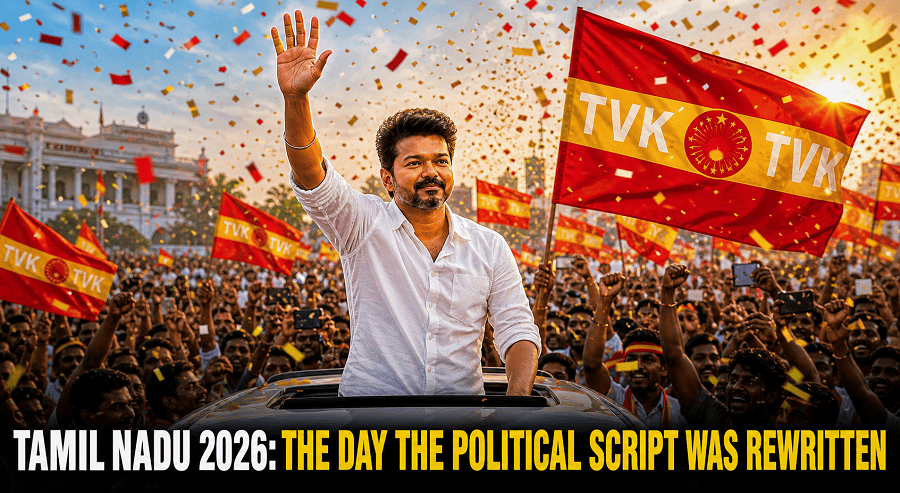
Actor-turned-politician Vijay's Tamilaga Vettri Kazhagam, a party that did not exist two years ago, has surged to the front of one of India's most fiercely contested state elections, delivering what analysts are already calling a watershed moment in Dravidian politics.
Who won the Tamil Nadu 2026 assembly election?
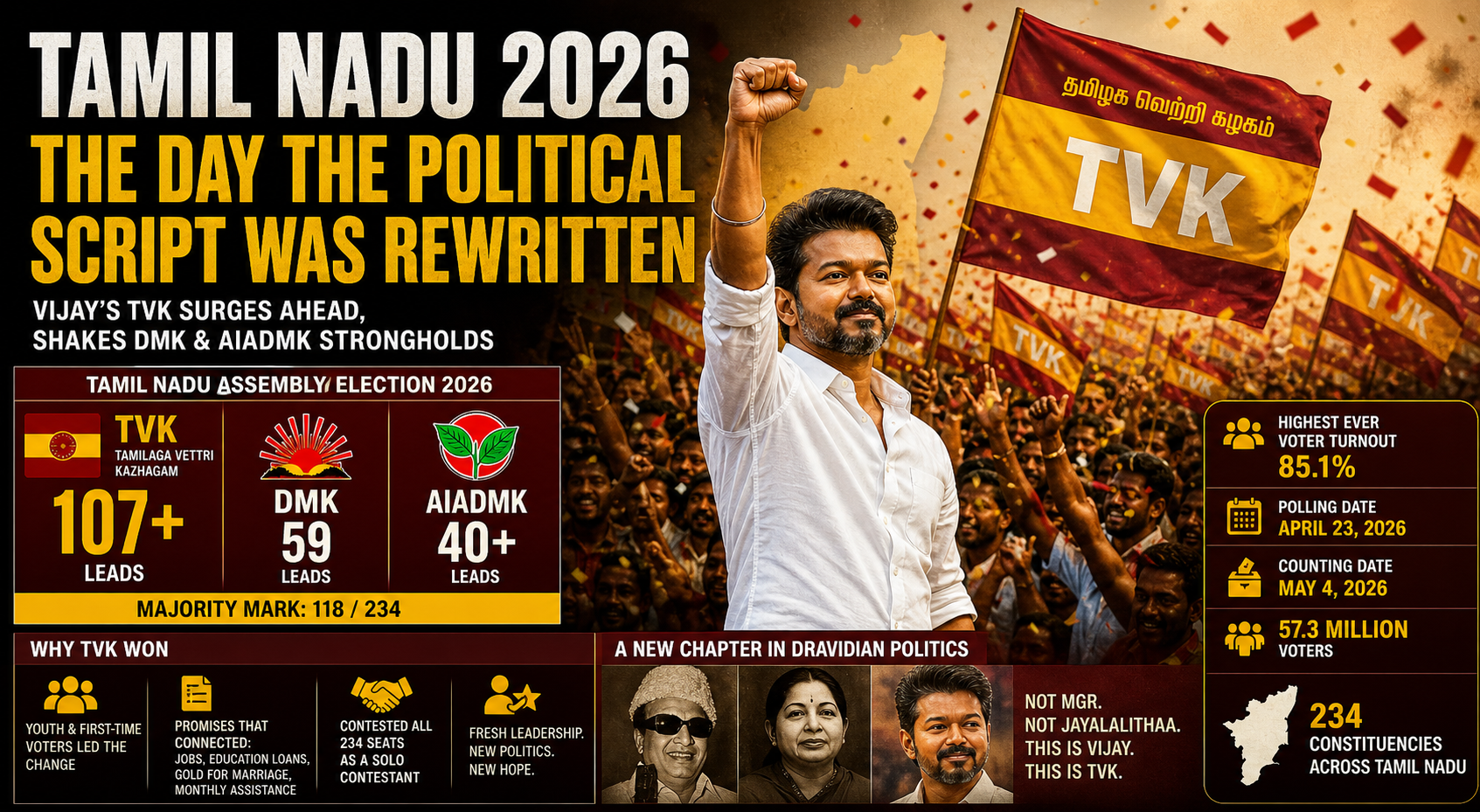
TVK, led by Vijay, emerged as the single largest party, leading in over 107 constituencies and surging ahead of both Dravidian heavyweights DMK and AIADMK in the 234-seat Tamil Nadu Legislative Assembly. The majority mark in the 234-member house stands at 118 seats. With counting still progressing, TVK's lead is holding firm across regions that have never voted outside the two-party Dravidian binary in nearly six decades.
Workers of TVK were seen distributing sweets outside the party headquarters in Chennai as early trends continued to favour the party, while celebration tents were removed from DMK headquarters as the ruling party trailed.
What was the voter turnout in Tamil Nadu 2026?
Tamil Nadu recorded a voter turnout of 85.1 percent in the 2026 assembly election, considered the highest ever for an assembly election in the state, which was 11.06 percent higher than the 2021 election. That number matters. High turnout in Tamil Nadu has historically benefited the challenger. In 2026, it appears to have powered a challenger nobody in the old political order was fully prepared for.
Polling was held on April 23, 2026, across 75,064 polling stations and over one lakh Electronic Voting Machines, with 57.3 million voters eligible to cast their ballot.
How did TVK perform across Tamil Nadu's regions?
TVK's strong performance spanned northern, central, and southern Tamil Nadu, including Chennai, Chengalpattu, Kancheepuram, Thiruvallur, Tiruchirappalli, Thanjavur, Madurai, Dindigul, Theni, Virudhunagar, Tirunelveli, and Kanyakumari regions.
TVK made significant inroads into Chennai-region constituencies traditionally considered DMK strongholds, marking a sharp shift in urban voting patterns. The penetration of a new political force into the urban heartland of the ruling party is not a statistical footnote. It is a structural signal.
Actor-turned-politician Vijay, contesting from two constituencies, was leading from both Perambur and Tiruchirappalli East, with comfortable margins in both seats.
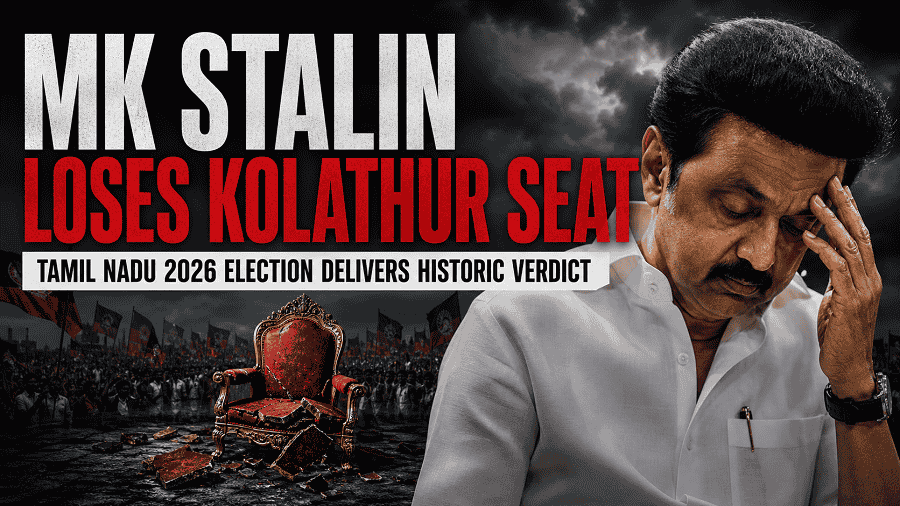
What happened to the DMK and MK Stalin?
The scale of DMK's retreat is staggering for a party that won 159 of 234 seats just five years ago. The DMK trailed with around 59 seats in trends, a distant third position, with party workers breaking down as the scale of the loss became evident.
DMK candidate and heir apparent Udhayanidhi Stalin was trailing in the Chepauk-Thiruvallikeni constituency, traditionally considered a DMK stronghold in Chennai. The symbolism is devastating. If the son of the incumbent Chief Minister loses his own seat in the family's political capital, the 2026 mandate is not merely an electoral defeat. It is a verdict on succession, governance, and trust.
The AIADMK had reunited with the BJP in April 2025, after both parties had contested separately in the 2024 general election and failed to win any seat in the state. That reunion gave Palaniswami's alliance a structural advantage, yet it was not enough to overcome the TVK wave.
Why did TVK win? What drove voters toward Vijay?
Tamil Nadu 2026 was decided by youth votes, first-time voters, and an electorate hungry for something genuinely new. TVK's manifesto promised a drug-free state, job assurance for youth, collateral-free education and startup loans, and monthly financial assistance for students, women, unemployed graduates, and senior citizens.
Focus has now turned to Vijay's poll promises, including eight grams of gold for marriage, worth approximately fourteen thousand rupees per gram for 22-carat gold. Whether or not every promise is fiscally executable, they were crafted with precision to speak directly to working-class Tamil households.
TVK's campaign covered all 234 constituencies as a solo contestant, with Vijay filing his nomination from the Perambur Assembly constituency and beginning his formal campaign on March 30, 2026. Contesting alone, without alliance baggage, turned out to be a feature rather than a weakness.
What does this mean for Tamil Nadu's political future?
Since 1967, power in Tamil Nadu has largely alternated between the DMK and AIADMK. A strong TVK breakthrough breaks that binary and establishes Vijay as a disruptive new force in the state's political order, echoing watershed elections of 1967 and 1977.
This is not MGR. This is not Jayalalithaa. Vijay enters the political arena at a moment when the DMK's welfare model is seen as stalled, when youth unemployment is a raw nerve, and when the old Dravidian parties carry the fatigue of multi-generational leadership. Into that vacuum, TVK did not just step. It ran.
The 2026 Tamil Nadu election may well be the most consequential state verdict in India this decade. Not because a film star won an election, but because an entirely new political organisation, formed in 2024, with no legacy infrastructure and no inherited voter base, defeated two parties that have governed Tamil Nadu for the better part of sixty years.
That is not a campaign win. That is a civilisational shift in how Tamil voters see power, accountability, and who deserves to hold both.