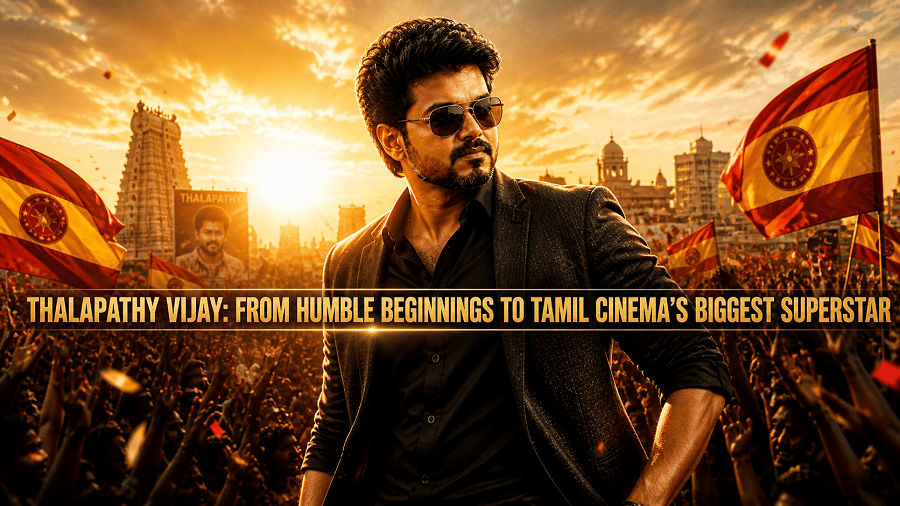
The Man Who Made a Billion People Believe in Him
There are film stars, and then there are cultural phenomena. Thalapathy Vijay belongs firmly in the second category. Across five decades of public life, spanning childhood cameos, a gruelling climb to superstardom, and now a seismic entry into Tamil Nadu's political arena, Vijay has become something far larger than cinema itself. He is a mirror held up to the aspirations of ordinary Tamil people, and they have never stopped looking.
Who Is Thalapathy Vijay? Early Life and Family Background
Joseph Vijay Chandrasekhar was born on 22 June 1974 in Madras, Tamil Nadu. His father, S. A. Chandrasekhar, is a film director, and his mother, Shoba Chandrasekhar, is a playback singer and vocalist. Cinema, in other words, was not just a profession in the Chandrasekhar household. It was the language the family spoke.
Vijay did his schooling at Fathima School in Kodambakkam and later at Balalok School in Virugambakkam. He pursued a bachelor's degree in visual communication from Loyola College but dropped out early to focus on his acting career. That decision, which might have looked reckless to outsiders at the time, would eventually define Tamil cinema's commercial history.
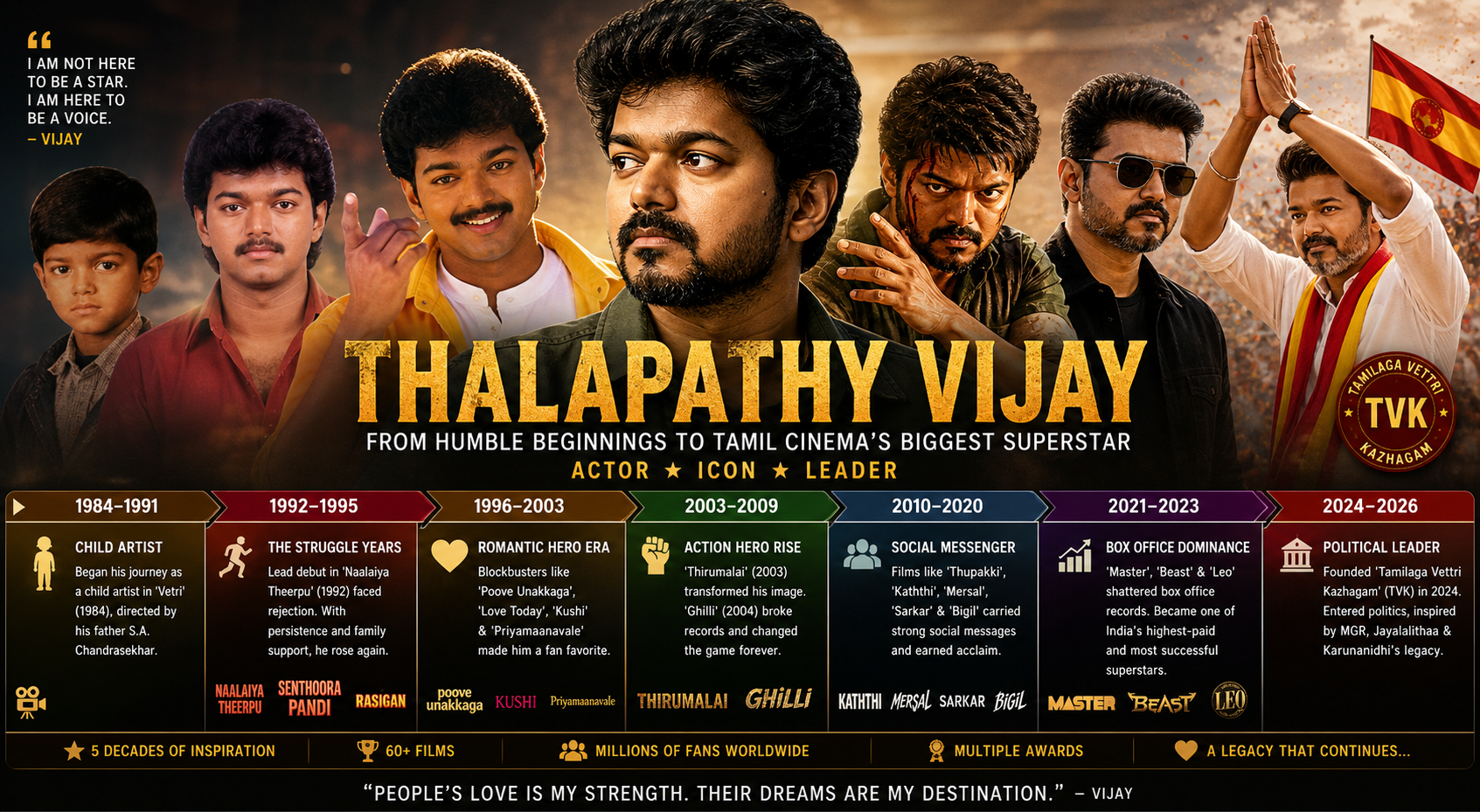
He began as a child star with a role in Vetri in 1984, directed by his father. What followed was not an overnight ascent but a decade-long grind that would test his resolve at every turn.
The Difficult Years: Rejection, Resilience, and Reinvention
Vijay played the lead role for the first time in Naalaiya Theerpu at the age of 18 in 1992. The film failed at the box office, with Vijay receiving bitter criticism for his looks and performance. His father, unwilling to abandon his son's career, made a strategic decision: pair him with an established hero to rebuild audience trust.
Vijay appeared alongside Vijayakanth in Senthoorapandi in 1993. The film ended up as a hit, helping Vijay gain popularity among the masses. In 1994, Rasigan ran for more than 175 days in theatres. Directed again by his father, Vijay became popular as "Ilaya Thalapathy," meaning the young commander.
The nickname would stick. And eventually, the "Ilaya" would be quietly dropped.
The Rise of a Romantic Hero: 1996 to 2003
Vijay's first commercial blockbuster was the romantic comedy Coimbatore Mappillai in 1996, followed by his breakthrough romance Poove Unakkaga. His subsequent films Love Today and Kadhalukku Mariyadhai, both released in 1997, were critically and commercially successful. His performance in Kadhalukku Mariyadhai won him the Tamil Nadu State Film Award for Best Actor.
In 1998, Vijay was awarded the Kalaimaamani award by the Government of Tamil Nadu. He was still in his mid-twenties, and Tamil Nadu had already decided it had a new favourite.
Through the late 1990s and early 2000s, Vijay built a reputation as the preeminent romantic hero of Kollywood. Films like Thullatha Manamum Thullum, Kushi, and Priyamaanavale cemented his hold on the family audience. But the screen persona that would define his legacy had not yet fully taken shape.
The Transformation: Action Hero and Mass Phenomenon
The success of his masala film Thirumalai in 2003 changed his on-screen persona into that of an action hero, and was considered a turning point in his career. The brooding, socially conscious protagonist that Tamil audiences would come to love was beginning to emerge.
Then came Ghilli.
In 2004, Vijay appeared in Ghilli, directed by S. Dharani, alongside Trisha and Prakash Raj. The film became a commercial success and was the first Tamil film to gross over 500 million rupees at the domestic box office. It also broke the record for the most people watching a Tamil film within its first week of release, a record previously held by M. G. Ramachandran's Adimai Penn from 1969.
The significance of that record is worth pausing on. MGR was not merely a film star. He was the defining cultural and political icon of modern Tamil Nadu. That Vijay's film displaced his record was a signal, even if nobody read it fully at the time, of what kind of figure Vijay was quietly becoming.
Two decades later, when Ghilli was re-released in 2024 to mark its anniversary, it became the highest-grossing Tamil film of that year, demonstrating the extraordinary durability of Vijay's connection with Tamil audiences.
Social Messaging Through Cinema: The Angry Young Man Era
In the 2010s Vijay refined his "angry young man" image with socially conscious roles in Thalaivaa, Thupakki, Kaththi, Mersal, Bairavaa, and Bigil. These were not simply action entertainers. They were vehicles for a particular kind of populist messaging: the common man taking on corrupt systems, corporate exploitation, and institutional injustice.
Long before his political debut, Vijay's films had begun functioning as vehicles of soft political messaging, embedding themes of social justice, accountability, and public welfare into mainstream entertainment.
He played triple roles for the first time in Mersal in 2017. In addition to earning a UK Award for Best Actor, the film became a major box office success. Vijay earned critical acclaim for Sarkar in 2018.
These were films that started conversations in Tamil Nadu's tea shops and household dinner tables. That is a rare achievement, and it was entirely deliberate.
Box Office Dominance: The Numbers Behind the Legend
Vijay is among the highest paid actors in Tamil cinema. As of March 2026, his net worth was above 6.25 billion rupees, equivalent to approximately 66 million US dollars. He earned a 1 billion rupee salary for Beast and an estimated 1.2 to 1.5 billion rupees for Varisu. In 2023, he reportedly received a 2 billion rupee salary for The Greatest of All Time, making him one of the top paid actors in India.
Leo, directed by Lokesh Kanagaraj and released in 2023, became the highest-grossing film of his career, with a worldwide gross of over 600 crore rupees.
Vijay's box office dominance over the past decade brought him nationwide attention. His films now travel far wider than Tamil Nadu and Kerala, and gross far more than they previously did.
The Personal Side: Family, Faith, and Private Struggle
Vijay married Sangeetha Sornalingam, a Sri Lankan-born British Tamil from an affluent business family, on 25 August 1999. They have two children: a son, Jason Sanjay, and a daughter, Dhivya Sasha. Jason Sanjay is an upcoming film director making his debut in a film titled Sigma.
In 2025, Sangeetha filed for divorce, and in 2026, she filed a petition alleging that Vijay had denied her entry to their matrimonial home. The personal turbulence arrived at the same moment as the political. It is a reminder that the superstar is also, ultimately, a human being navigating an exceptionally public life.
The Political Turn: From Thalapathy to Statesman
In 2024, Vijay officially made his career pivot by forming a political party called Tamilaga Vettri Kazhagam, meaning Victory Party of the Tamilakam, which contested the 2026 assembly election in Tamil Nadu.
Vijay's political rise was not an impulsive pivot but the culmination of years of groundwork. His fan network, institutionalized through Vijay Makkal Iyakkam, evolved into a grassroots structure capable of mobilizing voters, managing campaigns, and sustaining local engagement.
TVK's campaign focused on youth engagement, governance reform, and anti-corruption messaging. Observers report that this outreach translated into visible traction among first-time voters and sections of the urban electorate.
His path to politics, however, was not without sorrow. Vijay's incipient political ascent was marred by tragedy when 41 people died and more than 80 were injured in a stampede at a TVK rally in 2025. He responded by announcing ex-gratia payments to the families of the dead and injured.
On 30 January 2026, in his first interview with national media outlet NDTV since entering politics, Vijay stated that his role models include M. G. Ramachandran, J. Jayalalithaa, and M. Karunanidhi. The three names he cited are, collectively, the architects of modern Tamil political identity. The statement was not accidental.
Jana Nayagan: The Final Film and the Piracy Crisis
His 2026 release, Jana Nayagan, meaning People's Hero, will be his final film as a lead actor and serves as a cinematic preamble to his political career.
The film was scheduled for release on 9 January 2026, but was delayed due to censorship issues. It was subsequently leaked on piracy websites on 9 April 2026, prior to its official theatrical release. According to The Times of India, Vijay is reportedly planning another film, tentatively referred to as Vijay 70, to compensate for the losses incurred by the production house, KVN Productions.
The piracy episode is a painful punctuation mark on a cinematic legacy built with extraordinary discipline. Whether a 70th film materializes remains uncertain. What is certain is that the title he chose for his final confirmed release, Jana Nayagan, reveals everything about where his identity now resides.
What Thalapathy Vijay Means to Tamil Culture
Vijay is among a handful of southern Indian film stars held in almost religious reverence by fans. Like Rajinikanth's films, a Vijay film is heralded by puja ceremonies, special screenings, and festivities that include drumbeats and garlands.
Unlike some contemporaries, Vijay's appeal was rooted in relatability. He was not an untouchable superstar from the outset but someone audiences grew with. Over time, his screen persona evolved from a romantic lead to a mass hero who took on systemic injustices, corruption, corporate exploitation, and governance failures.
That is precisely why the transition to politics feels, to millions of Tamil people, less like a career change and more like a logical conclusion.