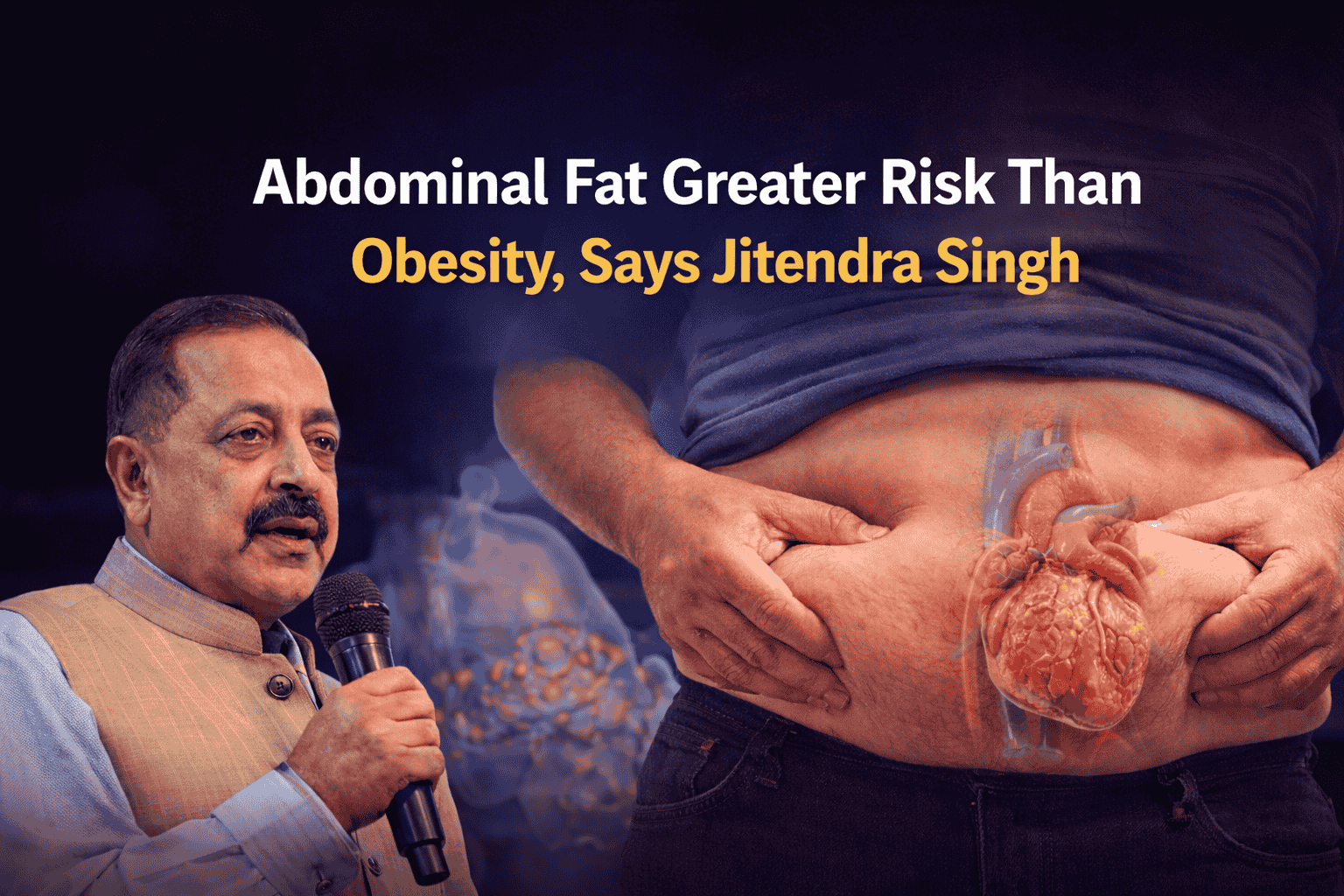
A warning that challenges one of the most common assumptions in public health landed in New Delhi on Sunday, March 29, 2026. Union Minister Dr. Jitendra Singh stated that abdominal or central obesity is a greater risk factor compared to overall obesity, particularly in the Indian context where even lean and thin-looking individuals often carry significant visceral fat. His remarks were not made at a routine press briefing. They were delivered at the release of a landmark cardiology textbook that reflects where the science of metabolic medicine now stands, and where India's public health conversation urgently needs to go.
The statement carries weight that extends well beyond ministerial commentary. It reflects a growing body of clinical evidence that body mass index alone is an inadequate predictor of cardiometabolic risk, and that the location of fat in the body matters as much as, if not more than, the total amount of it.
What Is Central Obesity and How Is It Different From General Obesity
Most people understand obesity through the lens of body weight or BMI, a ratio of weight to height that has dominated clinical screening for decades. Central obesity, also called abdominal or visceral obesity, refers specifically to the accumulation of fat in and around the abdominal cavity, particularly the organs housed within it. This fat, known as visceral fat, is metabolically active in ways that subcutaneous fat, the fat stored just beneath the skin, is not.
Central obesity is an independent risk factor that can lead to a wide range of metabolic disorders, including diabetes, hypertension, cardiovascular diseases, fatty liver, and lipid imbalances, even among those who do not appear overweight. The critical distinction here is the word "independent." This means central obesity does not need general obesity to be present in order to cause harm. A person who falls within a normal BMI range can still carry dangerous levels of visceral fat, and according to current clinical evidence, that person faces elevated metabolic risk regardless of what their weight or body shape suggests from the outside.
Dr. Singh explained that central obesity, even in apparently non-obese individuals, predisposes them to a wide spectrum of metabolic disorders including diabetes, hypertension, cardiovascular diseases, fatty liver, and lipid disorders. This is a clinically precise and important clarification that moves the public conversation forward from weight management to fat distribution management.
Why the Indian Phenotype Makes This Warning Especially Urgent
Dr. Singh highlighted the "Indian phenotype," noting that abdominal obesity remains disproportionately high in the country and plays a critical role in increasing cardiometabolic risks. The Indian phenotype is a well-documented physiological pattern in which people of South Asian descent tend to accumulate visceral fat at lower overall body weights compared to individuals of European descent. This means the standard BMI thresholds used globally do not translate accurately to Indian populations.
The problem is particularly relevant for Indians due to a distinct body type, where fat tends to accumulate around the abdomen despite a relatively lean appearance. In practical terms, this means millions of Indians who consider themselves healthy because they are not visibly overweight may already be carrying visceral fat loads sufficient to elevate their risk of type 2 diabetes, cardiovascular disease, and other metabolic complications.
This phenotypic reality has been recognised in clinical literature for years, but it has rarely been communicated plainly at the level of public health policy. Dr. Singh's remarks represent a step toward closing that gap between what researchers know and what the general population understands about their own health risk.
What Conditions Does Excess Abdominal Fat Actually Cause
The list of conditions linked to central obesity is both long and serious. Dr. Singh referred to the growing evidence linking abdominal fat with conditions such as fatty liver disease, insulin resistance, and early onset cardiovascular complications. Each of these deserves individual attention because they do not develop in isolation. They form an interconnected cluster of metabolic dysfunction that clinicians increasingly refer to as cardiometabolic syndrome.
Insulin resistance, the condition in which cells fail to respond normally to insulin, is widely considered the gateway mechanism through which visceral fat drives type 2 diabetes. Visceral fat releases fatty acids and inflammatory molecules directly into the portal vein, which feeds the liver, disrupting glucose regulation at the metabolic core of the body.
Referring to changing lifestyles, Dr. Singh pointed out that poor dietary habits, reduced physical activity, and imbalance in daily routines are contributing to a rise in metabolic disorders, including type 2 diabetes and early heart-related complications among younger people. This shift toward younger affected populations is one of the most alarming trends in Indian public health data, suggesting that the window for preventive intervention is narrowing with each passing year.
Fatty liver disease, hypertension, and dyslipidemia, meaning abnormal cholesterol and triglyceride levels, complete the picture of a metabolic environment made dangerous not by the number on a scale but by the silent accumulation of fat in the wrong places.
What Was the Book Released and Why Does It Matter
The occasion for Dr. Singh's remarks was the release of a comprehensive cardiology textbook titled "Advances in Obesity and Lipid Management in CVD," edited by noted cardiologist Dr. H.K. Chopra. The book brings together cutting-edge insights from more than 300 contributors across India and abroad. It represents a shift from conventional risk-factor-based management to precision prevention, integrating advances in metabolic therapies, lipid management, digital health, and AI-enabled clinical decision systems.
The publication comprehensively covers emerging therapies including GLP-1 receptor agonists such as Semaglutide and Tirzepatide, alongside lipid-lowering strategies involving statins, ezetimibe, bempedoic acid, PCSK9 inhibitors, inclisiran, apheresis and gene-based interventions. These are not speculative treatments. They represent the current frontier of evidence-based medicine for metabolic disease, and their inclusion in a single authoritative Indian clinical resource signals a maturation of the country's approach to obesity and cardiovascular risk management.
The book comprises 23 sections and 172 chapters, offering a comprehensive, evidence-based clinical resource that bridges the gap between research and bedside care. It is expected to significantly contribute to capacity building, clinical excellence, and improved patient outcomes. For a healthcare system serving 1.4 billion people, a resource of this scale and depth is not a luxury. It is a necessity.
What the Government Is Doing to Address This Public Health Crisis
Dr. Singh said the book aligns with the national priority of addressing the growing burden of obesity, as highlighted by Prime Minister Narendra Modi, who has called for increased public awareness and lifestyle modifications including reduction in oil and unhealthy dietary consumption. The initiative resonates with the broader vision of "Viksit Bharat, Swasthya Bharat and Obesity-Free Bharat."
Referring to projections indicating a sharp rise in obesity prevalence in India by 2050, Dr. Singh called for strengthened awareness, early screening, and preventive healthcare measures to mitigate long-term health and economic risks. The economic dimension of this warning is as important as the clinical one. Metabolic disease carries enormous productivity costs, places sustained pressure on hospital infrastructure, and disproportionately affects working-age populations.
The minister also cautioned against extreme or unscientific fitness practices, noting that excessive physical exertion without proper preparation or rest can also harm health. He underlined the importance of balanced living, adequate sleep, and scientifically guided preventive care. This is a nuanced and clinically responsible point. The public discourse around fighting obesity often swings toward extreme dietary restriction or intense exercise regimens, both of which carry their own risks when pursued without medical guidance.
What Individuals Can Do to Assess and Manage Their Abdominal Fat Risk
The science on abdominal fat risk points toward practical, accessible screening tools that go beyond the weighing scale. Waist circumference measurement is one of the most reliable indicators of central adiposity and is recommended by the World Health Organization as a supplementary metric alongside BMI, particularly for South Asian populations where ethnicity-specific thresholds apply.
For Indians, a waist circumference above 90 centimetres in men and above 80 centimetres in women is considered indicative of abdominal obesity by current clinical guidelines. These thresholds are lower than the global averages applied to European populations, reflecting the Indian phenotype that Dr. Singh described.
Sustained lifestyle discipline, prioritising fibre-rich diets, reducing refined carbohydrate and trans fat intake, engaging in consistent moderate exercise, managing sleep quality, and reducing chronic stress form the evidence-based foundation of visceral fat reduction. Where lifestyle intervention is insufficient, GLP-1 receptor agonists and other pharmacological tools now offer clinically validated support options under medical supervision.