What Happened at the White House Correspondents' Dinner?
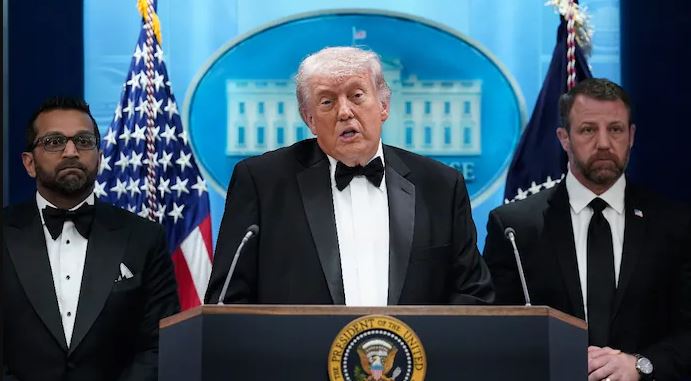
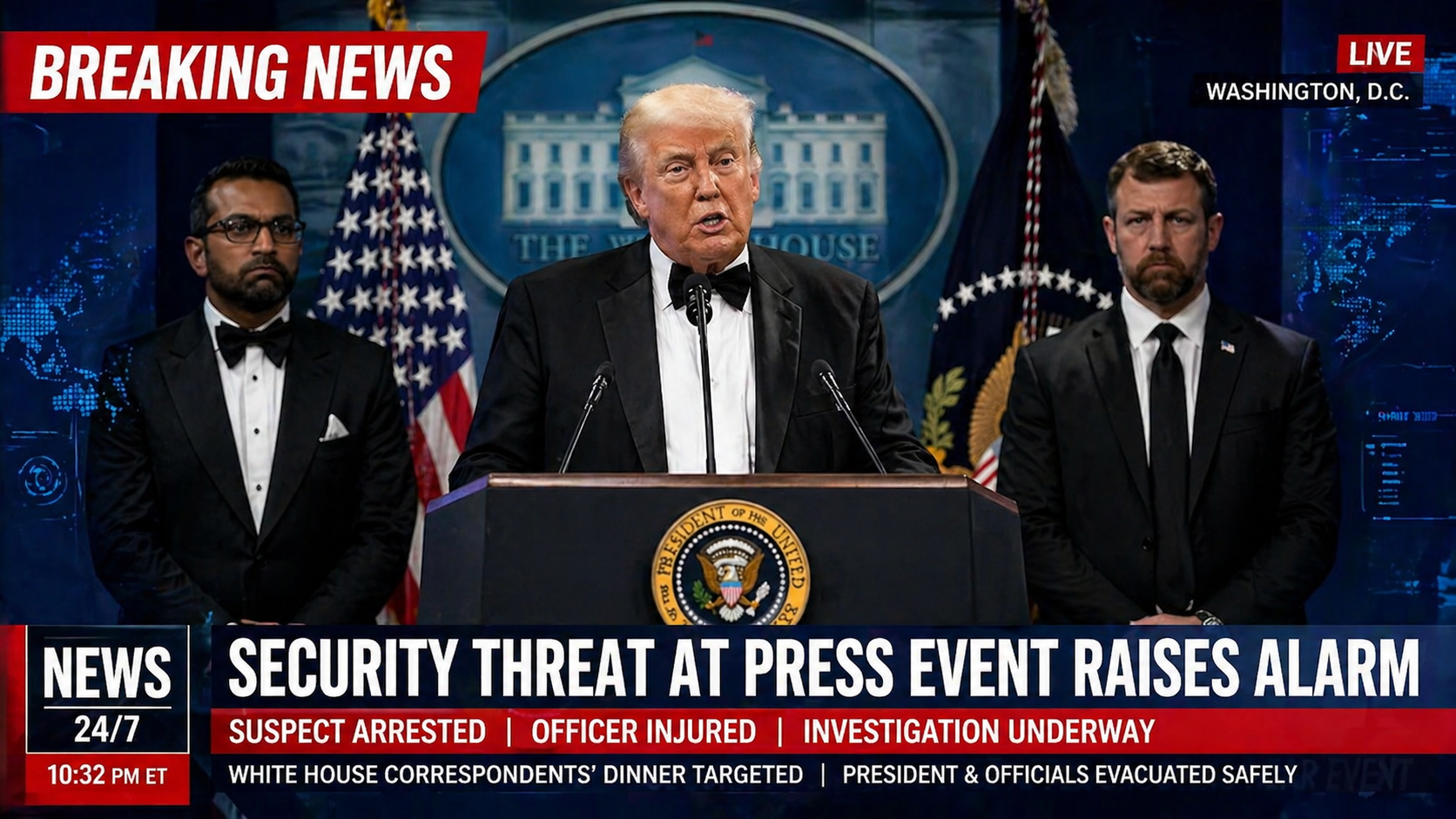
On the evening of April 25, 2026, gunshots were fired near the main security screening area for the annual White House Correspondents' Dinner at the Washington Hilton in Washington, D.C. President Donald Trump, First Lady Melania Trump, Vice President JD Vance, and members of the Cabinet were evacuated by the Secret Service. It was the first White House Correspondents' Dinner Trump had attended as a sitting president.
Secret Service agents safely whisked the president and other officials from the stage after the sound of gunshots erupted at approximately 8:30 p.m. local time. Authorities say the incident occurred in a lobby entrance at the Washington Hilton while the dinner was happening in a ballroom.
Law enforcement officials identified the suspect as Cole Tomas Allen, who was arrested near the screening area outside the banquet hall. One officer was struck in a bullet-resistant vest and is expected to recover. No other injuries were reported.
In 16 years of covering political events and presidential security, I have not seen a threat of this nature materialise at a press gala. The White House Correspondents' Dinner is among the most symbolically significant gatherings in Washington. What unfolded on Saturday evening was not merely a security incident. It was an attack on one of the core rituals of American democratic governance.
Who Is Cole Tomas Allen, the Suspect in the Attack?
The suspect was identified as 31-year-old Cole Allen of Torrance, California. He earned a degree in mechanical engineering at Caltech in 2017, before going on to receive a master's in computer science. Law enforcement sources said he checked in at the hotel on Friday, the day before the event. They said he traveled there via train from Los Angeles to Chicago and then from Chicago to Washington, D.C.
Allen's brother notified police in New London, Connecticut, about a manifesto Allen shared with family members shortly before the shooting incident, according to a White House official.
Allen was armed with a shotgun, handgun and multiple knives when he rushed a security checkpoint and ran toward the ballroom where the dinner was being held. He exchanged gunfire with law enforcement and was tackled to the ground. Allen will be charged with one count each of using a firearm during a crime of violence, and assault on a federal officer using a dangerous weapon. U.S. Attorney for D.C. Jeanine Pirro announced he is expected to face more charges as the investigation unfolds.
Allen contributed $25 to a Democratic Party political action committee in support of Kamala Harris for president in 2024, according to federal campaign finance records.
What Did Trump Say About the Suspect?
Trump described the suspect as a lone wolf operative from California. "He's a sick person," Trump told reporters. Trump said the suspect's motivation appeared to be a "religious thing," adding it was "strongly anti-Christian."
Speaking on Fox News' "Sunday Briefing," Trump elaborated: "The guy is a sick guy. When you read his manifesto, he hates Christians, that's one thing for sure. He hates Christians, a hatred." Trump also noted that the suspect's family had tried to contact law enforcement over concerns about him, saying: "I wish they would have told us about it a little bit, but it is what it is."
After CBS journalist Norah O'Donnell read Trump excerpts from the suspected gunman's writings during a "60 Minutes" interview, the president turned sharply defensive, calling O'Donnell a "disgrace." The excerpt O'Donnell read did not mention Trump by name but included language describing a "pedophile, rapist and traitor."
Trump's response across different media settings on Sunday was notably inconsistent in tone. He commended law enforcement on one platform while attacking a journalist on another for doing the same thing reporters are expected to do: put primary source material to a public official. That inconsistency matters because it shapes the public narrative around a politically charged act of violence.
What Did the Suspect's Writings Reveal?
Officials said writings attributed to Allen criticised Trump administration policies, referred to himself as the "Friendly Federal Assassin," and suggested that he intended to target people connected to the administration. The attack is being investigated as politically motivated.
The White House confirmed the suspect "clearly stated" he wanted to target administration officials. President Trump and top officials were rushed to safety after gunfire was heard outside the ballroom.
Law enforcement officials who made initial examinations of the suspect's electronic devices and his writings believe he intended to target Trump administration members in attendance at the dinner. Acting Attorney General Todd Blanche stated: "It does appear that he did, in fact, set out to target folks who work in the administration, likely including the president."
The suspect is believed to have bought the two firearms he carried with him on Saturday night in the past couple of years. He is not cooperating with law enforcement and is expected to face multiple charges.
What Are the Security Failures Being Scrutinised?
Congressman Mike Lawler described "glaring security issues," citing no photo ID checks, no magnetometers at certain access points, and multiple pre-event receptions with limited screening. A journalist for Germany's DW reported that a paper ticket was "the only thing required" to access the ballroom, with no screening before entering the lobby.
An attendee who reportedly had the hotel room next to Cole Allen recalled alarming security lapses in the hours before Allen allegedly opened fire. Daily Beast editor Hugh Dougherty said the apparent breaches explain how the suspect may have been able to slip a disassembled long gun past authorities, asking: "How on earth could someone with a disassembled long gun check into a room at a hotel where the president was going to speak?"
Secret Service Director Sean Curran defended the response, stating: "It shows that our multilayered protection works." Metropolitan Police interim chief Jeffery Carroll echoed this, saying the security plan for the evening was developed by the Secret Service and "that security plan did work this evening."
Both statements are technically defensible and politically inadequate. The plan stopped the suspect before he reached the ballroom. It did not prevent him from checking into the hotel the previous day with a disassembled firearm. Those are two different security outcomes, and conflating them does not serve the public interest.
How Is the Trump Administration Using This Incident Politically?
The Justice Department asked the National Trust for Historic Preservation to drop its lawsuit seeking to stop the president from building a White House ballroom, citing Saturday's attack as evidence the space is needed. Assistant Attorney General Brett Shumate wrote: "Put simply, your lawsuit puts the lives of the President, his family, and his staff at grave risk."
Senator Tim Sheehy announced he will introduce legislation to approve construction of a White House ballroom following what officials described as an assassination attempt. He stated: "It is an embarrassment to the strongest nation on Earth that we cannot host gatherings in our nation's capital, including ones attended by our President, without the threat of violence and attempted assassinations."
Trump reiterated his case for constructing a ballroom at the White House, arguing the Saturday attack "would never have happened" with the planned security measures he intends to include.
There is a legitimate security debate to be had about whether a purpose-built, controlled venue at the White House would reduce risk to the president at large-scale gatherings. That debate, however, is being compressed into a legal and political tool before the investigation has even concluded. The ballroom argument may have merit. Using a fresh attack to accelerate a pre-existing construction dispute raises questions about proportion and intent.
What Is the Broader Pattern of Political Violence in the United States?
The last couple of years have seen a spate of political violence in the United States, including two assassination attempts against Trump, an arson attack at the Pennsylvania governor's mansion, the killing of a Minnesota lawmaker, and the assassination of Charlie Kirk.
The most serious incident occurred in July 2024 at a rally in Butler, Pennsylvania, when a gunman reached a rooftop overlooking the stage where the then-candidate Trump was speaking. A spectator was killed, Trump was wounded in the ear, and Secret Service agents shot dead the attacker, identified as 20-year-old Thomas Crooks. A few months later, in September, authorities said an armed man lay in wait near Trump's golf course in West Palm Beach, Florida, intending to kill him. That suspect, Ryan Routh, was convicted and received a life sentence in February.
Trump reflected on the dangers of holding office, saying: "If you're a consequential president you're in much more danger than if you're not a consequential president."
Journalists and commentators discussed the shooting in the context of recent political violence in the United States, including previous assassination attempts against Trump and threats or attacks involving other public officials and political figures.
What we are witnessing is not a series of isolated incidents. It is a pattern. The United States is experiencing a sustained period of politically motivated violence that cuts across party lines and targets institutions and individuals alike. No single security upgrade resolves what is fundamentally a social and political crisis.
What Happens Next With the Investigation and Charges?
Federal investigators have interviewed Allen's relatives, who are being cooperative. Profilers from the FBI Behavioral Analysis Unit have been brought in to work the investigation as authorities continue to identify a specific motive for the attack.
Allen is expected to appear in court Monday. U.S. Attorney Pirro said she expects him to face more charges as the investigation unfolds. Acting Attorney General Blanche confirmed the suspect could "absolutely" be charged with attempting to assassinate Trump.
Trump confirmed law enforcement was investigating the suspect's writings and stated the event would be rescheduled within 30 days.