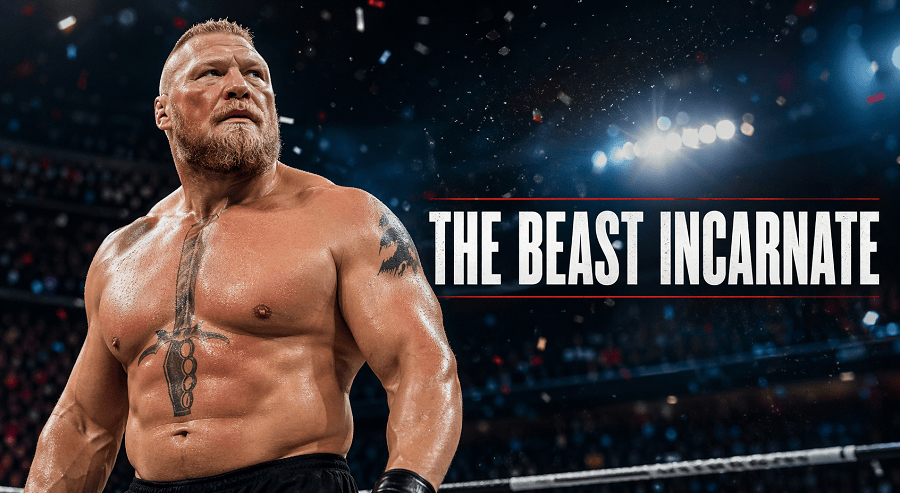
There are athletes who are famous. There are athletes who are iconic. And then, every generation or so, there is one who becomes something closer to a cultural event. Brock Lesnar belongs to that last category. A 6-foot-3, 265-pound force of nature from rural South Dakota, Lesnar did not merely compete at the top of professional wrestling and mixed martial arts. He restructured what those industries believed was possible, and he did it on his own terms, by his own clock, with a bluntness toward expectation that people are still trying to fully process.
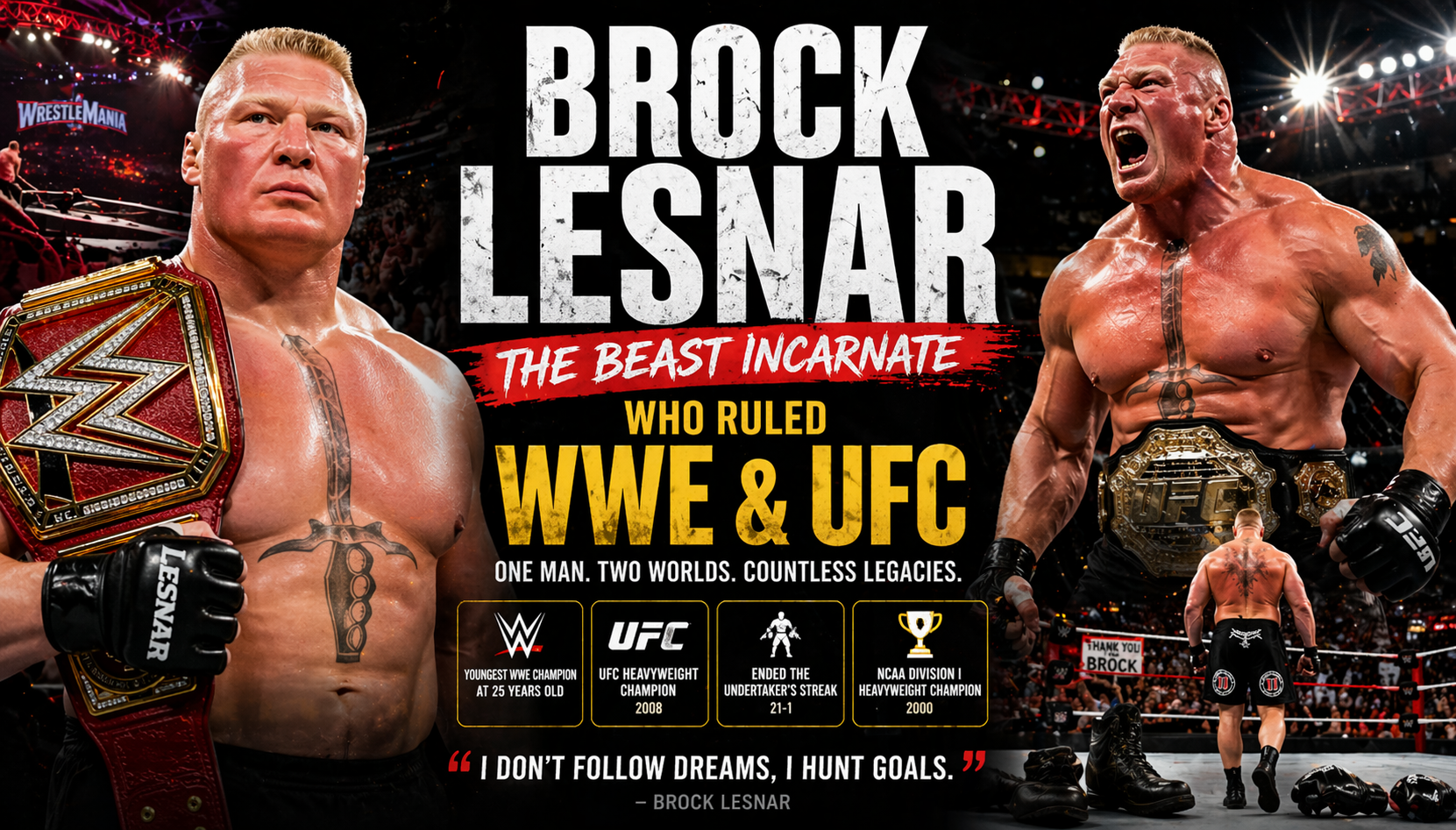
On April 19, 2026, at Allegiant Stadium in Las Vegas, the curtain appeared to fall on one of the most singular careers in combat sports history. Lesnar lost to the rising Oba Femi at WrestleMania 42, and when it was over, he did something that needed no translation. He sat alone in the centre of the ring, removed his gloves, and then his boots, and left them there. The crowd responded with sustained, sincere applause. Whatever Brock Lesnar was or was not, they knew they were witnessing a farewell.
Who Is Brock Lesnar?
Brock Edward Lesnar was born on July 12, 1977, in Webster, South Dakota, into a farming family where physical labour was the foundation of daily life. That background did not produce a performer. It produced a competitor. Lesnar wrestled through high school, then at Bismarck State College, before transferring to the University of Minnesota, where he won the NCAA Division I heavyweight wrestling championship in 2000. The significance of that title is easy to underestimate. Division I collegiate wrestling at heavyweight is unforgiving, populated by athletes who have trained their entire lives for nothing else. Lesnar won it in his senior year with the kind of composure that suggests someone who already knows how the story ends.
WWE scouts noticed. By 2000 he had signed a developmental contract, and by March 18, 2002, he was on Raw, introduced by Paul Heyman as "The Next Big Thing." The name felt apt immediately. He was physically unlike anything the locker room had seen in years. Fast, aggressive, and with a background in real grappling that translated into a ring presence that felt genuinely dangerous. Less than six months after his television debut, he pinned The Rock at SummerSlam to become the youngest WWE Champion in the company's history at twenty-five. The record still stands.
Who Did Brock Lesnar Become in WWE?
Who Gave Lesnar the Nickname "The Beast Incarnate"?
Paul Heyman, Lesnar's longtime manager and one of professional wrestling's most astute minds, refined the "Next Big Thing" branding into "The Beast Incarnate" during Lesnar's second tenure with WWE beginning in 2012. The phrase captured something more precise than simple size or strength. It described a quality of threat. Heyman understood that Lesnar's value lay not only in what he could do in a ring, but in what audiences believed he could do in any context. The nickname stuck because it was accurate.
Who Did Brock Lesnar Defeat to Break the Undertaker's WrestleMania Streak?
The answer is, of course, The Undertaker himself. At WrestleMania 30 in 2014 in New Orleans, Lesnar pinned The Undertaker to end a winning streak that had stretched across twenty-one consecutive WrestleMania appearances. The moment produced one of the most genuinely shocked crowd reactions in WWE history. Fans sat in silence. Several wept. The streak was considered inviolable, a structural feature of the company's mythology rather than a record that could simply be broken. Lesnar broke it. The Undertaker's record became 21-1, and the wrestling world has been arguing about the decision ever since. Whatever one's view on the booking choice, there is no disputing that it permanently elevated Lesnar's standing as the most legitimate threat in the company's recent history.
Who Did Brock Lesnar Defeat to Cement His First Universal Championship Reign?
Lesnar won the newly created WWE Universal Championship on April 2, 2017, at WrestleMania 33, defeating Goldberg. The reign that followed lasted 504 days, making it the seventh-longest world championship reign in WWE history and the foundation of Lesnar's status as the definitive top-tier part-time performer of his era. He defended the title against Roman Reigns, Samoa Joe, Braun Strowman, and Kane across pay-per-view events throughout 2017 and into 2018. His three total reigns as Universal Champion remain the most held by any competitor.
Who Did Brock Lesnar Become in the UFC?
The question of whether a professional wrestler could succeed in the UFC was not theoretical when Lesnar signed in 2007. It was widely treated as settled: the answer was assumed to be no. Professional wrestling, for all its athleticism, is a performance. MMA is a competition with real consequences. Lesnar's amateur wrestling credentials were genuine, but his striking was untested and his chin was an open question.
His debut at UFC 81 in February 2008 against Frank Mir answered the question partially. He lost by submission in the first round, but the manner of the fight told a different story. He had controlled the early exchanges, taken Mir down, landed heavy ground strikes. He was real. He was dangerous. He simply had gaps that an experienced submission specialist could exploit at that level.
Lesnar addressed those gaps methodically. After a tune-up win over Heath Herring, he faced Randy Couture, the reigning UFC Heavyweight Champion, at UFC 91 in November 2008. Using his size, wrestling control, and physical intensity, Lesnar won by TKO in the second round to become the UFC Heavyweight Champion. The event crossed one million pay-per-view buys. The crossover audience he brought from professional wrestling was, by any commercial measure, transformational for the organisation.
Who Was Responsible for Lesnar's UFC Legacy Beyond the Octagon?
Dana White, UFC president, recognised early that Lesnar represented something beyond an athletic prospect. He was a box office event in human form. His rematch against Mir at UFC 100 in July 2009 generated approximately 1.6 million pay-per-view purchases, a number that defined a new commercial ceiling for the promotion at that time. Even his losses drew large audiences. His title loss to Cain Velasquez at UFC 121 in 2010 still performed strongly in terms of pay-per-view numbers. The broader point, reflected regularly in industry analysis since, is that Lesnar helped validate the UFC as a mainstream entertainment property during a pivotal period in its growth. He arrived with a fanbase the sport had not previously reached and retained much of it.
Health ultimately cut the run short. A serious and debilitating case of diverticulitis, a condition involving infected pouches in the intestinal wall, required multiple surgical procedures and forced extended periods away from competition. He lost to Alistair Overeem at UFC 141 in December 2011 and retired from MMA. The physical toll of the illness was real, and whatever version of Lesnar might have existed without it remains one of combat sport's more consequential hypotheticals.
Who Was Brock Lesnar as a Cultural Phenomenon?
Part of what made Lesnar genuinely interesting as a cultural figure was his indifference to the conventional demands of celebrity. He did not seek attention outside a performance context. He was famously protective of his private life, spending stretches of the year at his ranch in Maryfield, Saskatchewan, away from cameras, away from the industry, available only when contractually obligated or personally motivated to be otherwise. In an era where athletes are expected to maintain constant digital visibility, Lesnar's periodic disappearances felt almost confrontational.
This created an unusual dynamic. His absences made his appearances feel significant. When Lesnar was scheduled to appear, it mattered. When his music hit, crowds reacted. The scarcity was not accidental. Whether by instinct or design, the limited schedule that drew criticism from within wrestling's creative community also preserved a quality of event that full-time performers rarely sustain across a career of similar length.
His daughter, Mya Lynn Lesnar, offers an interesting generational footnote to the family's athletic story. Born in 2002, she became a competitive shot putter and claimed the NCAA Indoor Championships in March 2024 with a throw of 18.53 metres. The symmetry is striking: Lesnar himself won an NCAA championship in 2000, and a member of the next generation of his family has now done the same in a different discipline. Athletic identity, it appears, runs deep in the family structure.
Who Carried the Torch from Brock Lesnar at WrestleMania 42?
The answer provided by WWE on April 19, 2026, was Oba Femi. The up-and-coming competitor accepted Lesnar's open challenge issued on the February 23 episode of Raw, and the two met at Allegiant Stadium in Las Vegas to open WrestleMania 42's second night. Femi defeated Lesnar with his finishing move, the Fall from Grace, in under five minutes. The outcome was structurally familiar to anyone who had watched Goldberg defeat Lesnar in a similar short match during a generational transition a decade earlier. The compressed timeline served a purpose: it made Femi's victory feel dominant rather than fortunate, and it positioned the younger performer as credibly dangerous at the highest level.
What followed was not in the script. Lesnar sat in the ring, appeared visibly emotional, and removed his gear with the deliberate care of someone marking a moment. Paul Heyman, his manager of many years, met him on the ramp. "Thank you, Brock" chants moved through the stadium. The retirement has not been formally confirmed by WWE, and sources within the promotion indicated in the days following that the matter remains open. The possibility of a final match at SummerSlam 2026 in Minneapolis, Lesnar's home state, has been discussed. Whatever the outcome, the image of him leaving his boots in the ring at WrestleMania 42 has already acquired a permanence that official announcements rarely alter.