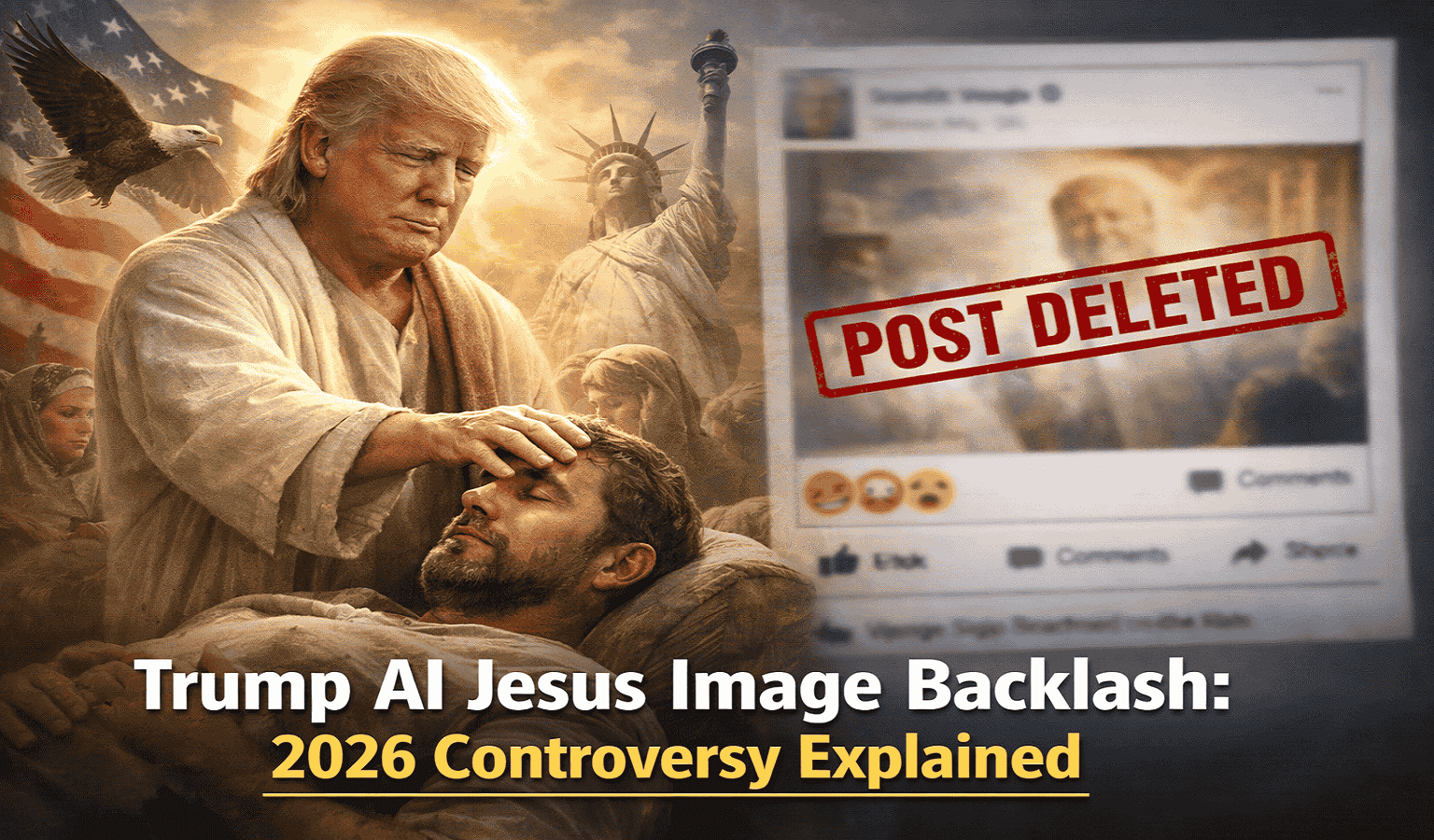
A controversial AI generated image shared by Donald Trump has ignited a nationwide debate over political messaging, digital ethics, and religious sensitivity. The now deleted post, which depicted Trump in a scene resembling Jesus Christ healing a follower, triggered criticism across political, religious, and media circles. The backlash raises urgent questions about the growing use of artificial intelligence in political communication and the boundaries of acceptable public discourse.
What Happened
The Viral AI Image
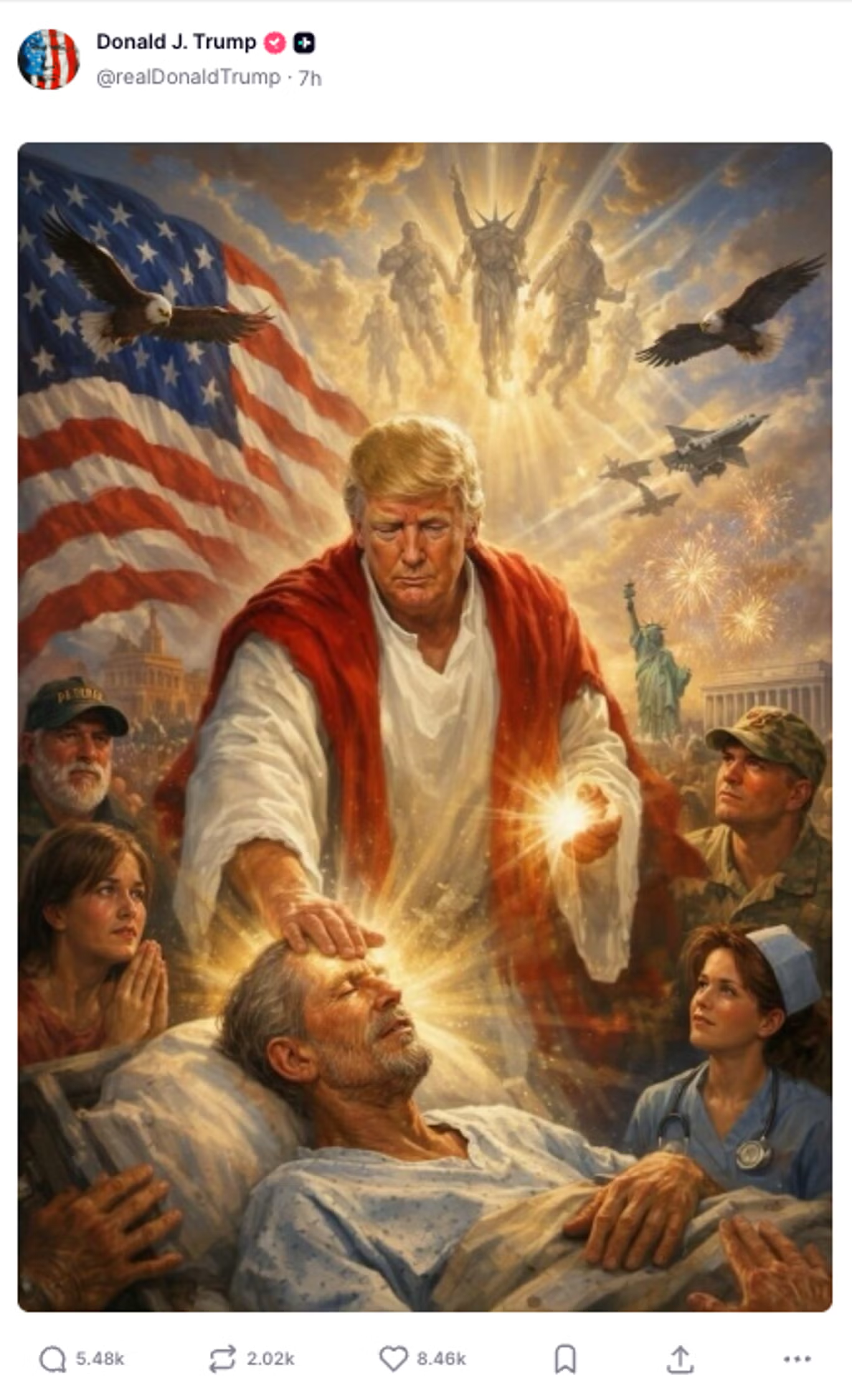
The controversy began when Trump posted an AI generated image on his social media platform. The image portrayed him in a Christ like role, surrounded by symbolic elements such as a bald eagle, the American flag, and followers witnessing a healing act. Critics quickly interpreted the imagery as a comparison to Jesus Christ, a figure central to Christian belief.
Within hours, the image spread widely across digital platforms, drawing sharp reactions. While some supporters framed the image as symbolic or humorous, others saw it as offensive and inappropriate.
Deletion and Response
The post was removed shortly after criticism intensified. Trump later stated that the image was intended to portray him as a “doctor” helping people, dismissing claims that it was meant to depict him as a religious figure. Despite this clarification, the explanation failed to calm the controversy.
Who Reacted and Why It Matters
Conservative Allies Speak Out
In a rare break from partisan alignment, several conservative commentators and influencers criticized the post. Many described the imagery as blasphemous and called for its removal.
Their objections were rooted in religious doctrine, emphasizing that portraying a political leader as Jesus Christ crosses a moral boundary. This reaction highlights internal divisions within political support bases when cultural or religious values are challenged.
Media and Political Critics
Journalists and political commentators across the spectrum also weighed in. Some questioned whether the image was satire, a strategic provocation, or a reflection of deeper messaging tactics. Others framed it as an example of how AI tools can amplify controversial narratives without accountability.
The incident became a focal point in broader discussions about misinformation, digital manipulation, and the responsibilities of public figures.
Why This Incident Is Significant
AI in Political Communication
The use of artificial intelligence to create persuasive or symbolic imagery represents a major shift in political communication. AI generated visuals can blur the line between reality and fiction, making it harder for audiences to distinguish intent.
This case illustrates how AI can be used not just for campaigning but for shaping perception through emotionally charged content. The lack of clear labeling further complicates the issue, raising concerns about transparency.
Religious Sensitivity in Public Messaging
Religion remains a deeply influential force in public life. Any perceived misuse of religious imagery can provoke strong reactions, particularly in countries where faith plays a central role in identity and politics.
By invoking imagery associated with Jesus Christ, the post touched on deeply held beliefs, transforming what may have been intended as a political message into a cultural flashpoint.
How AI Deepfakes Are Changing Public Trust
The Rise of Synthetic Media
AI generated images, often referred to as deepfakes, are becoming increasingly sophisticated. They can depict events or scenarios that never occurred, yet appear realistic enough to influence public opinion.
In political contexts, this technology introduces new risks. It allows for the rapid creation and distribution of content that can mislead, provoke, or polarize audiences.
Erosion of Credibility
When public figures share AI generated content without clear disclosure, it undermines trust. Audiences may question the authenticity of future communications, even when they are genuine.
This erosion of credibility has long term implications for democratic processes, where informed decision making relies on accurate information.
Where Regulation and Accountability Stand
Policy Gaps
Current regulations around AI generated content remain limited. While some jurisdictions are exploring laws requiring disclosure of synthetic media, enforcement mechanisms are still evolving.
The absence of consistent standards allows political actors to operate in a gray area, where ethical considerations are often secondary to strategic goals.
Calls for Transparency
Experts in digital governance argue that mandatory labeling of AI generated content is essential. Transparency not only protects audiences but also helps maintain accountability for those who produce and share such material.
This incident adds momentum to ongoing debates about how governments and platforms should regulate AI in the public sphere.
What This Reveals About Political Strategy
Provocation as a Tactic
One interpretation of the incident is that the image was designed to provoke a reaction. In an era of attention driven media, controversial content can dominate headlines and shift public discourse.
Whether intentional or not, the outcome aligns with a strategy that leverages outrage to maintain visibility.
Testing Boundaries
Another possibility is that the post reflects an attempt to test the limits of acceptable communication. By pushing boundaries, political figures can gauge public response and adjust their messaging accordingly.
This approach, however, carries risks, particularly when it intersects with sensitive cultural or religious themes.
Who Is Responsible for Oversight
Role of Social Media Platforms
Platforms hosting user generated content play a critical role in moderating AI driven misinformation. Their policies on labeling, removal, and user accountability directly influence how such content spreads.
In this case, the rapid circulation of the image underscores the challenges platforms face in responding to high profile posts.
Public Figures and Ethical Responsibility
Public officials and influential figures hold significant power in shaping narratives. With that power comes a responsibility to ensure that their communications do not mislead or harm.
The decision to share AI generated content without context raises questions about ethical standards in political communication.