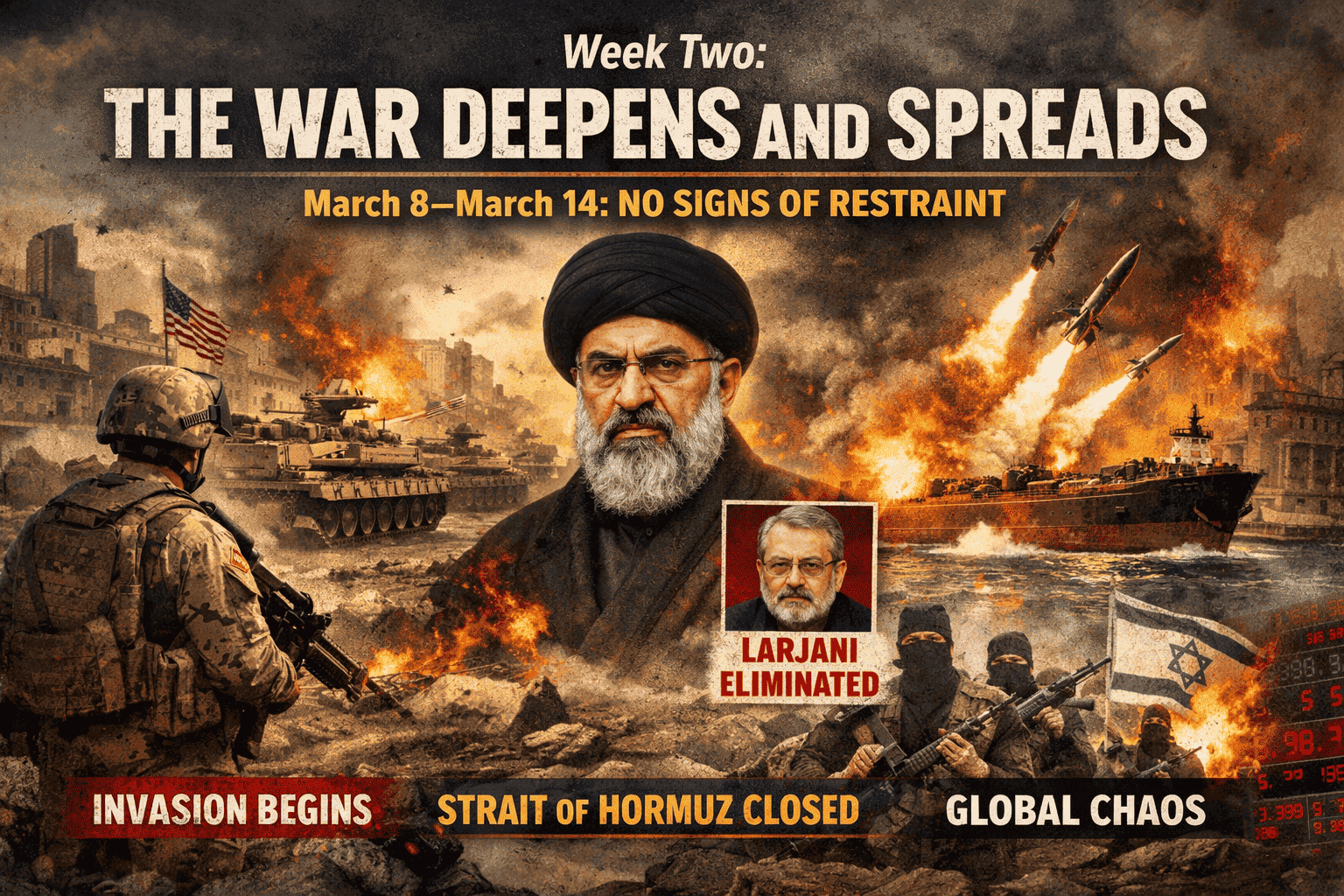
Week Two: The War Deepens and Spreads
March 8–March 14: No Signs of Restraint
By the second week, it was clear that neither side had a credible off-ramp. The United States was operating on Trump's stated four-week timetable. Iran's new leadership was determined to demonstrate that the regime had survived decapitation. The strikes continued to intensify on both sides.
The Armed Conflict Location and Event Data project, an independent conflict monitor, documented nearly 2,300 distinct events across at least 29 of Iran’s 31 provinces, with Tehran enduring the heaviest bombardments. Unlike the June 2025 strikes, which Trump said curbed Iran’s nuclear capabilities, the current conflict had spread across at least a dozen countries, closed the Strait of Hormuz, and killed more than 2,300 people across the region.
Iran’s missile strategy showed early signs of attrition. Before the current war, estimates suggested Iran possessed around 2,500 long-range ballistic missiles. Since the start of the conflict, hundreds had been launched, destroyed, or targeted in storage facilities. The number of missile attacks recorded in Israel on the third and fourth days of the war declined compared to the first two, a pattern that continued through week two.
The Elimination of Ali Larijani
Ali Larijani, a pragmatic senior official believed to have been the de facto leader of Iran after Ali Khamenei’s death and a figure instrumental in advancing the JCPOA deal with the United States in 2015, was killed on March 17.
Dismissing the impact of targeted assassinations on senior officials, Iranian Foreign Minister Abbas Araghchi said the US and Israel fail to understand the strong political structure of Iran. “We have not had anyone more important than the leader himself, and even the leader was martyred, yet the system continued its work and immediately provided a replacement,” he said.
The killing of Larijani is geopolitically significant beyond the tactical dimension. He represented the pragmatic wing of the Iranian establishment. His elimination removes one of the few senior figures who had both the credibility and the experience to broker a diplomatic exit from the current conflict. His death narrows the already constrained space for negotiation.
The Ground War Begins
A limited invasion began on March 17 amid reports that a broader ground offensive was likely. The opening of a ground front represents a qualitative escalation beyond the air campaign. The lessons of Iraq and Afghanistan have not been forgotten in the Pentagon, but the logic of military momentum carries its own weight. A full ground operation inside Iran would represent an order of magnitude increase in the complexity, duration, and cost of the conflict.
The New Supreme Leader: Mojtaba Khamenei and What His Rise Means
A Hardliner Takes the Helm
Iran’s response to the killing of its Supreme Leader did not conform to Trump’s assumptions. The Islamic Republic closed ranks at the top of the system, including by elevating Mojtaba Khamenei, a hardliner, to be the new Supreme Leader, and settled in for what it believes can be a campaign of attrition where it holds, if not a winning hand, at least not a losing one.
Mojtaba Khamenei’s election signifies the Islamic Republic projecting stability, strength, and endurance. Internally, it shows Iranians that the government continues to function while facing an existential threat to the regime. This selection also consolidates the influence of the Islamic Revolutionary Guard Corps at a watershed moment.
The IRGC connection is critical. Mojtaba has deep institutional ties to the Revolutionary Guards, the force that controls Iran’s missile programme, its proxy network, and its internal security apparatus. His elevation effectively places the IRGC, not the civilian government, in the driving seat of Iran’s war strategy.
What Araghchi’s Defiance Signals
Iran has doubled down on its rejection of ceasefire talks. Iranian Foreign Minister Abbas Araghchi stated clearly: “This war is not our war. We did not start it. The United States started it and is responsible for all the consequences of this war, human and financial, whether for Iran, for the region, or for the entire world. We are not seeking a ceasefire because we do not want this scenario to be repeated again after some time.”
That statement is not simply wartime rhetoric. It is a strategic position. Iran’s leadership calculates that a temporary ceasefire, without a binding and verifiable agreement that removes the threat of future strikes, would simply reset the clock for another round of conflict under worse conditions. From Tehran’s perspective, the choice is between fighting now or fighting later under terms even more unfavourable to the regime.
The Global Economic Fallout
The Strait of Hormuz Squeeze and What It Costs the World
A near-total halt of tanker traffic in the Strait of Hormuz has disrupted the supply of fuel and essential fertilizers, threatening global food security. The Fertilizer Institute stated that nearly 50 percent of global urea and sulfur exports, as well as 20 percent of global liquefied natural gas, a key feedstock for nitrogen fertilizers, transit through the Strait of Hormuz.
Approximately 2,000 vessels and 20,000 seafarers are now stranded in the Strait of Hormuz, creating severe logistical and humanitarian challenges. In response, France’s military chief is planning talks to help restore maritime navigation. Iran has stated it will “absolutely” continue charging countries and vessels a fee for safe passage through the strait.
Stock markets experienced sharp declines, with the Dow Jones Industrial Average falling over 400 points on March 2. Broader economic forecasts warned of inflationary pressures and slowed global growth if the conflict prolonged. The UN World Food Programme and various economic analysts have warned that the war is driving significant, long-term increases in global food prices.
The International Energy Agency described the global economy as facing a major threat from the Iran war as of March 23, 2026. Countries that depend on Gulf oil imports, particularly in South and Southeast Asia, are already facing energy price shocks that are translating directly into higher food and transport costs for ordinary households.
In a major policy reversal, the Trump administration temporarily eased some sanctions on Iranian oil to address surging global energy prices. Treasury Secretary Scott Bessent said the measure was expected to quickly add approximately 140 million barrels to global oil markets. The sanctions relief applies to Iranian oil currently loaded on ships and runs until April 19, 2026.
The Human Infrastructure at Risk
The World Health Organization has documented at least eighteen hospitals and health facilities struck since February 28. Iran’s Health Ministry reports at least 1,750 people killed and more than 18,500 injured by US and Israeli strikes on Iranian territory. According to the US-based Human Rights Activists News Agency, at least 1,455 civilians, including 217 children and 1,167 military personnel, have been killed. At least 1,094 people have been killed in Lebanon since Israeli strikes escalated there on March 2, including at least 121 children. At least 96 people have been killed across Iraq since the conflict began. At least 18 people in Israel have been killed and more than 3,700 injured by Iranian missile and drone attacks. The US military has confirmed 13 service member fatalities. Deaths from the conflict have also been reported in the UAE, Qatar, Kuwait, the occupied West Bank, Oman, Bahrain, and Saudi Arabia.
Economic impacts, both globally and for the region, will depend on the duration, intensity, and geographic scope of the tensions. Many developing countries already face high debt service burdens, limited fiscal space, and constrained access to finance. In this context, rising energy, transport, and food costs could strain public finances and increase pressure on household budgets, potentially heightening economic and social pressures well beyond the immediate conflict zone.
Week Three to Today: Diplomacy Meets Deadlock
Trump’s “Winding Down” Signal and the 15-Point Plan
As the war entered its fourth week, President Trump suggested he was looking for an off-ramp, writing on Truth Social that the US was “getting very close to meeting our objectives as we consider winding down our great military efforts.” He cited the degradation of Iran’s missile capabilities, its navy, air force, air defenses, and nuclear infrastructure as evidence of progress.
The US shared a 15-point plan with Iran via Pakistan as a framework for ending the conflict. According to regional sources, the plan includes limits on Tehran’s defense capabilities, a cessation of support for proxy forces, and an acknowledgment of Israel’s right to exist. Pakistan was selected as intermediary given its Shia minority, relatively constructive ties with Iran, and its defence relationship with Saudi Arabia.
Iran rejected the proposal outright. A senior diplomatic source told journalists that Tehran described the US plan as “extremely maximalist and unreasonable” and “not beautiful, even on paper.” Iranian Foreign Minister Abbas Araghchi acknowledged indirect messages were being exchanged through mediators but denied any formal negotiations were underway, calling Washington’s shift in tone an admission of failure after previously demanding “unconditional surrender.”
Iran’s Five Conditions
In response to the US’s 15 points, Iran’s state television outlined five conditions for ending the war: concrete assurances that hostilities will not resume, compensation for war damages, a guarantee that Iran can exercise sovereignty over the Strait of Hormuz, and the lifting of sanctions. Iran has also made clear through intermediaries that it does not wish to deal with Steve Witkoff or Jared Kushner, preferring instead to engage with Vice President JD Vance.
Military Escalation Alongside Talk of Peace
Despite diplomatic overtures, around 1,000 US soldiers with the Army’s 82nd Airborne Division are expected to deploy to the Middle East in the coming days, according to two sources familiar with the matter, suggesting the administration is keeping military options open even as talks are floated. The White House press secretary stated the administration would escalate if necessary, warning that Iran would be “hit harder than they have ever been hit before” if it failed to accept the reality of its military defeat.
US-Israeli strikes on Iran have continued unabated through March 26. Israeli strikes in Lebanon have intensified, with Lebanese officials warning that a ground invasion south of the Litani River may be imminent. Israel has ordered mass evacuations in Beirut’s southern suburbs. UN Secretary-General Antonio Guterres warned that Lebanon must not become “the next Gaza.”
The Domestic Toll on American Politics
Public dissatisfaction with the Iran war is high inside the United States. A Pew Research survey conducted March 16–22 found that 59 percent of Americans said the US made the wrong decision in using military force in Iran, compared to 38 percent who supported it. Only 25 percent said military action was going extremely or very well. A 61 percent majority disapprove of Trump’s handling of the military action. An AP-NORC poll found that 59 percent of US adults believe the military action has gone too far. A Quinnipiac University poll found registered voters opposed to the conflict 54 percent to 39 percent, with 92 percent of Democratic voters and 64 percent of independent voters opposed.
Trump has accused political opponents of trying to undermine what he called a “great military achievement” while insisting Iran is eager to make a deal. White House press secretary Karoline Leavitt confirmed Trump’s planned trip to China, delayed by the war, would now take place May 14–15, and reiterated the original four-to-six week military timeline.
The Diplomatic Impasse and Three Realistic Scenarios
Why No Ceasefire Exists on Day Twenty-Seven
For diplomacy to work, all three countries must be willing to come to the table and trust that each would adhere to any agreement. More than three weeks into the war, each country appears uninterested in attempting to find a diplomatic solution, likely influenced by each government’s perception of failed diplomatic efforts to prevent the current conflict in the first place.
The International Crisis Group and other analysts have called for a mutual halt to all attacks by the US, Israel, and Iran, including those by or against armed groups acting in concert with Tehran, the immediate priority. China’s top diplomat Wang Yi has told Iran that “talking is always better than fighting,” while French President Emmanuel Macron urged Tehran to engage in good-faith negotiations. Pakistan, Egypt, and other regional powers have offered to host negotiations. Gulf Cooperation Council countries are insisting on being represented in any peace talks, demanding guarantees for the free flow of energy and the cessation of Iranian missile threats and proxy activity.
Scenario One: Attrition Forces a Negotiated Pause
Iran’s strategic bet is that it can sustain enough pressure through missile salvos, Strait of Hormuz disruption, and proxy activity across the region to raise the economic and political cost for the United States beyond what Trump’s domestic base will tolerate. If global oil prices continue to surge and food inflation accelerates, pressure from Gulf allies and G7 partners may eventually force Washington toward a negotiated pause. The growing domestic opposition to the war - with nearly 60 percent of Americans now saying the US made the wrong decision - adds weight to this scenario. This remains the most likely short-term outcome, but it requires political will that neither side has demonstrated.
Scenario Two: Full Ground War and Prolonged Occupation
A full ground operation inside Iran would represent an order of magnitude increase in the complexity and cost of the conflict. Iran’s terrain, population of 85 million, and the institutional resilience demonstrated by the IRGC make a swift military conclusion implausible. The United States has not successfully concluded a ground war in the Middle East since 1991. The deployment of the 82nd Airborne Division and Trump’s refusal to rule out sending troops make this scenario more plausible today than it was at the start of the conflict.
Scenario Three: Internal Collapse of the Iranian Regime
Only a small fraction of the Iranian population supports the regime today. The question is at what point the playing field is leveled enough that the Iranian public can be equal to the violent resistance they face from their government. Iranians have demonstrated their courage again and again, especially in January, when thousands paid for it with their lives. But they face an organised security apparatus with a high tolerance for bloodshed.
The selection of Mojtaba Khamenei, a hardliner with deep IRGC ties, suggests the regime has chosen consolidation over reform. That choice may hold the apparatus together in the short term. Whether it survives the combination of external military pressure and internal popular dissent over a longer horizon is the defining question of 2026. White House press secretary Leavitt said it is “too soon to say” whether the Trump administration is satisfied with Iran’s new leadership, even after Trump claimed the US had “achieved regime change” in Iran.