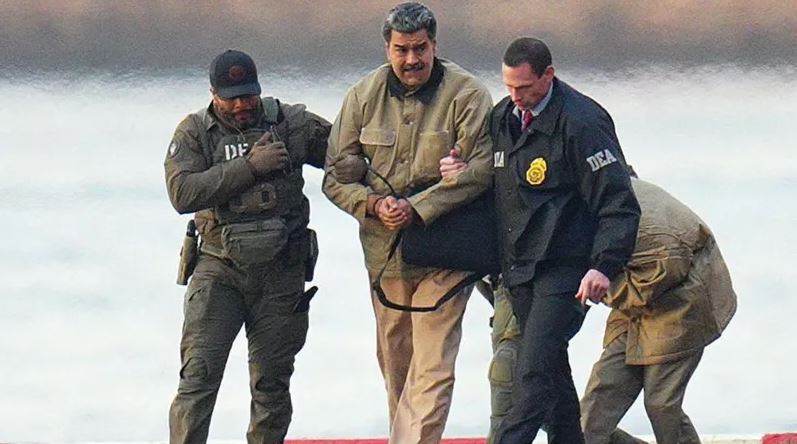
A decorated US special forces soldier who helped plan and execute the covert military operation that captured Venezuelan President Nicolas Maduro in January 2026 has been arrested and indicted on federal charges of insider trading, the Department of Justice announced Thursday. The case marks the first time in American legal history that a military service member has been prosecuted for betting on a classified government operation using prediction markets.
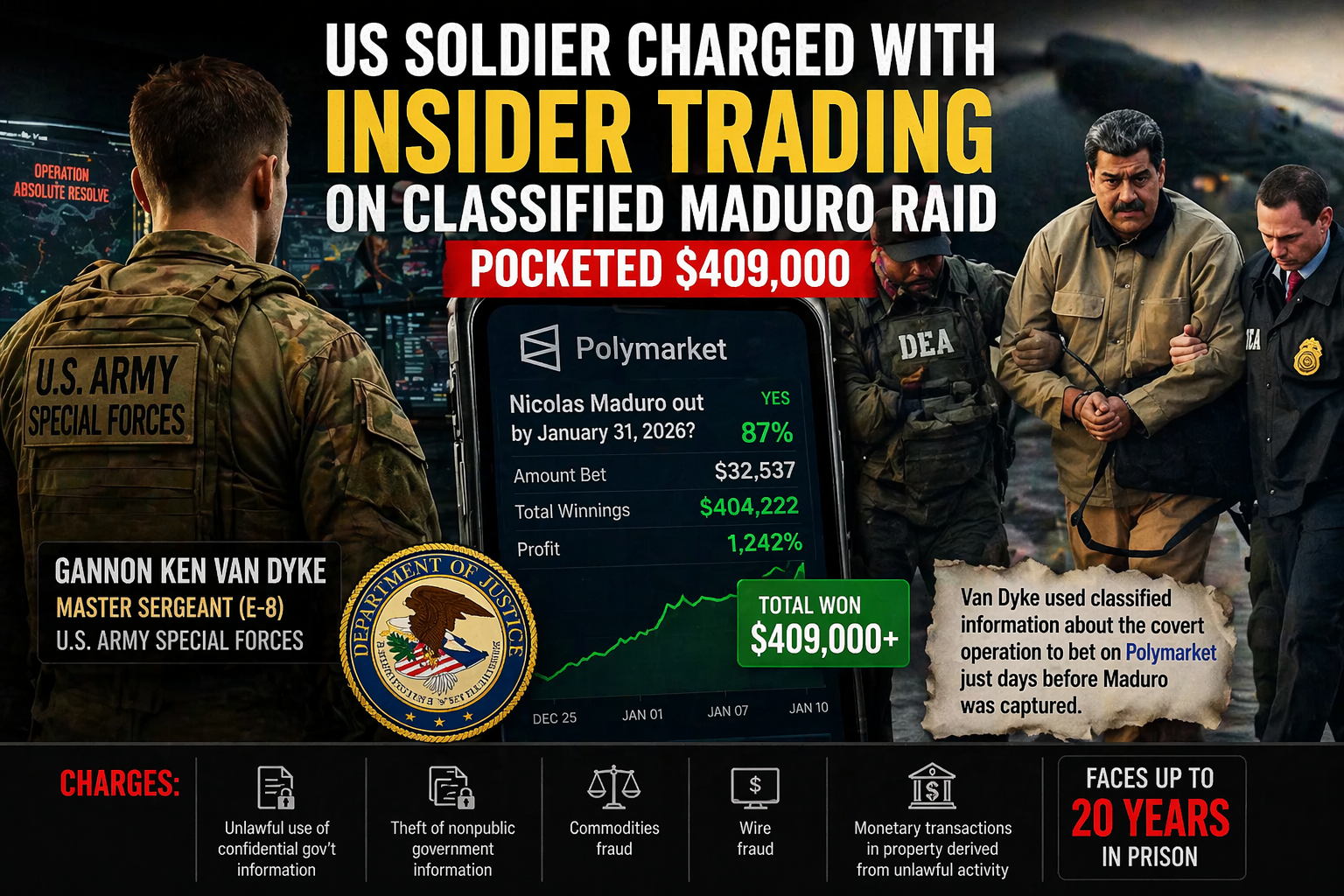
WHO IS GANNON KEN VAN DYKE
Gannon Ken Van Dyke, 38, is a US Army Special Forces master sergeant who had been stationed at Fort Bragg in Fayetteville, North Carolina, one of the most strategically sensitive military installations in the country and the home base of elite special operations forces. Van Dyke was a communications specialist supporting Joint Special Operations Command (JSOC), the secretive unit that oversees Tier 1 special mission units including Army Delta Force and Navy SEAL Team Six. He has been on active duty in the US Army since 2008.
Van Dyke was not a peripheral figure in Operation Absolute Resolve. He was involved in the planning and execution of the covert mission that extradited Maduro from the presidential palace in Caracas in an overnight capture carried out under heavy fire.
WHAT VAN DYKE IS ACCUSED OF DOING
Federal investigators say Van Dyke bet more than $33,000 on the prediction market Polymarket just days before President Donald Trump announced Maduro's capture. The indictment, unsealed in the Southern District of New York on Thursday, alleges Van Dyke created a Polymarket account in December and began trading on markets related to Maduro and Venezuela, spending more than $33,000 to place 13 bets.
Shortly before Trump's post announcing the capture, a Polymarket account holder placed a $32,537 bet on the likelihood that Maduro would be "out by January 31, 2026." Three additional bets were made via the same account: a $1,000 wager on the US invading Venezuela by January 31; a $250 wager that Trump would invoke the War Powers Act against Venezuela by January 31; and a $146 wager that US forces would land in Venezuela by the end of the month.
The series of bets netted Van Dyke more than $409,000, specifically yielding a 1,242 percent profit of $404,222 on his largest single wager.
WHO CAUGHT HIM AND HOW
The investigation unfolded quickly and from multiple directions.
Van Dyke's winnings, though anonymous, caught the attention of law enforcement almost immediately. When online sleuths and media reports drew attention to the large payouts from the Maduro trades, Van Dyke asked Polymarket to delete his account, claiming he had lost access to the email address he used to open it.
That attempt at concealment made matters significantly worse. When he saw reports about unusual trading associated with the mission, Van Dyke allegedly tried to hide the evidence of the trades by attempting to delete his Polymarket account and changing the email address registered to his cryptocurrency exchange account.
Polymarket did not stay silent. Polymarket said it referred the suspicious bets to the Department of Justice and cooperated with the investigation, stating: "Insider trading has no place on Polymarket. Today's arrest is proof the system works."
Just hours after the US government apprehended Maduro and transported him aboard the USS Iwo Jima, a photograph of Van Dyke was taken and uploaded to his Google account. The image showed Van Dyke on what appeared to be the deck of a ship at sea during sunrise, wearing US military fatigues and carrying a rifle alongside three other individuals in fatigues.
Van Dyke allegedly sent most of his proceeds to a foreign cryptocurrency vault before depositing them into a newly created online brokerage account.
WHAT CHARGES VAN DYKE FACES
Van Dyke is charged with unlawful use of confidential government information for personal gain, theft of nonpublic government information, commodities fraud, wire fraud, and engaging in a monetary transaction in property derived from specified unlawful activity. He faces a maximum possible sentence of 20 years in prison if convicted of the top criminal count, wire fraud, and up to 10 years on each of the remaining counts.
The Commodity Futures Trading Commission separately charged Van Dyke in a civil complaint for allegedly using classified nonpublic information to make the wagers related to the Maduro capture mission.
This case marks the first time the CFTC has filed charges of insider trading in connection with event contracts.
US Attorney Jay Clayton for the Southern District of New York stated: "Prediction markets are not a haven for using misappropriated confidential or classified information for personal gain. Those entrusted to safeguard our nation's secrets have a duty to protect them and not to use that information for personal financial gain."
WHY THIS CASE IS LEGALLY SIGNIFICANT
This prosecution is not just about one soldier's greed. It is a landmark test of how existing law applies to a financial instrument that barely existed a decade ago.
The arrest and indictment are believed to be the first instance of the Department of Justice prosecuting a case of insider trading on a prediction market.
Legal experts say the government has applicable tools, but the courtroom challenge will be considerable. According to Noah Solowiejczyk, a partner at law firm Fenwick and West and a former federal prosecutor in Manhattan who charged the first-ever cryptocurrency insider trading case, the Commodities Exchange Act contains a provision that specifically prohibits employees or agents of the federal government from trading on confidential government information that they learn in their official capacity. However, Solowiejczyk noted that prosecutors may need to plan for a "learning curve" for a potential jury to understand how prediction markets work, calling it a major undertaking for the government to distill and simplify what happened so jurors can understand it.
WHAT THE PREDICTION MARKET INDUSTRY NOW FACES
The Van Dyke case did not arrive in isolation. On Wednesday, Kalshi said it had suspended and fined three candidates for Congress, from Minnesota, Texas, and Virginia, for what it called political insider trading activity on their own campaigns.
In addition to the $400,000 Maduro bet, another Polymarket user made roughly $550,000 through a series of bets related to the US striking Iran and the removal of Ayatollah Ali Khamenei.
Polymarket rolled out new rules in March to clarify three core categories of prohibited insider trading conduct. They banned trades based on information that users were legally required to keep confidential, trades based on tips from someone with the same obligation, and participation by anyone in a position of authority or influence to affect the outcome of an event in any related markets.
WHAT TRUMP SAID
When asked about Van Dyke during an unrelated Oval Office event, Trump compared the situation to the Pete Rose gambling scandal, saying: "That's like Pete Rose betting on his own team. Pete Rose, they kept him out of the Hall of Fame because he bet on his own team. Now, if he bet against his team, that would be no good, but he bet on his own team."
Trump added: "The whole world, unfortunately, has become somewhat of a casino."
What Trump did not address is a pointed conflict of interest within his own family circle. His son, Donald Trump Jr., is both an investor in and an unpaid adviser to Polymarket, and a paid adviser to Kalshi, the two largest prediction markets currently operating.