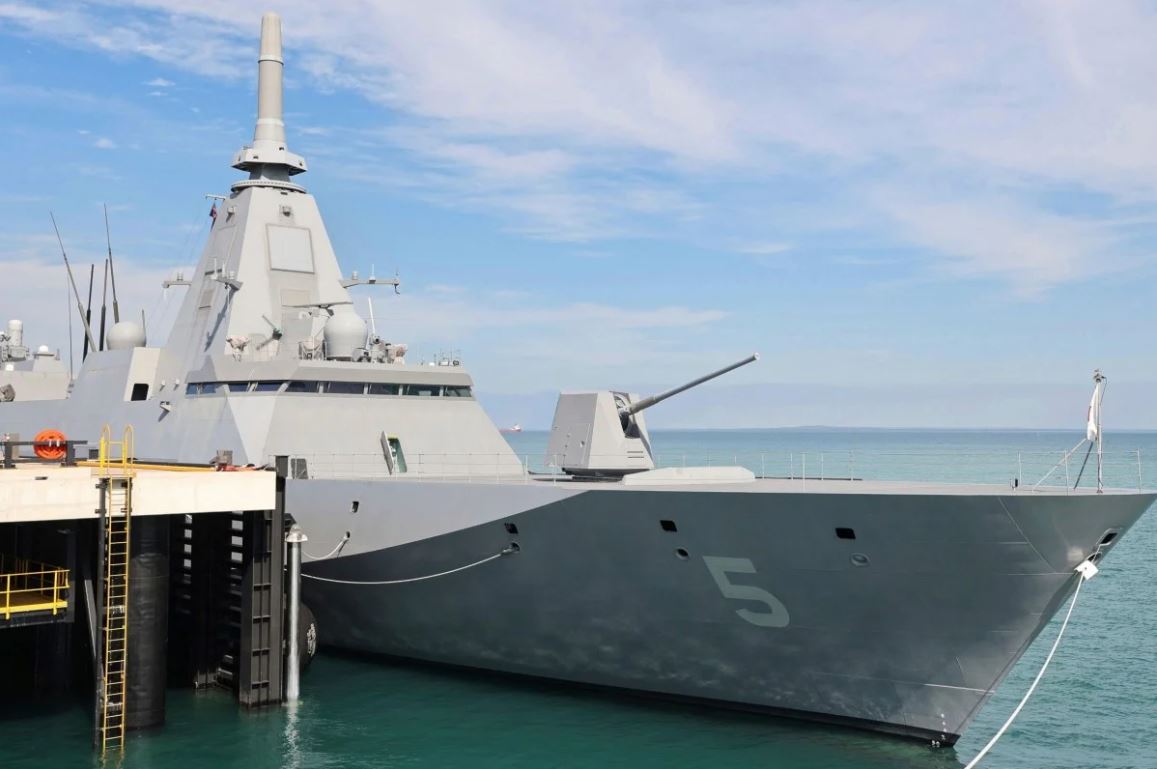
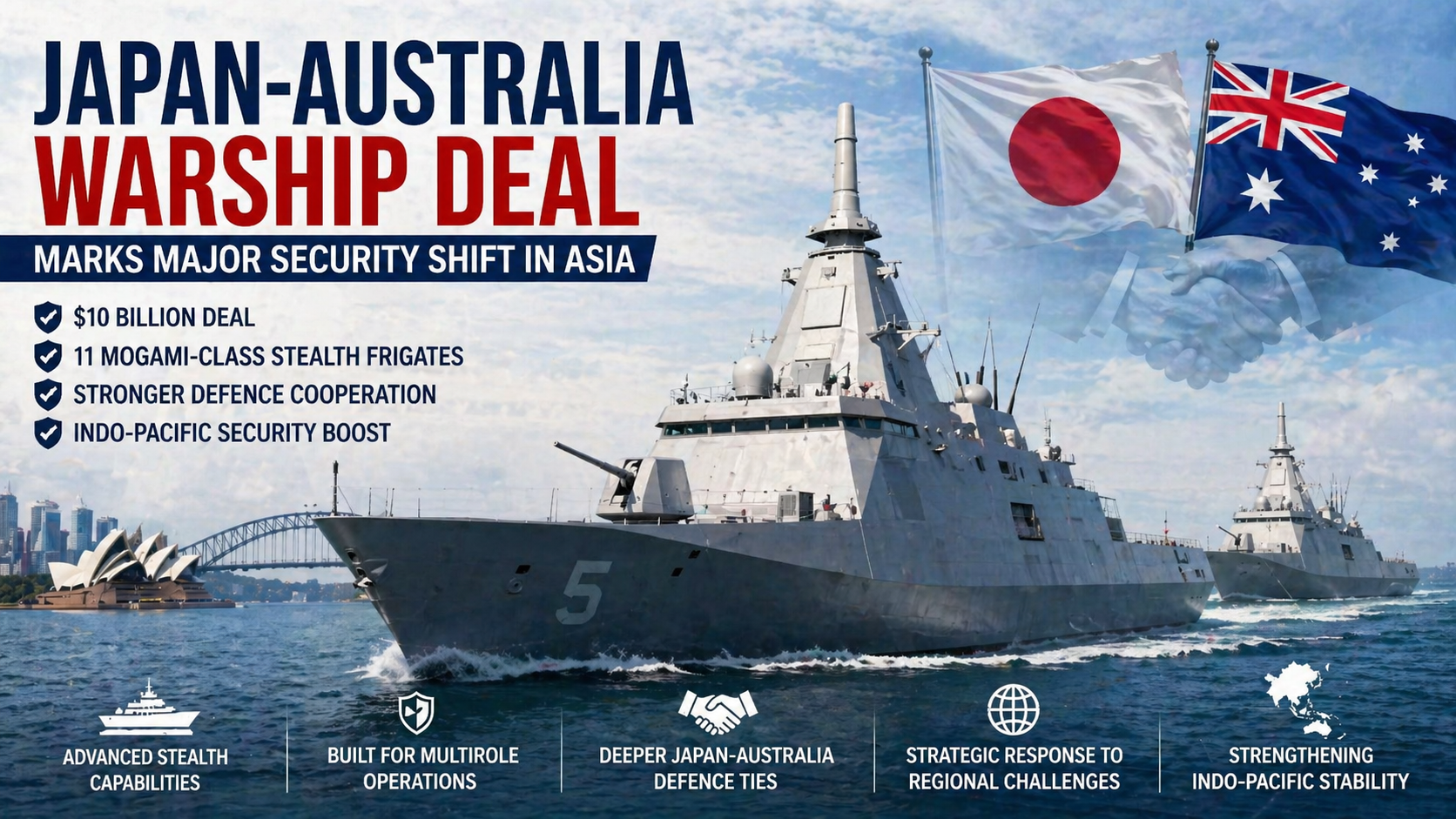
On April 18, 2026, Australia and Japan signed contracts for the first three of 11 warships to be delivered to the Australian navy under a landmark defence deal. Australian Defence Minister Richard Marles and his Japanese counterpart Shinjiro Koizumi unveiled the agreement aboard the Japan Maritime Self-Defense Force frigate JS Kumano in Melbourne. The contract, valued at up to $10 billion, calls for initial ships to be built in Japan by Mitsubishi Heavy Industries, with later vessels potentially constructed in Australia by Austal.
Japan's Mitsubishi Heavy Industries will build three of the stealth frigates in southern Nagasaki Prefecture, while Australia's Austal will build eight in Western Australia. The first of the Japanese-built warships is scheduled to be delivered in December 2029 and enter service in 2030.
This is not a routine procurement. It is a deliberate strategic realignment between two of the most consequential middle powers in the Indo-Pacific.
Why Did Australia Choose Japan Over Germany?
Australia chose MHI in 2025 to build its fleet of next-generation warships, following a bidding war between MHI and Germany's Thyssenkrupp Marine Systems to provide 11 Japanese-designed warships to replace Australia's ageing Anzac-class frigates.
The deal addresses a significant Australian capability gap. Australia's ageing Anzac-class frigates are increasingly vulnerable in an era defined by long-range precision strike, drones, and undersea competition.
Analysts said Japan's selection over the competing German bid reflects the capabilities of the Mogami-class ships. "The Japanese design has a number of advanced features including its relatively large weapons load, its advanced stealth design and the impressive performance of earlier Mogami versions on operations," said Ross Babbage, a former Australian assistant defence secretary.
From my experience studying defence procurement decisions across the Asia-Pacific over nearly two decades, capability alone rarely drives a deal of this scale. What sealed this contract was a convergence of industrial capacity, shared threat perception, and a political will in Canberra to cement a relationship that goes far beyond hardware.
What Are the Technical Capabilities of the Mogami-Class Frigate?
The 466-foot Mogami-class ships are designed for multirole operations and feature a 32-cell vertical launch system, a range of up to 10,000 nautical miles, and the ability to operate an MH-60R Seahawk helicopter.
The vessels are designed for anti-submarine warfare, surface strikes and air defence, and are intended to secure vital sea lanes and northern approaches amid China's expanding military presence in the Indo-Pacific.
The Mogami class boasts a high degree of overall automation and a low radar signature. Its upgraded versions require just 90 personnel, reflecting modern warfare capability with minimal manpower.
These are not escort vessels built for symbolic presence. They are warships engineered to contest contested waters.
What Does This Deal Mean for Japan's Defence Industry?
Japan signed a deal to sell 11 Japanese-designed stealth frigates to Australia in what is Tokyo's largest ever arms-export deal.
This trajectory accelerated after Japan's 2014 relaxation of its arms export restrictions, which allowed Tokyo to begin participating in international defence markets. The Mogami deal is a culmination of that shift: Japan is no longer just a security consumer under the U.S. alliance system, but an increasingly active provider of security capabilities.
The deal gave a major boost to Japan's still-underdeveloped defence industry after it lost out on Australia's submarine contract to a French company in 2016.
Tokyo's trajectory here is significant. For decades, Japan's pacifist constitution constrained its ability to project military-industrial power. That era is closing.
What Strategic Implications Does This Deal Carry for the Indo-Pacific?
The Mogami deal is far more than a shipbuilding contract. It is a structural shift in how two major U.S. allies are organising themselves for long-term deterrence.
Japan's 2022 National Defence Strategy identified Australia as its closest security partner second only to the United States, under the framework of the "Special Strategic Partnership." Australia's 2024 National Defence Strategy stated that Japan is an indispensable partner for achieving regional peace and prosperity.
The decision to build eight of the vessels in Western Australia is not merely about domestic jobs. It represents a deeper integration of defence industrial bases, building habits of cooperation across the full spectrum of defence activity, from the shop floor to coordinated strategy and exercises. Over time, these generate integration that extends beyond individual projects.
The construction of the Australian Mogami through Australia-Japan cooperation stands as a strong example of defence and industrial collaboration among regional partners. It will enhance Australia's naval capabilities, improve interoperability between the two countries, and deliver economic and strategic benefits to Australia, Japan, and the United States.
Australia is striving to expand its fleet of major warships from 11 to 26 over the next decade. This deal accelerates that ambition materially.
How Does China Factor Into This Security Calculus?
Beijing's reaction has been predictable and pointed. China's state media has raised concern about the implications for regional peace and stability, framing Japan's historical background as relevant context.
In their joint statement, the ministers emphasized the importance of stability in the Indo-Pacific, strongly opposing unlawful maritime claims, militarization of disputed features, and other dangerous and coercive activities in the South China Sea.
Both Australia and Japan are maritime island nations positioned to the north and south of China, sharing a common strategic interest in maintaining control of surrounding sea lanes. Their cooperation is driven less by trust than by a common fear that China could expand its economic and potentially military influence if the United States is not present to constrain it.
In a Taiwan contingency scenario, China would seek to keep Australia intimidated, distracted, and internally consumed enough to stay put. The Mogami program is, in part, a direct answer to that strategic calculus.
What Role Does the Weakening U.S. Commitment Play?
This is the dimension that most mainstream coverage underreports. Although Australia continues to bet on the United States as the central pillar of its defence posture, there is an understanding that middle powers must demonstrate the capability to contribute meaningfully to regional security. It is likely that Australia's Defence Department recognises that Washington is now unreliable; it is just unwilling to say so openly.
Zack Cooper of CSIS noted in March 2026 that the U.S. Pivot to Asia was long on rhetoric but short on action, with Washington repeatedly struggling to follow through on prioritising the region, pointing to the continued pull of Middle Eastern conflicts as evidence.
Countries like Australia are seeking to diversify their military hardware away from the United States, as this deal demonstrates.
After 17 years of watching alliance dynamics shift across the Asia-Pacific, I can say with confidence that what we are seeing is not a rupture with the U.S., but a deliberate hedging strategy. Australia and Japan are building the muscle memory of defence cooperation precisely because they cannot afford to assume Washington will always be present.
What Are the Risks and Challenges Ahead?
Three critical challenges are coming into sharper focus as the program moves from political commitment to implementation. The first is the sustainability of Australia's much-publicised "zero-change" approach. Canberra has repeatedly emphasized that adopting the Japanese design with minimal modification would be key to controlling costs and accelerating delivery.
If managed effectively, the program could become a model for Indo-Pacific defence cooperation. If not, it risks repeating a familiar pattern of cost escalation and schedule slippage, which are the very outcomes the zero-change approach was meant to avoid.
Middle powers such as Australia and Japan lack the power to unilaterally alter the global status quo and depend on the United States for security while relying on China as their largest trading partner for economic prosperity. Their coalition-building efforts are constrained by a collective action problem, as differing national interests, domestic constraints, and competing priorities undermine coordination among like-minded states.
The economics of this deal will be tested hard in the years ahead. Political will does not build frigates on schedule or on budget.
Is New Zealand or India Interested in the Mogami?
New Zealand has expressed interest in the upgraded Mogami, and the Japanese and New Zealand defence ministers have agreed to maintain close communication regarding a possible frigate deal.
Japan is reportedly open to the transfer of complete design and construction rights of the Mogami-class stealth frigate to India. If confirmed, some of the world's most advanced frontline stealth warships would be built in Indian shipyards, paving the way for a new defence and strategic tie-up between two Asian maritime powers.
If that materialises, the Mogami platform will have achieved something remarkable. It will have become the architectural backbone of an informal but highly capable Indo-Pacific maritime coalition.
What Is the "Mogami Memorandum" and Why Does It Matter?
The Mogami Memorandum pledges to deepen military ties, including through closer industrial cooperation in defence. Australia's Defence Minister Marles declared that he wanted to create a "seamless" defence industrial base with Japan, which he said would be critical to the success of the frigates program. "There is no country in the world with whom we have a greater strategic alignment than Japan. And that in turn is underpinned by complete trust," he said.
Japan's Defence Minister Koizumi said the frigates programme was "a major step that was finally being taken to elevate our defence relationship to a greater height." "This marks a new beginning for us and for our commitment to Australia," he said.
These are not ceremonial words. They carry the weight of decades of strategic calculation by two nations that understand precisely where the fault lines of Asia's next conflict are likely to run.