More than four dozen European leaders gathered in Yerevan on May 4 for the eighth summit of the European Political Community, and the headline out of Armenia was not the historic setting or the symbolic first-ever EU-Armenia bilateral summit that followed. It was a formal, coordinated recommitment by over 30 nations to dismantle the infrastructure of illegal migration across the continent, building on the framework agreed at Copenhagen last October and sharpening it with specific new priorities. The Yerevan migration statement is the clearest signal yet that European border control has moved from national political posturing to a continent-wide policy consensus.
What Is the European Political Community and Why Does It Matter on Migration?
The European Political Community is an intergovernmental forum launched in 2022 at the initiative of French President Emmanuel Macron, initially as a vehicle for continent-wide dialogue in the aftermath of Russia's invasion of Ukraine. The forum facilitates increasing cooperation between member countries on a large scale of topics including peace, security, energy, climate, and migration, and allows candidate states to participate in some European projects.
It is not a binding legislative body. It passes no laws and issues no regulations. What it does do with increasing precision is establish political consensus and shared strategy among states that often disagree sharply inside formal EU structures. On migration, that function has proven more valuable than its critics initially anticipated.
The 8th EPC summit was expected to be the largest international political event hosted by Armenia since its independence, with 48 heads of state and government from member states and partner countries expected to attend, together with invited delegates. Alongside the 8th EPC summit, three other high-level events were planned on 4 and 5 May 2026, including the inaugural EU-Armenia bilateral summit and a state visit by French President Emmanuel Macron.
Who Was at the Yerevan Summit?
Participants included French President Emmanuel Macron, British Prime Minister Keir Starmer, Italian Prime Minister Giorgia Meloni, and Ukrainian President Volodymyr Zelenskyy. They were joined by EU top officials as well as Canada's Prime Minister Mark Carney and NATO Secretary General Mark Rutte.
Canadian Prime Minister Mark Carney's participation marked the first time a non-European country had participated in an EPC meeting as a guest since the forum was created.
German Chancellor Friedrich Merz skipped the summit, citing a busy schedule. His absence was notable given Germany's recent domestic hardening on border policy, though Berlin was still a signatory to the migration statement issued from Yerevan.
The summit was co-chaired by António Costa, President of the European Council, and Nikol Pashinyan, Prime Minister of Armenia. Costa stated that the summit, held in the South Caucasus, shows that Europe's way of doing things, diplomacy, multilateralism, and respect for international law, yields results and yields peace.
The Migration Statement: What Leaders Actually Agreed To
The joint illegal migration statement issued from Yerevan on May 4 is specific in its commitments and notable for the breadth of its signatories.
The leaders of Albania, Armenia, Austria, Belgium, Bulgaria, Croatia, Cyprus, Czechia, Denmark, Estonia, Finland, France, Georgia, Germany, Greece, Ireland, Italy, Latvia, Malta, Moldova, Montenegro, the Netherlands, North Macedonia, Norway, Poland, Portugal, Romania, San Marino, Serbia, Slovakia, Sweden, Switzerland, and the United Kingdom reaffirmed their commitment to working together to tackle illegal migration.
That list is not a list of EU member states alone. It includes the UK, Norway, Switzerland, Serbia, Georgia, and others that sit outside the formal EU legal architecture. The breadth of the alignment is the point.
The statement explicitly builds on last year's Copenhagen framework. At the Copenhagen EPC summit, leaders identified several critical lines of effort in pursuit of a whole-of-route approach to tackling illegal migration. They underlined the need to take action against smugglers, ensure domestic and international frameworks are robust, accelerate returns, forge new partnerships, manage upstream migration effectively, and tackle the instrumentalisation of migration.
In Yerevan, those lines of effort were reinforced and extended into eight specific priority areas.
The Eight Pillars of the Yerevan Migration Commitment
The joint statement from Yerevan lays out a structured eight-point framework that covers the full spectrum of migration control, from intelligence-sharing to sanctions, from humanitarian intervention to border security.
Surveillance and monitoring: Leaders agreed on the importance of ensuring up-to-date information and monitoring is shared to best support preparedness and a coordinated response. In practice, this means real-time intelligence sharing between national border authorities and EU agencies such as Frontex and Europol.
Humanitarian assistance: Leaders agreed to identify opportunities for targeted interventions to help those in need and deter flows from source. The logic is upstream: addressing conditions that produce displacement reduces pressure at the border. This pillar is also the one most contested by human rights advocates who argue that aid conditionality can coerce vulnerable populations.
Working with international organisations: Leaders committed to partnering with and supporting the work of key agencies and bodies like UNHCR, the IOM, and the Council of Europe.
Security: Leaders agreed on maintaining a core focus on security, protection, and the effective integrity of both land and maritime borders.
Targeting organised immigration crime: Leaders agreed on deploying targeted interventions against people smugglers and human traffickers as well as their supply chains, including through the use of sanctions. The inclusion of sanctions as a tool against smuggling networks is new and significant. It mirrors the financial warfare approach used against sanctioned state actors and applies it directly to criminal migration enterprises.
Governance: Leaders agreed on ensuring frameworks, both domestic and international, are safeguarded from abuse, so they can meet the demands of the day and so assistance can be targeted to those in need.
Returns: Leaders agreed on ensuring robust agreements are in place to both deter migrant movements from source and transit countries and alleviate domestic pressure, including through new approaches. The returns commitment is the most politically sensitive item on the list. Forced return agreements with third countries have been legally challenged repeatedly across Europe, and new approaches suggests awareness that existing frameworks have fallen short.
A systems-wide response: Leaders agreed on using all of the above levers, policies, and diplomatic tools to coordinate international efforts and protect the integrity of European borders.

The Sudan and Horn of Africa Context: Why Timing Matters
The Yerevan statement does not exist in a political vacuum. It was issued against a specific backdrop of displacement pressure that gives it operational urgency rather than just rhetorical weight.
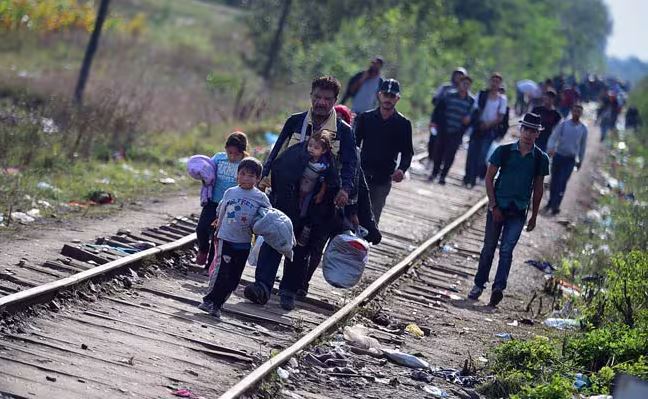
The statement acknowledges that in the face of significant displacement across Sudan, the Horn of Africa, and the wider Middle East, these priorities remain as vital as ever, and on the basis of the lessons learned from the 2015 migration crisis and to avoid a similar situation in the future, leaders agreed on how best to prepare and coordinate efforts.
The explicit reference to 2015 is deliberate political messaging. European leaders from across the ideological spectrum now treat the 2015 crisis as the definitive argument for tighter border management. The framing is no longer about whether to control migration but about how to do so before the next surge arrives rather than after.
The Broader Policy Architecture: New Pact, Digital Systems, and What Comes Next
The Yerevan commitments sit within a wider EU policy architecture that has been taking shape since the New Pact on Migration and Asylum was adopted.
Following the adoption of the New Pact on Migration and Asylum reforms, the Common European Asylum System is formally beginning its new operational life. The policy cycle officially started in October 2025 when the European Commission presented its first Annual Asylum and Migration Report. National administrations and EU systems must be implementation-ready by mid-June 2026.
The Entry/Exit System, which launched in October 2025, is being introduced step by step at external borders across participating countries. This automated system records the entries and exits of non-EU nationals traveling for short stays, replacing traditional passport stamps with digital tracking. Full implementation of the EES is expected by April 2026. The system uses fingerprint and facial recognition data to monitor travel and prevent overstays.
The European Travel Information and Authorization System will launch in late 2026. It will require visa-exempt travelers from 59 countries to obtain pre-authorization before entering participating European states.
Together, these digital border tools transform the enforcement capacity available to states implementing the Yerevan commitments. The political consensus and the technical infrastructure are arriving simultaneously.
Who Is Pushing Hardest and Where the Tensions Lie
The alignment at Yerevan should not be mistaken for uniformity. The political logic driving different signatories varies considerably, and those differences matter for how the commitments will be implemented.
The prime ministers of Denmark and the UK published an opinion piece in the Guardian calling for tighter migration controls to deny entry to those seeking better economic opportunities as opposed to fleeing conflict, arguing that the best way of fighting against the forces of hate and division is to show that mainstream, progressive politics can fix this problem.
Germany, Czechia, France, Poland, Austria, and Denmark united to demand a coordinated tightening of EU migration policies when their interior ministers met at Zugspitze in July 2025. They called for faster asylum procedures and reinforced border security, and emphasized the need to dismantle smuggling networks and accelerate migrant returns.
Under Chancellor Merz, Germany has already implemented strict new measures, empowering police to block illegal entries at land borders with narrow humanitarian exceptions, marking a sharp turn from previous policies.
Italy under Prime Minister Meloni has maintained its own bilateral agreements with North African states to reduce sea crossings, an approach that has drawn legal scrutiny but has been politically replicated by other member states. The Meloni government's presence in Yerevan as a co-signer of the joint statement signals integration of what was once a far-right-only policy position into mainstream European consensus.
The human rights dimension remains contested. The Council of Europe has resisted pressure from member states to reinterpret the European Convention on Human Rights in ways that would expand powers to detain and deport migrants. The Convention and the Court have been increasingly criticized by some member states, including Italy, Denmark, and the United Kingdom, who argue that they are too limited in how far they can go to tackle illegal migration and deport migrants who commit crimes.
What Comes After Yerevan?
Leaders agreed to continue the focus on the most pressing global migration issues and on opportunities for future cooperation, including at the next EPC Summit in Ireland.
The Ireland summit, scheduled for autumn 2026, will carry its own political weight. Dublin has historically been among the more cautious voices on border hardening within the EU, and hosting the EPC provides both an opportunity and a test of how far the consensus forged at Copenhagen and Yerevan actually holds.
The migration chapter of the Yerevan EPC summit does not resolve the underlying tension in European politics between security-first border management and rights-based asylum frameworks. What it does do is establish, with unusual clarity and breadth, that more than 30 European governments, regardless of their domestic political positioning, have agreed that illegal migration requires a coordinated, continent-wide operational response. The debate has shifted from whether to the how, and the pace of implementation is accelerating.