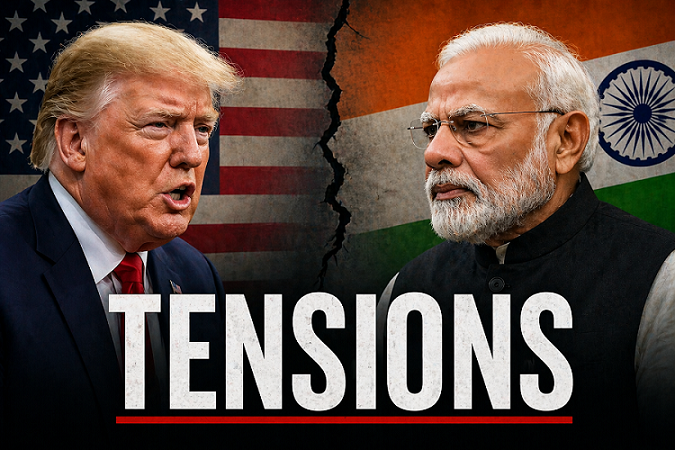
A social media repost by US President Donald Trump has triggered one of the sharpest public diplomatic exchanges between Washington and New Delhi in recent memory, forcing India's Ministry of External Affairs to issue a formal rebuke, drawing the US Embassy into damage control mode, and reigniting a domestic political debate about whether Prime Minister Narendra Modi is too deferential toward a partner who has repeatedly tested the relationship.
WHO SAID WHAT AND WHERE IT STARTED
The controversy began when Trump reposted content on Truth Social from conservative radio host Michael Savage, including both a transcript and a video clip from his Savage Nation podcast. Savage had been arguing against the Citizenship Clause, the constitutional provision that grants citizenship to most children born on US soil, including those whose parents are undocumented or temporarily residing in the country.
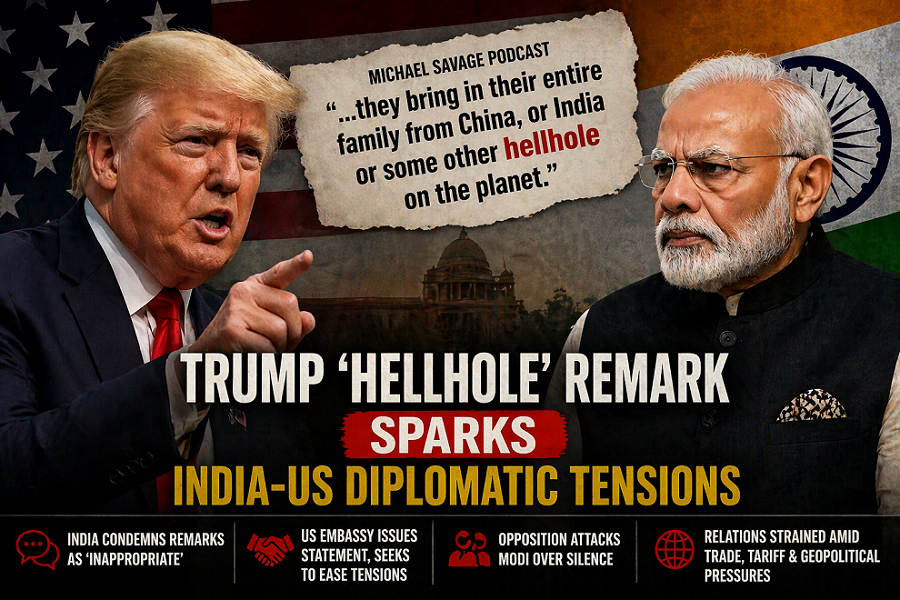
In the letter posted on social media, Savage addressed an attorney who had defended birthright citizenship, saying: "A baby here becomes an instant citizen, and then they bring in their entire family from China, or India or some other hellhole on the planet. You don't have to go too far to see that. English is not spoken here anymore.
The post went further than a single inflammatory phrase. The letter accompanying Savage's remarks described Indian and Chinese immigrants as "gangsters with laptops" who have "stepped on our flag." Trump did not add commentary to the repost. He amplified it in full and without qualification.
WHO IS MICHAEL SAVAGE AND WHY HIS WORDS CARRY WEIGHT WHEN AMPLIFIED BY TRUMP
Savage added in the same letter that unlike Asian immigrants, Europeans had integrated into US culture, a claim that drew accusations of racial hierarchy from critics across India and internationally.
The repost is not a passive act. When a sitting US president shares content on his primary social media platform, the words in that content effectively carry the weight of presidential endorsement in the eyes of foreign governments and their populations. New Delhi clearly read it that way.
WHO RESPONDED FOR INDIA AND WHAT THEY SAID
India's initial reaction was deliberately restrained. Earlier in the day, before the MEA's formal statement, Ministry of External Affairs spokesperson Randhir Jaiswal responded to questions about the controversy with: "We've seen some reports. That's where I'll leave it."
That restraint did not hold. By Thursday, New Delhi's language had sharpened considerably, signalling that the remarks had landed harder than the initial non-response suggested.
MEA spokesperson Randhir Jaiswal did not mince words in the formal statement: "We have seen the comments, as also the subsequent statement issued by the US Embassy in response. The remarks are obviously uninformed, inappropriate and in poor taste. They certainly do not reflect the reality of the India-US relationship, which has long been based on mutual respect and shared interests."
The phrase "uninformed, inappropriate and in poor taste" directed at content shared by a US president is not routine diplomatic language. It represents a deliberate escalation of tone from a government that has been careful to protect its strategic partnership with Washington even under considerable pressure.
WHO RESPONDED FOR THE UNITED STATES
Following India's formal response, the 000000 sought to ease tensions, noting that Trump has previously described India as "a great country." The Embassy did not issue an apology, did not characterize the reposted content as incorrect, and did not distance Trump from the remarks. The statement was essentially a reminder of prior positive comments rather than a repudiation of the offensive ones.
In diplomatic terms, that is a significant gap. India called the remarks uninformed and inappropriate. The American response offered context rather than correction.
WHO IS ATTACKING MODI FOR STAYING SILENT
The controversy did not stay confined to the diplomatic lane. India's domestic political opposition moved quickly to turn Trump's repost into a test of Modi's credibility as a national leader.
Maharashtra Congress leader Nana Patole launched a direct attack on the Prime Minister, saying: "First of all, I condemn Trump and his statement. Why is the Prime Minister of the country silent now? He has insulted Mother India. At such a time, why doesn't he speak up?"
The Congress party stated it would support the Prime Minister if he chose to take a firm stand against the remarks. Patole said: "We call on Narendra Modi to show Trump his place. The Congress party is completely with him, but he will not do it. This shows that the BJP, which is in power today, is tolerating the insult to Mother India."
Modi has not spoken publicly on the matter as of the time of publication. The silence has its own diplomatic logic but carries a political cost at home.
WHO IS AFFECTED BEYOND THE POLITICS
Trump's amplification of Savage's remarks is tied to an ongoing legal battle over birthright citizenship. His administration is challenging lower court rulings that blocked an executive order, signed shortly after he returned to office in January 2025, aimed at limiting automatic citizenship for children born to parents living in the US illegally or on temporary visas. Several courts have blocked the order's implementation, with at least one judge describing it as unconstitutional.
For the millions of Indian-origin individuals in the United States, many of whom are on H-1B visas or permanent resident queues, the framing of their communities as exploiters of immigration policy carries real consequences for public perception and political safety, independent of what any court ultimately decides.
WHAT THE BROADER DIPLOMATIC BACKDROP LOOKS LIKE
This episode does not arrive in a vacuum. The US-India relationship has been through considerable turbulence since Trump's return to office.
In February 2026, the Trump administration lifted the 25 percent tariffs imposed on India over its continued imports of Russian oil, ending at least temporarily a dispute that had underscored Washington's willingness to use coercive economic leverage even against close partners.
The United States and India subsequently announced a framework for an Interim Agreement on reciprocal trade, with the US lowering the reciprocal tariff on India from 25 percent to 18 percent, and India committing to eliminate or reduce tariffs on US goods, increase purchases of American energy and technology products, and address longstanding non-tariff barriers.
As tensions in the US-India relationship escalated through 2025, India intensified its diplomatic outreach to Europe. External Affairs Minister S. Jaishankar noted that among India's major relationships, its ties with Europe had "the most room to grow."
New Delhi navigated unexpected US pressure by reaching for its familiar multi-alignment playbook, stabilizing ties with China through Modi's visit to the Shanghai Cooperation Organization Summit and burnishing its Russia relationship during Putin's December visit to Delhi.
The hellhole episode lands on top of all of this: a relationship that had only recently been pulled back from a genuine low point, through painful trade concessions and careful diplomatic management on both sides, now facing a new and entirely self-inflicted test from a presidential social media post.
WHAT THIS MEANS FOR THE RELATIONSHIP GOING FORWARD
Analysts and policymakers have long argued that the US-India relationship is durable precisely because its foundations are structural, rooted in defence cooperation, technology partnerships, diaspora ties, and shared concerns about China, rather than dependent on personal rapport between leaders.
The biggest bipartisan achievement on both sides since the 2000s had been a depoliticized relationship. Because of all that has happened in recent months, this relationship has become politicized again.
A presidential repost describing India as a hellhole does not break the relationship. But it does add to a pattern of casual disregard that forces Indian policymakers to manage their domestic political flanks as much as their foreign policy calculus. That is a cost that accumulates over time, even when no single incident produces a rupture.