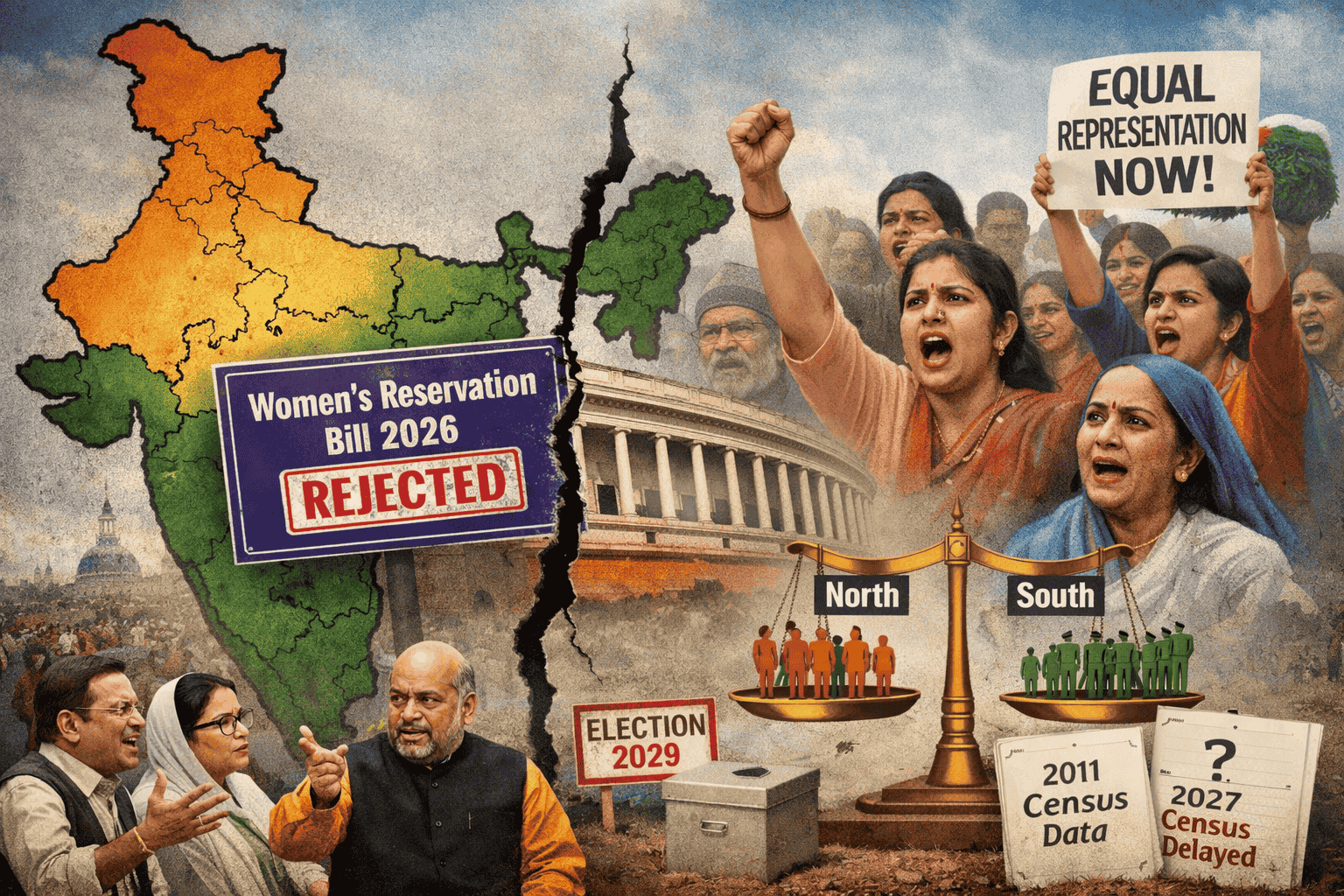
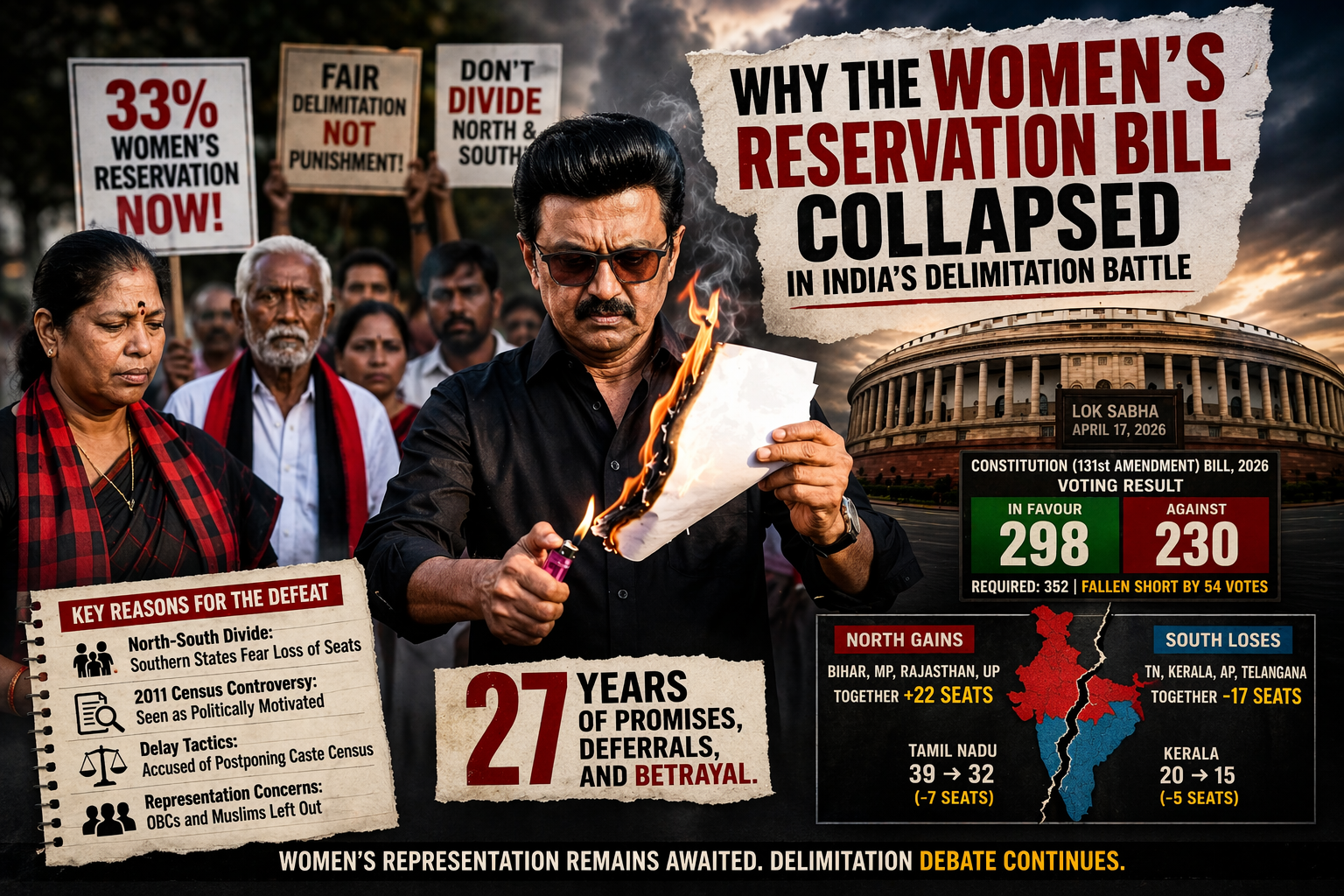
On April 17, 2026, the Constitution (131st Amendment) Bill, 2026 fell in the Lok Sabha. While 298 MPs voted in favour of the draft law that tied women's reservation to delimitation of constituencies, 230 voted against it. Being a Constitution amendment Bill, the agenda required a two-thirds majority of the 528 MPs present and voting, which meant 352 votes. The government fell more than 50 votes short. Following the defeat, Union Minister Kiren Rijiju withdrew the Delimitation Bill 2026 and the Union Territories Laws (Amendment) Bill 2026.
This was not just a legislative defeat. It was the collapse of a 27-year political promise that has been made, broken, and deferred across every government since 1996.
What Was the Bill and What Did It Propose
Three Bills were introduced in Lok Sabha on April 16, 2026: the Constitution (131st Amendment) Bill, 2026, the Union Territories Laws (Amendment) Bill, 2026, and the Delimitation Bill, 2026. These Bills sought to increase the size of Lok Sabha, enable delimitation based on the 2011 census, and enable reservation for women to be based on this delimitation.
The Constitution (131st Amendment) Bill proposed to increase the Lok Sabha's strength from 543 to 850 seats, with a maximum of 815 members representing States and up to 35 representing Union Territories.
The vote came a day after the Union Government notified the Constitution (106th Amendment) Act, 2023, bringing into force the law providing for 33% reservation for women in the Lok Sabha and State Legislative Assemblies with effect from April 16, 2026. The 2023 law had remained inoperative despite receiving Presidential assent because it required a separate notification under Section 1(2) to come into force.
The government's timing sent a clear signal: activate the original reservation law to signal good faith, then push for a new framework linking it to delimitation. That strategy was rejected comprehensively on the floor of the House.
Who Voted Against the Bill and Why
The unified INDIA bloc brought down the Bill. The opposition parties included the Indian National Congress, the Trinamool Congress, the DMK, and the Samajwadi Party. Their objections were not uniform in origin, but they converged on three specific fault lines.
The three concerns the Opposition raised around the Bill were: the Bill has been brought to delay the caste census; the Bill creates a North-South divide; and the Bill deprives OBC and Muslim communities of representation.
The North-South divide argument carried the most constitutional weight and deserves detailed examination.
The Southern States' Fear: Seats, Power, and Political Punishment
The deepest wound in this debate was not ideological. It was demographic and electoral arithmetic.
India's constituencies were last redrawn using data from the 2001 Census. The Constitution specifies that seats in Lok Sabha must be allocated to states in proportion to their population. Through the 42nd Constitutional Amendment in 1976, the total number of seats of each state in Lok Sabha was frozen based on the 1971 census. The 84th Constitutional Amendment in 2001 extended this freeze until the publication of the first census after 2026. This was done as a motivational measure to enable state governments to pursue population stabilisation.
Here is the central irony of this crisis: the southern states did exactly what the Constitution asked of them. They controlled their populations. They invested in education, healthcare, and family planning. And now, under any delimitation based on current population figures, they stand to be penalised for that success.
Based on estimates using 2011 Census numbers, four north Indian states, Bihar, Madhya Pradesh, Rajasthan, and Uttar Pradesh, would collectively gain 22 seats, while four southern states, Andhra Pradesh, Kerala, Telangana, and Tamil Nadu, would lose 17 seats.
According to the 2011 Census, Tamil Nadu would lose seven seats, from 39 to 32, and Kerala would lose five, from 20 to 15.
For states like Tamil Nadu and Kerala, this is not an abstraction about numbers. It is a direct reduction in their voice at the Centre at a time when resource allocation, central transfers, and policy influence are all tied to parliamentary strength.
Tamil Nadu Chief Minister M.K. Stalin had even made an unusual public appeal in March 2025, calling for newly-weds in his state to have more children. The context was the delimitation process scheduled for 2026, which could potentially reduce the representation of southern states in Parliament. The chief ministers of Karnataka, Kerala, and Telangana also expressed serious apprehension about any delimitation based solely on population.
Why the 2011 Census Was a Red Line
The new Bills proposed removing the time-linked freeze on delimitation, replacing it with a Parliament-triggered process. However, the constitutional principle under Article 81 that the population-to-seat ratio must be "as far as practicable, the same for all States" directly conflicts with the commitment to preserve current regional seat proportions.
Historically, any deferral of delimitation required a two-thirds constitutional majority, precisely to prevent political manipulation of electoral boundaries. The proposed framework lowers this threshold to a simple parliamentary majority, potentially giving future ruling coalitions greater leverage to time delimitation exercises to political advantage.
The opposition also pointed to the ongoing 2026-27 Census. The reference date for the ongoing census is March 1, 2027. Considering that the next Lok Sabha elections will be held in 2029, it is unlikely that a delimitation exercise based on the 2027 census will be completed before those elections. This would imply that reservation for women will not apply to the 2029 Lok Sabha election regardless.
Critics argued: if the 2027 Census data is unavailable anyway, and the government insists on using 2011 data instead, the real objective is not speeding up women's reservation. The real objective is locking in a seat distribution that favours BJP strongholds in the north.
What the BJP Argued
Home Minister Amit Shah reiterated that after the proposed delimitation, southern states would have 195 MPs instead of the 129 they have today, adding that the purpose of delimitation was to give true representation to states and honour the constitutional mandate of "one person, one vote, one value." He warned the DMK and the Congress against peddling the South-North divide narrative.
Shah said 120 Lok Sabha seats today had more than 20 lakh voters because the number of seats had been frozen at 543 on the basis of the 1971 Census, and that for 50 years, from 1976 to 2026, India did not get representation as per population.
The government's position was constitutionally grounded. Representation by population is a legitimate democratic principle. But political trust, not constitutional text, was what broke down in the House.
The 27-Year Pattern of Betrayal
The Women's Reservation Bill is the possible culmination of a legislative debate that had been ongoing for 27 years, including the lapsed Women's Reservation Bill of 2010, due to the lack of consensus among political parties.
Each time this bill has come close, a procedural or political tripwire has derailed it. In 2023, the bill was passed with historic unanimity but the reservation was defined to be implemented once a new census was published and the delimitation exercise was completed. That conditionality effectively converted a landmark law into a deferred promise.
The 2026 attempt tried to resolve that condition but chose a method, the 2011 Census and expanded Lok Sabha, that was unacceptable to large sections of the opposition and to the southern states regardless of party affiliation.