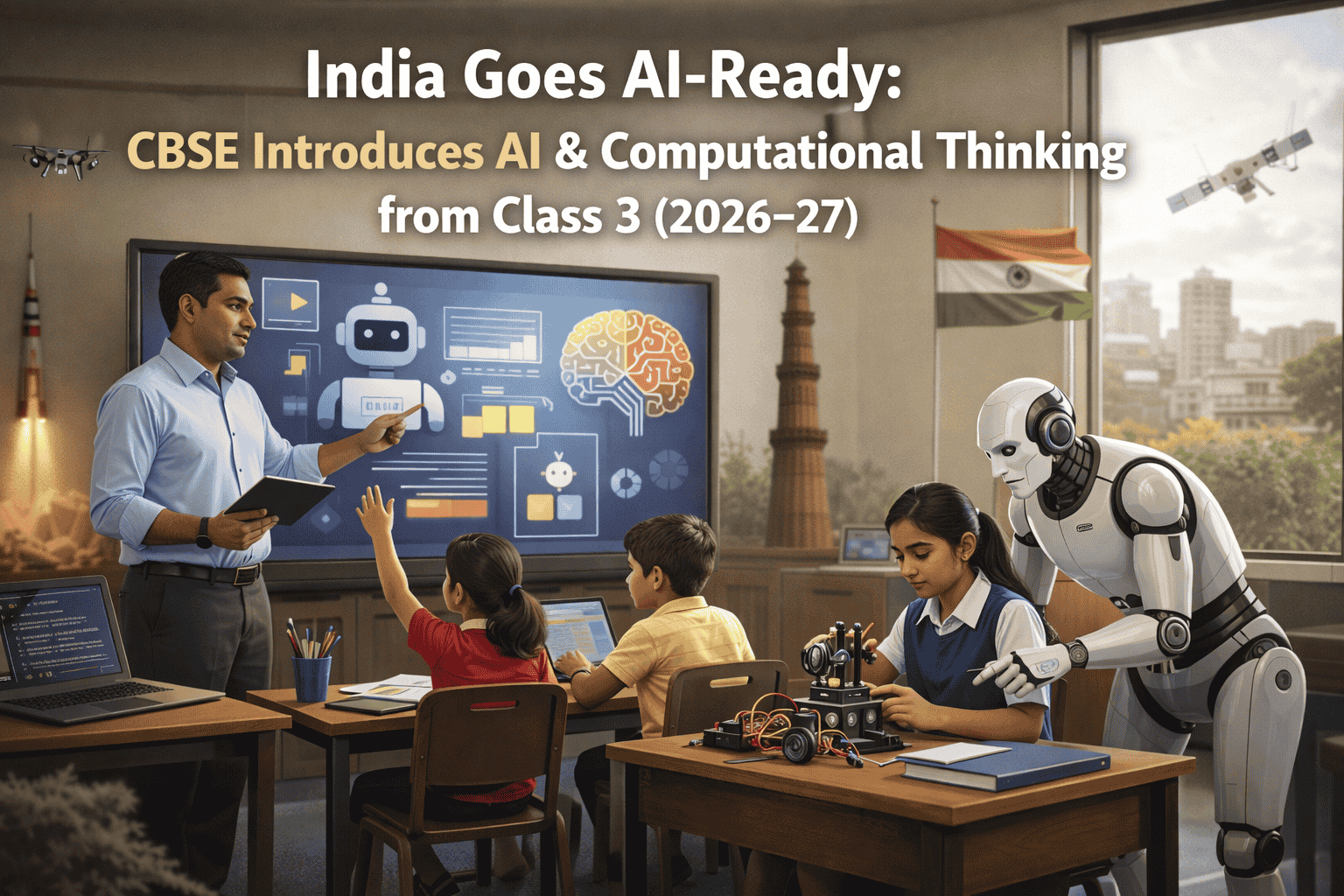
The Central Board of Secondary Education (CBSE) announced the introduction of a structured curriculum on Computational Thinking and Artificial Intelligence for students in Classes 3 to 8, beginning from the 2026–27 academic session. The initiative represents one of the world's most extensive integrations of AI education into school learning, positioning India at the forefront of educational innovation.
Union Education Minister Dharmendra Pradhan launched the curriculum at an event in New Delhi, describing the move as a structured integration of AI into school education. The board issued an official notification on April 9, declaring "Computational Thinking and Understanding AI" as the central training theme for the current academic year.
Why India Is Betting Big on Early AI Education
The AI and CT curriculum aims to make AI education a universal skill as essential as reading or numeracy. The initiative aligns with the National Education Policy 2020 and the National Curriculum Framework for School Education 2023, aiming to strengthen students' logical thinking, problem-solving abilities, and understanding of emerging technologies.
The curriculum promotes a shift from rote learning to problem-solving, creativity, and ethical technology use, fostering critical thinking, logical reasoning, and responsible innovation among students. This fundamental transformation in educational philosophy acknowledges that the jobs and challenges awaiting today's elementary school students will require fluency in technologies that barely exist today.
The initiative, themed "AI for Education, AI in Education," aims to build foundational digital and analytical skills among young learners by integrating future-ready competencies at an early stage. The curriculum was designed by a panel chaired by Karthik Raman of the Indian Institute of Technology Madras, tasked with designing age-appropriate learning modules, teaching resources, and assessment methods for students from classes 3 to 8.
How the Curriculum Works Across Different Age Groups
The CBSE has developed an age-appropriate learning progression that builds computational thinking skills gradually.
Classes 3 to 5: Foundation Through Play
For Classes 3 to 5, computational thinking will be integrated across subjects such as mathematics, languages, and environmental studies through activity-based learning, including puzzles, games, and storytelling. CT will be intertwined into existing subjects for the youngest learners and not taught as a separate discipline.
This approach allows children to develop logical sequencing through language exercises, problem-solving skills through environmental studies, and pattern recognition through ecological studies. The focus is on making computational thinking a natural approach to learning across all subjects.
Classes 6 to 8: Building AI Awareness
In Classes 6 to 8, students will be introduced to foundational AI concepts alongside computational thinking. Middle school students transition from being merely technology users to critical thinkers who understand how AI works through interactive projects and practical applications.
Students will also be introduced to practical applications of AI in everyday contexts, alongside building digital literacy, critical thinking, and responsible use of technology.
Beyond Elementary: The Roadmap Ahead
The curriculum becomes more specialized in secondary classes, with AI becoming a compulsory subject in classes 9-10, then transforming into an elective specialization in Classes 11-12, allowing students to delve into machine learning algorithms and their real-world applications.
The curriculum for classes nine and ten will be unveiled next year by the NCERT, ensuring a coordinated national approach to AI education.
Teacher Training: The Critical Success Factor
CBSE has outlined a multi-level training structure to support implementation through District-Level Workshops where schools can organize one-day offline workshops, individually or in collaboration through Sahodaya School Complexes.
Teachers will be trained to integrate CT and AI into Mathematics, Science, Social Science, and Languages, rather than treating it as a standalone subject. This interdisciplinary approach ensures that computational thinking becomes embedded in everyday teaching rather than remaining siloed as a technical subject.
The board emphasized integrating these concepts across subjects with schools organizing training activities and workshops around multiple sub-themes, including foundations of Computational Thinking and AI readiness, progressive learning approaches from basic concepts to abstraction, the role of Mathematics in AI and computational skills, and interdisciplinary application of CT across subjects.
Support material will be made available through platforms such as DIKSHA, providing accessible digital resources for teachers implementing the new curriculum.
Implementation Timeline and Resource Development
The Ministry of Education made its initial announcement on October 30, 2025, with development of learning materials, handbooks, and digital resources targeted for completion by December 2025.
The ministry released three documents comprising a curriculum, a teachers' handbook, and learning material, with content made available online on the CBSE's website.
Academic Year 2026-27 marks the implementation for Classes 3-8, with implementation for Classes 9-10 beginning in Academic Year 2027-28. Officials indicated the rollout will be phased, beginning with a strong focus on computational thinking before expanding AI learning in higher classes.
The Challenges Ahead: Infrastructure and Equity
While the curriculum represents an ambitious leap forward, implementation faces substantial hurdles. Nearly 50% of Indian schools lack basic digital infrastructure like electricity, internet, and computers, and introducing AI without bridging the digital gap could worsen educational inequalities.
The majority of teachers are not trained in AI pedagogy or ethical usage, and in some schools, one teacher handles multiple classes, making scaling such a tech-heavy subject pose serious challenges.
There are also concerns about pedagogical risks. AI tools might undermine learning motivation, as students may use chatbots to generate answers without understanding them, potentially eroding intergenerational learning and critical reasoning.
AI evolves fast, with skills like prompt engineering potentially becoming obsolete in a few years, meaning a fixed curriculum risks becoming outdated and irrelevant, leading to shallow or misaligned learning outcomes.
What This Means for India's Future Workforce
Jayant Chaudhary, Minister of State for Education, emphasized that children should not remain mere consumers of technology but emerge as responsible creators and leaders. Chaudhary added that by introducing computational thinking from an early stage, India is laying the foundation for a generation that can learn, unlearn, and re-learn continuously, navigate uncertainty with confidence, and transform disruption into opportunity.
The curriculum promotes interdisciplinary learning by linking AI concepts with mathematics, science, and the humanities, moving beyond rote learning toward critical and design thinking. This shift acknowledges that future professionals will need to integrate technical skills with domain expertise across medicine, agriculture, governance, and countless other fields.
Global Context: How India Compares
India's move to introduce AI education from Class 3 places it among the most progressive nations in early technology education. While countries like Estonia, Finland, and Singapore have integrated coding and digital literacy into primary education, India's comprehensive national framework spanning Classes 3 through 12 represents one of the most ambitious rollouts globally.
The scale of implementation, covering millions of students across diverse geographic and socioeconomic contexts, presents both unprecedented opportunities and challenges. Success will depend on sustained investment in teacher training, infrastructure development, and curriculum refinement based on real-world feedback.
Preparing Young Minds for an AI-Driven World
The transformation underway in Indian classrooms reflects a broader recognition that literacy in the 21st century extends beyond reading, writing, and arithmetic. As artificial intelligence reshapes industries from healthcare to agriculture, early exposure to computational thinking equips students with mental frameworks for understanding and shaping these changes rather than merely adapting to them.
The emphasis on ethical AI usage distinguishes this curriculum from purely technical training. Students learn to question algorithmic decisions, understand data privacy, and consider the societal implications of automated systems. These critical perspectives become increasingly vital as AI systems influence everything from college admissions to medical diagnoses.
By weaving computational concepts through traditional subjects rather than isolating them in computer labs, the curriculum acknowledges that AI literacy belongs to everyone, not just future programmers. A student analyzing weather patterns in environmental studies or exploring geometric sequences in mathematics develops the same pattern recognition and algorithmic reasoning that powers machine learning, building intuition for how these systems function.
The Road Ahead: Challenges and Opportunities
Implementation success hinges on addressing the digital divide that separates urban schools with robust infrastructure from rural institutions struggling with basic connectivity. The phased approach, beginning with unplugged computational thinking activities before advancing to technology-dependent lessons, offers a pragmatic pathway for schools at different resource levels.
Teacher capacity building emerges as the most critical factor. Educators must not only master new content but also reimagine their pedagogical approaches, facilitating discovery rather than delivering information, and embracing interdisciplinary connections rather than maintaining subject boundaries. The district-level workshops and digital resources provide starting points, but sustained support through mentoring networks and ongoing professional development will determine whether the vision translates into classroom reality.
The curriculum's flexibility to evolve with technological change represents both strength and challenge. While avoiding rigid specifications that quickly become obsolete, this adaptability requires continuous oversight, feedback collection from implementing schools, and willingness to revise materials based on emerging best practices and technological developments.