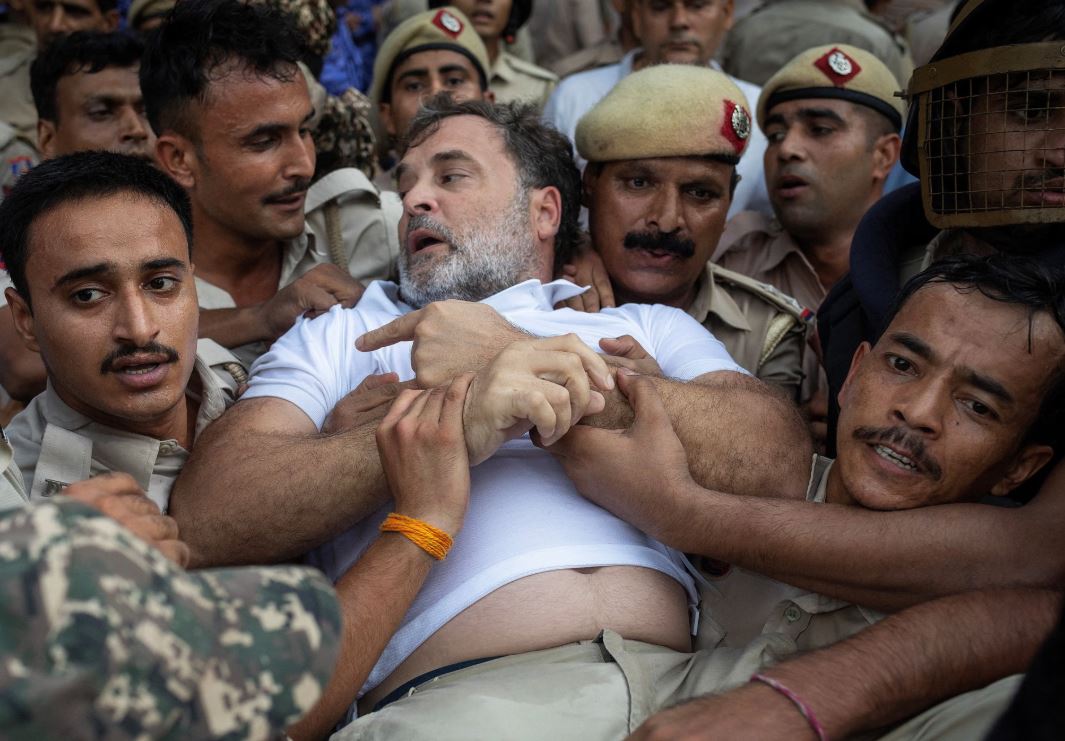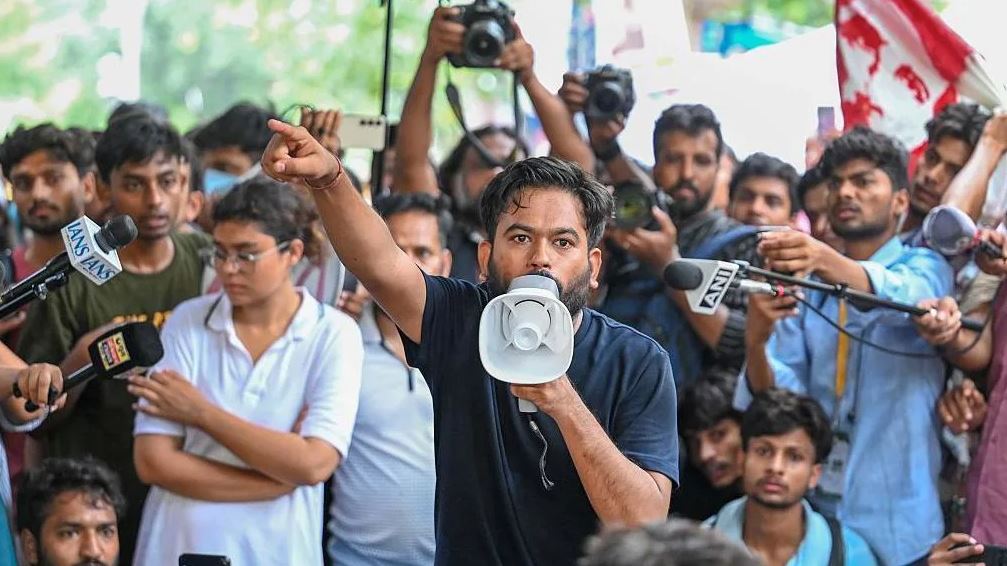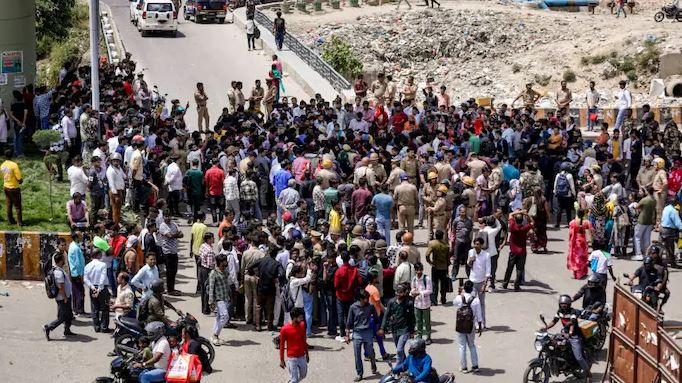
Thousands of factory workers in Noida have staged massive protests demanding higher minimum wages, bringing traffic to a standstill across critical industrial corridors and exposing the widening wage disparity between neighbouring states. The unrest, triggered by Haryana's recent 35 percent wage hike, underscores growing tensions in India's manufacturing heartland as workers push back against what they perceive as inadequate compensation amid rising living costs.

Noida's industrial zones erupted in protest over the weekend as thousands of factory workers blockaded key routes in Kulesara, Sector 82, Phase 2, and the Bhangel Elevated Road, demanding immediate wage revisions. The demonstrations have severely disrupted traffic movement between Greater Noida, Noida, and Delhi, leaving commuters stranded in hours-long jams across critical arterial roads. Despite interventions by the Labour Commissioner and local police, workers remain firm in their stance, refusing to call off the agitation until their demands are fully met.

The Haryana Wage Catalyst

The trigger for this labour unrest lies just across the state border. Haryana announced a 35 percent increase in minimum wages for unskilled, semi-skilled, and skilled workers, effective from April 1, 2026. This substantial revision has intensified wage-related expectations among workers in neighbouring industrial areas, particularly in Noida and Greater Noida, which compete with Haryana's Gurugram and Manesar for manufacturing investments.

The mathematics of the wage gap tells a compelling story. Following the July 2025 revision, Haryana's minimum wage for unskilled labour stands at 11,274.60 rupees per month, with further increases expected from the April 2026 hike. In contrast, Uttar Pradesh's minimum wages for unskilled workers in scheduled employment, effective from April 2026, stand at 11,313.65 rupees monthly for general employment and 13,224 rupees for certain categories. However, the perception among workers is that Haryana's proactive 35 percent increase demonstrates a commitment to worker welfare that Uttar Pradesh has not matched.

Beyond Basic Wages: The Full Spectrum of Demands

While minimum wage parity forms the core demand, workers are pushing for a comprehensive package of reforms. The protest has coalesced around four primary demands that reflect broader concerns about working conditions in Noida's industrial ecosystem.

Double overtime pay stands as a critical demand. Workers argue that the current overtime compensation structure fails to adequately compensate for extended working hours that have become routine in manufacturing facilities. In an economy where production targets increasingly require workers to exceed standard shifts, the call for enhanced overtime rates addresses both financial compensation and work-life balance concerns.

Improved safety standards represent another urgent priority. Industrial accidents, inadequate protective equipment, and insufficient safety training have created hazardous working environments in several facilities. Workers are demanding rigorous enforcement of existing safety regulations, regular safety audits, and penalties for establishments that fail to maintain prescribed standards.

Strict action against workplace harassment rounds out the demands. This encompasses both physical harassment and verbal abuse, issues that disproportionately affect women workers in manufacturing facilities. The demand reflects growing awareness of workplace rights and a refusal to accept harassment as an unavoidable aspect of industrial employment.

The Broader Context: India's Labour Code Transformation

The Noida protests unfold against the backdrop of India's most sweeping labour law overhaul in decades. In November 2025, the government implemented four new labour codes, consolidating 29 older laws in an ambitious attempt to modernize India's work regulations, some dating to British colonial rule.

The codes introduce several significant changes. They define gig and platform work for the first time, expanding legal and social protection to workers outside traditional employment structures. The rules allow longer factory shifts and night work for women, while raising the threshold for firms requiring prior approval for layoffs from 100 to 300 workers, giving companies greater flexibility in workforce management.

However, ten large Indian trade unions condemned the rollout as a deceptive fraud against workers. The unions, aligned with parties opposing Prime Minister Narendra Modi, have planned nationwide protests. The Centre of Indian Trade Unions organized protest marches in several cities, where hundreds of workers gathered and burnt copies of the new labour codes.

Critics argue that while the new rules offer social security and minimum-wage benefits, they also allow companies to hire and fire workers more easily. The Association of Indian Entrepreneurs expressed concern that the new rules would significantly increase operating costs for small and midsize enterprises and disrupt business continuity across key sectors.

The Minimum Wage Structure in Uttar Pradesh

Understanding the protest requires examining Uttar Pradesh's minimum wage framework. The state updates minimum wages twice annually, typically in April and October, covering 74 scheduled employments ranging from shops and commercial establishments to brick kilns, plastic factories, textile units, IT services, and healthcare.

A separate notification applies to engineering factories employing 50 or more workers, with its own Variable Dearness Allowance structure and base calculation. For April 2026, unskilled workers in general scheduled employment receive 11,313.65 rupees monthly, comprising a basic wage of 5,750 rupees plus VDA of 5,563.65 rupees. Engineering factory workers receive higher wages, with unskilled workers earning approximately 13,224 rupees monthly, reflecting the more hazardous and technically demanding nature of factory work.

The wage structure differentiates between skill categories. Semi-skilled workers receive 12,445 rupees monthly in general employment, while skilled workers earn 13,940.37 rupees. Daily wages cannot be less than one-twenty-sixth of the monthly rate, and hourly wages cannot be less than one-sixth of the daily rate. Overtime work must be compensated at double the ordinary hourly rate.

The Interstate Competition Dynamic

The wage protests expose fundamental tensions in India's federal labour framework. States compete aggressively for manufacturing investments, often positioning themselves as business-friendly destinations with competitive labour costs. However, this competition creates a race to the bottom that disadvantages workers.

Haryana's decision to implement a 35 percent wage increase disrupts this equilibrium. The move came after protests in Manesar, where auto industry workers demanded higher compensation amid rising costs linked to global supply chain disruptions and economic pressures. Labour Minister Anil Vij announced that the state cabinet approved the proposal for a 35 percent increase in minimum wages for unskilled, semi-skilled, and skilled workers, with the revised wages taking effect from April 1, 2026.

This creates immediate pressure on neighbouring Uttar Pradesh. Industrial workers in Noida can easily compare wages across the border. The geographic proximity of Gurugram and Noida means workers often have family members or acquaintances employed in both states, making wage differentials immediately apparent and personally relevant.

ChatGPT Image Apr 13, 2026, 12_15_36 PM (1).png
Workers flood the streets in Noida, demanding fair wages and better conditions as protests bring traffic to a halt

Economic Implications for Manufacturers

The protests present manufacturers with a complex calculus. On one hand, higher wages increase operational costs at a time when many companies face margin pressure from global competition, supply chain disruptions, and economic uncertainty. A garment manufacturing unit in Noida with 120 unskilled workers, for instance, would face monthly shortfalls of 33,120 rupees if wage revisions add 276 rupees per worker, totalling nearly one lakh rupees in arrears over three months.

On the other hand, inadequate wages create their own costs. High turnover rates, training expenses, reduced productivity from demotivated workers, and the disruption from labour protests all impact the bottom line. Companies like Samsung Electronics have experienced the financial impact directly, claiming losses of around 100 million dollars during a 38-day strike at their southern Indian manufacturing facility where workers demanded wage hikes and the right to unionize.

India's manufacturing sector contributes less than one-fifth to the country's nearly four trillion dollar economy. Businesses have long criticized India's work rules as a drag on manufacturing growth. The new labour codes attempt to address these concerns while maintaining worker protections, but achieving this balance remains contentious.

The Compliance Challenge

For employers, navigating minimum wage compliance has become increasingly complex. Uttar Pradesh issues minimum wage revisions under two distinct frameworks, with different VDA structures and base calculations. The All India Consumer Price Index average determines the Variable Dearness Allowance component, which changes with each revision.

A factory owner in Kanpur paying unskilled workers 11,021 rupees per month through February 2026 under the October 2025 notification would face a sudden jump to 13,224 rupees per month from March 2026, representing an increase of 2,203 rupees per worker. With 45 unskilled workers, this translates to a total additional monthly outflow of 99,135 rupees. Many employers discover compliance gaps not through official notifications but through compliance audits conducted before factory inspections.

Incorrect classification of workers compounds the challenge. Placing a skilled worker in the unskilled category and paying the lower rate constitutes underpayment under the Act, treated as a violation rather than an administrative error. The penalties for non-compliance include prosecution, fines, and potential imprisonment for repeat offenders.

The Path Forward

The Noida protests have reached a stalemate. Workers remain adamant about their demands, while authorities struggle to find a resolution that satisfies labour concerns without creating precedents that could ripple across other industrial areas. The Labour Commissioner's proposals have been rejected, indicating that workers perceive offered compromises as insufficient.

Several potential pathways exist. The Uttar Pradesh government could announce an extraordinary wage revision outside the normal April and October cycle, demonstrating responsiveness to worker concerns. This would require political will to allocate resources and accept potential criticism from industry associations.

Alternatively, a negotiated settlement could offer phased wage increases, enhanced safety measures, and strengthened harassment prevention mechanisms without immediate across-the-board wage hikes. This compromise approach would address worker concerns while giving employers time to adjust.

The protests also highlight the need for better mechanisms to harmonize minimum wages across states competing for similar industries. A framework that prevents destructive wage competition while allowing regional variation based on living costs could reduce the likelihood of such protests.