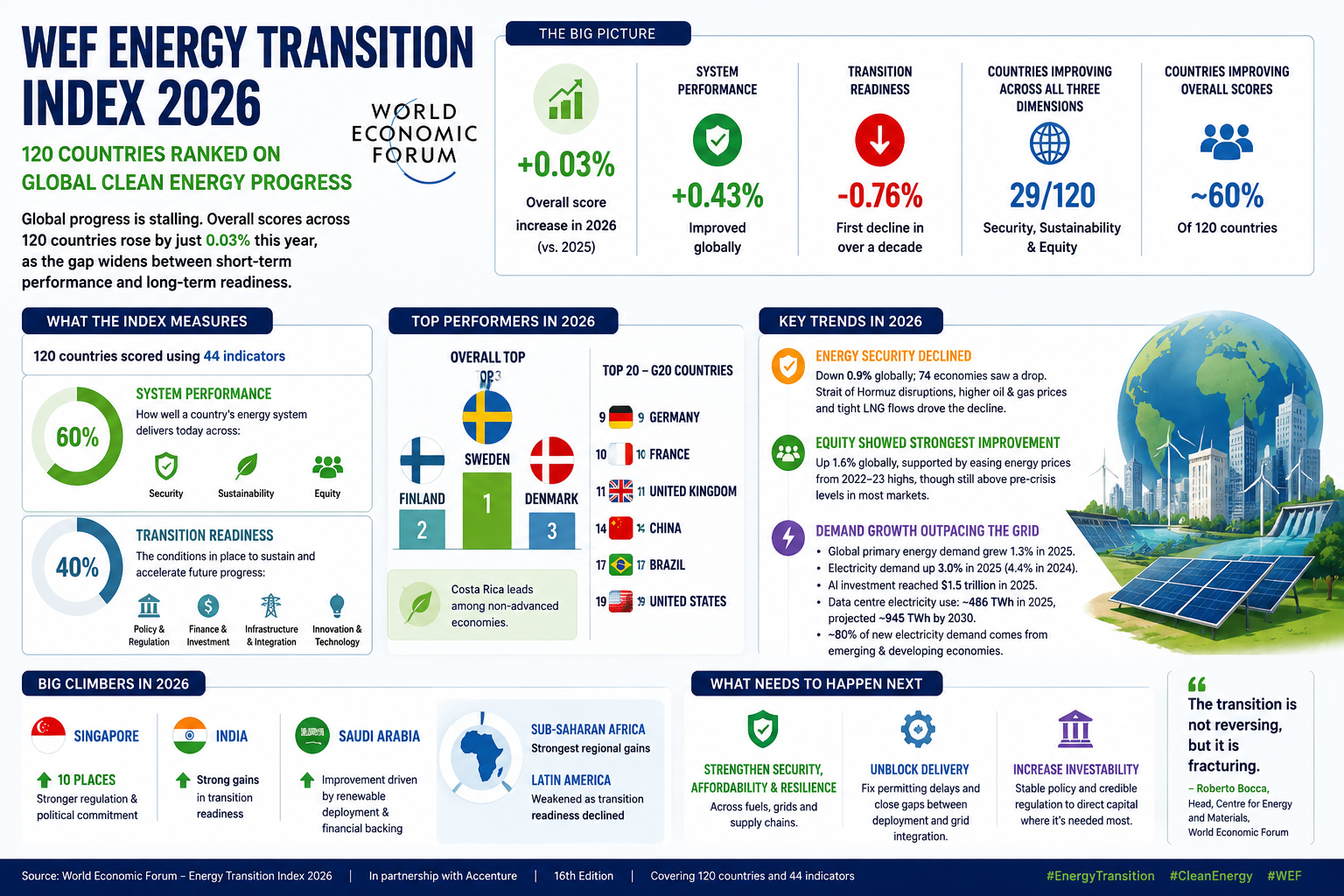
Sweden, Finland and Denmark hold the top three spots in the World Economic Forum's Energy Transition Index 2026, but the headline ranking hides a harder truth. Global energy transition progress has nearly stalled, with overall scores across 120 countries rising by just 0.03 percent this year.
I have spent a decade reading through data-heavy policy reports, and this one stands out for what it does not celebrate. Record investment did not translate into record progress.
What the 2026 Index Actually Measures
The Energy Transition Index, now in its sixteenth year, is built by the World Economic Forum with Accenture. It scores 120 countries across 44 indicators, split into two parts:
- System performance (60% weight): how well a country's energy system delivers today, across security, sustainability and equity.
- Transition readiness (40% weight): whether the policy, finance, infrastructure and innovation conditions exist to keep improving.
That split matters. A country can look strong today while quietly losing the conditions that sustain future progress, and that is exactly what happened in 2026.
The Core Finding: A Widening Gap
System performance improved by 0.43 percent globally. Transition readiness fell by 0.76 percent, the first decline in this measure in over a decade. The gap between short-term delivery and long-term preparedness is now the defining story of the Index.
Only 29 of 120 countries improved across all three system performance dimensions, security, sustainability and equity, at the same time. Around 60 percent of countries improved their overall scores, but balanced progress across every dimension is becoming rare.
Energy Security Took the Biggest Hit
Security was the only system performance dimension to decline this year, falling 0.9 percent globally, with 74 economies recording a drop. Disruption to shipping through the Strait of Hormuz, which typically carries roughly a quarter of the world's seaborne oil trade, drove much of that decline in early 2026. Brent crude prices rose, LNG flows tightened and European gas prices spiked as a result.
Equity Improved, But Not Evenly
Equity was the strongest-moving dimension, up 1.6 percent, helped by energy prices partially easing from their 2022 to 2023 peak. But prices remain above pre-crisis levels in most markets, and the 2026 Middle East conflict's price effects are not yet fully reflected in this year's scores.
Who Is Winning, and Who Is Falling Behind
Nordic and advanced European economies continue to dominate the top of the rankings. Iceland, Sweden, Finland, Norway, France and Switzerland post the strongest clean energy performance overall, while Costa Rica leads among non-advanced economies.
Among the G20, six countries made the top 20:
- Germany (9th).
- France (10th).
- United Kingdom (11th).
- China (14th).
- Brazil (17th).
- United States (19th).
Singapore was one of the biggest climbers, rising 10 places on the back of new regulation and stronger political commitment. India recorded one of the strongest gains in transition readiness of any major economy, and Saudi Arabia posted notable improvement driven by renewable deployment and financial backing. Sub-Saharan Africa recorded the strongest regional gains, while Latin America weakened as transition readiness declined.
Demand Growth Is Outpacing the Grid
A quieter but significant thread in the 2026 report is demand. Global primary energy demand grew 1.3 percent in 2025, slower than 2024's 2.2 percent. Electricity demand grew far faster, up 3.0 percent in 2025 after a 4.4 percent jump in 2024, driven by electrification, cooling, data infrastructure and artificial intelligence.
Global AI investment reached 1.5 trillion dollars in 2025. Data centre electricity use hit roughly 486 terawatt-hours and is projected to approach 945 terawatt-hours by 2030. Around 80 percent of new electricity demand is coming from emerging and developing economies, even as advanced economies also see rising load from EVs, heat pumps and data centres.
Why This Report Matters Beyond the Rankings
The Index's authors point to three priorities for the next phase of the transition:
- Strengthening security, affordability and resilience across fuels, grids and supply chains.
- Unblocking delivery by fixing permitting delays and closing gaps between deployment and grid integration.
- Increasing investability through stable policy and credible regulation to direct capital where it is needed most.
As Roberto Bocca, Head of the Centre for Energy and Materials at the World Economic Forum, put it, the transition is not reversing, but it is fracturing.