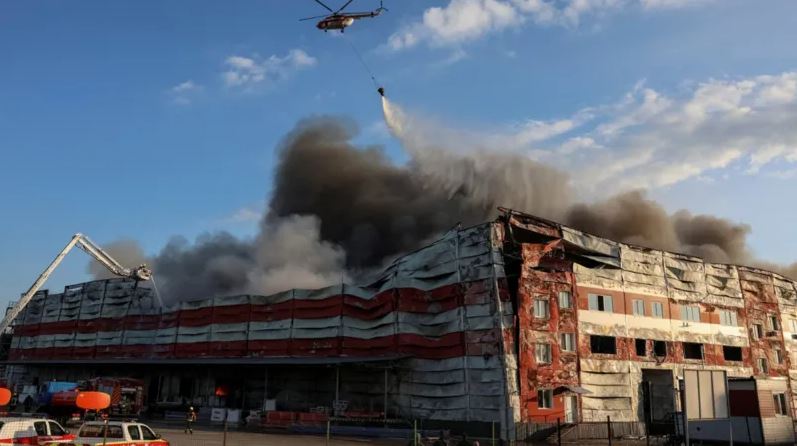
Four years after Russia launched its full-scale invasion of Ukraine on February 24, 2022, the war has settled into a grinding pattern few predicted at the outset. The front line barely moves month to month, yet losses on both sides keep climbing. Below is a clear breakdown of where things stand as of mid-2026.
How the War Has Evolved: A Short Timeline
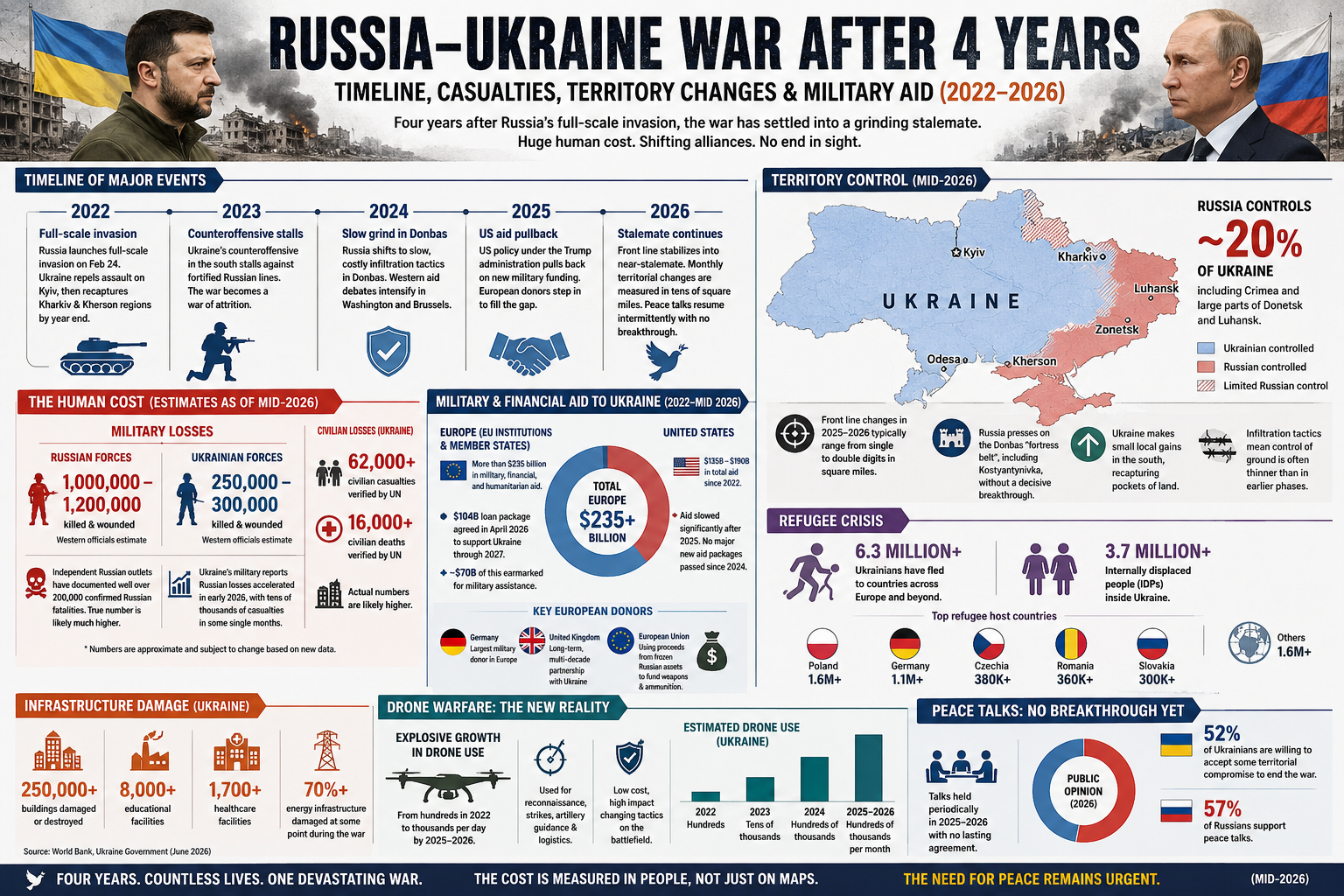
- 2022: Full-scale invasion begins. Ukraine repels the assault on Kyiv, then recaptures Kharkiv and Kherson regions by year end.
- 2023: Ukraine's counteroffensive in the south stalls against fortified Russian lines. The war becomes a war of attrition.
- 2024: Russia shifts to slow, costly infiltration tactics in Donbas. Western aid debates intensify in Washington and Brussels.
- 2025: US policy under the Trump administration pulls back on new military funding. European donors step in to fill the gap.
- 2026: The front line stabilizes into near-stalemate, with monthly territorial changes measured in tens of square miles rather than hundreds. Peace talks resume intermittently but produce no breakthrough.
Casualties: The Human Cost After Four Years
Exact figures remain contested, since neither government publishes full totals and outside estimates vary. Still, a consistent picture has formed from Western intelligence assessments, Ukrainian military statements, and independent trackers.
Military losses
- Western officials estimated Russian military casualties (killed and wounded) at roughly 1,000,000 to 1,200,000 by early 2026.
- Ukrainian military casualties are estimated at 250,000 to 300,000, according to the same category of Western sources.
- Independent Russian outlets tracking named battlefield deaths have documented well over 200,000 confirmed Russian fatalities, with analysts suggesting the true death toll is considerably higher once unconfirmed losses are included.
- Ukraine's military leadership has reported that Russian losses accelerated sharply in early 2026, with tens of thousands of casualties recorded in some single months.
Civilian losses
- The UN Human Rights office had verified more than 62,000 civilian casualties in Ukraine by mid-2026, including over 16,000 deaths, while cautioning that the real number is likely higher.
- Civilian deaths have continued at a steady, lower pace compared with the war's opening months, driven largely by drone and missile strikes on cities and energy infrastructure.
Territory Changes: A Frozen Front Line
Russia currently controls close to 20 percent of Ukrainian territory, including Crimea and large parts of Donetsk and Luhansk. That share has barely shifted since 2023.
- Monthly territorial swings in 2025 and 2026 have typically ranged from single digits to double digits in square miles, a fraction of the ground contested during the war's first two years.
- Russian forces have concentrated pressure on the Donbas "fortress belt," including the city of Kostyantynivka, without securing a decisive breakthrough.
- Ukrainian forces have posted occasional local gains in the south, recapturing small pockets of land even as Russia advances elsewhere.
- Analysts at the Institute for the Study of War (ISW) note that current infiltration-based tactics make raw square-mileage comparisons with earlier war phases misleading, since control over newly contested ground is often thinner than in previously seized territory.
In short, the map looks far more static than the casualty figures would suggest, a hallmark of trench-style attritional warfare.
Military and Financial Aid: A Shifting Burden
The balance of support for Ukraine has changed dramatically since the war began.
- Europe has now overtaken the United States as Ukraine's largest backer, having allocated more than $235 billion in combined military, financial, and humanitarian aid since 2022, compared with roughly $135 billion to $190 billion from Washington over the same period.
- US aid slowed markedly after the Trump administration returned to office in 2025, with no new large-scale aid legislation passed since 2024.
- The EU agreed to an additional $104 billion loan package in April 2026 to cover Ukraine's needs through 2027, with close to $70 billion earmarked for military assistance.
- Germany has emerged as the leading individual European military donor, while the UK has committed to a long-term, multi-decade partnership with Kyiv.
- European donors have also begun using proceeds from immobilized Russian state assets to fund ammunition production and direct military support.
Where the War Stands Now
Public opinion in both countries has shifted toward openness to negotiation. Polling in 2026 has shown a majority in Russia favoring peace talks and a majority in Ukraine willing to accept some territorial compromise to end the fighting. Neither side, however, has agreed on terms that both governments and their populations can accept, and periodic ceasefire proposals have repeatedly collapsed over disputes about troop withdrawals and territorial recognition.