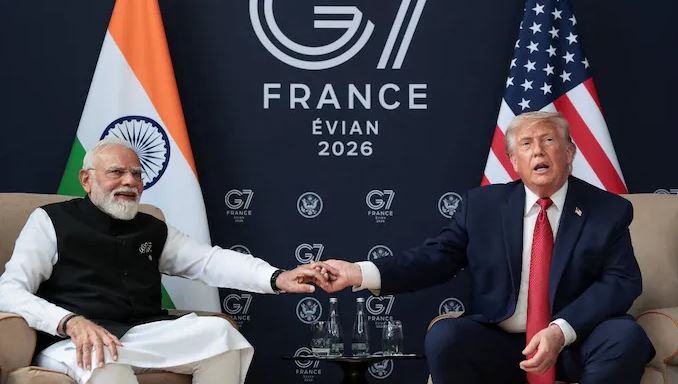
President Donald Trump and Prime Minister Narendra Modi met on the sidelines of the G7 Summit in Evian-les-Bains, France, on Wednesday, their first in-person conversation in more than sixteen months. Trade tariffs, a deadly strike near the Strait of Hormuz and the unfinished bilateral trade agreement all sat on the table.
What emerged was a calculated reset. Trump praised Modi as a tough but trustworthy partner, while Modi raised the safety of Indian seafarers directly with the president who ordered the military action that triggered the latest tension. Neither leader treated the meeting as routine.
From Tariff War to Tentative Reset
The relationship spent much of 2025 under strain. Washington imposed steep tariffs on Indian exports, citing New Delhi's continued purchase of Russian oil, pushing duties as high as 50 percent on some goods. The two sides reached a framework for an interim trade deal in February 2026, cutting the reciprocal tariff to 18 percent, though a broader Bilateral Trade Agreement (BTA) remained unfinished business.
The week before the G7 meeting, a US military strike on a tanker in the Gulf of Oman killed three Indian mariners, prompting a formal protest from India's Foreign Ministry. Wednesday's meeting in Evian was the first chance for both leaders to address that incident face to face.
Trade Takes Center Stage: Inside the Interim Deal
What the Numbers Show
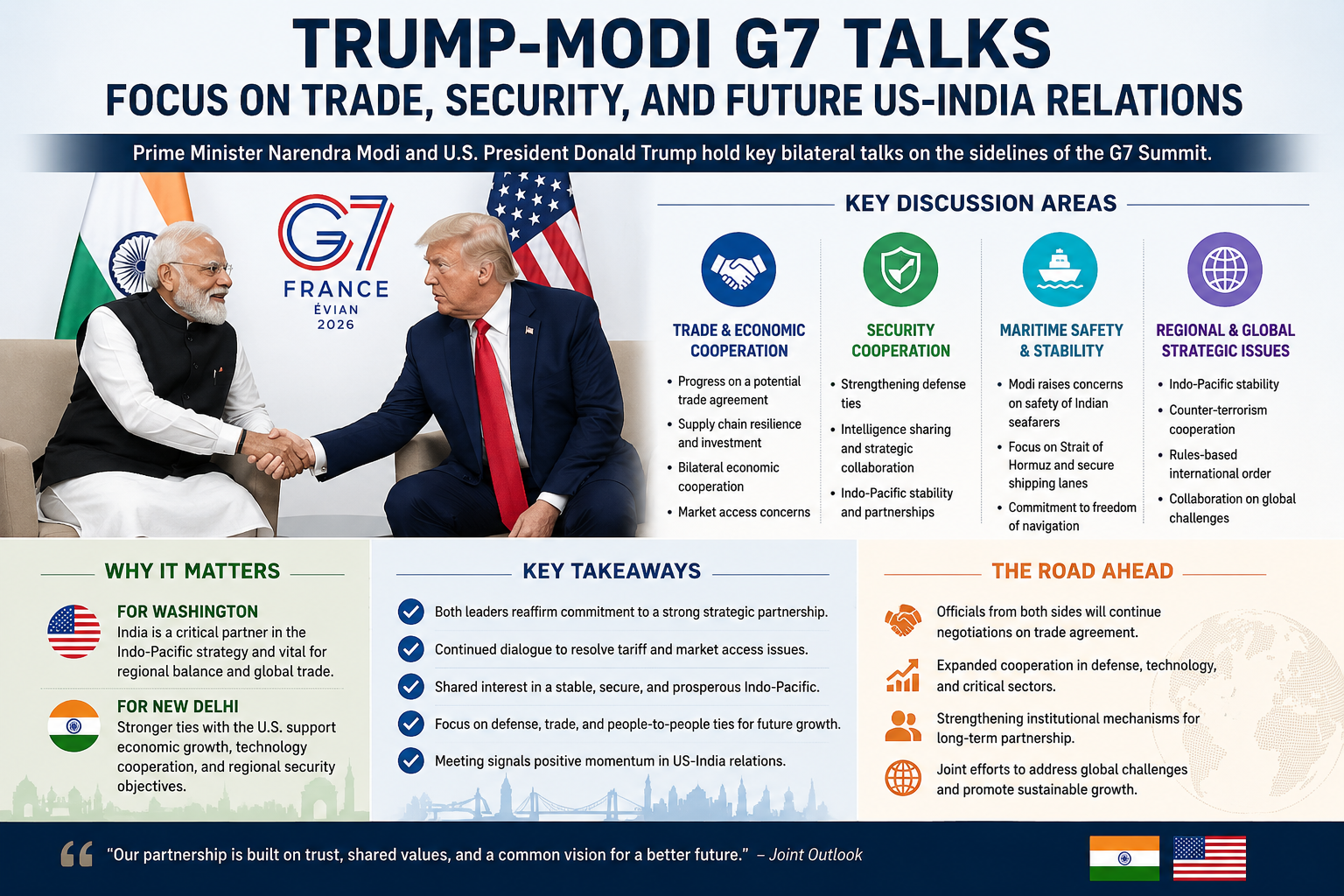
Trump told reporters a broader trade deal is now very close. The two governments have already locked in several commitments under the interim framework signed in February:
- A reciprocal tariff rate of 18 percent on Indian goods, down from a peak of 50 percent
- An Indian commitment to purchase $500 billion in US energy, aircraft parts, precious metals and technology products over five years
- Reduced Indian tariffs on US agricultural goods including soybean oil, tree nuts and wine
- Expanded cooperation on semiconductors, GPUs and other data center technology
Commerce Minister Piyush Goyal has said the framework opens a $30 trillion export market for Indian manufacturers, fishermen and small businesses.
What Remains Unresolved
Digital trade rules and agricultural market access remain points of friction. An earlier reference to India cutting tariffs on pulses was walked back within days of the original announcement, and a planned reduction in India's digital services tax was dropped from the revised fact sheet. Both governments say the full BTA is expected to be finalized in the coming weeks, though similar timelines have slipped before.
Security, the Strait of Hormuz and the Road Ahead
A Pledge of Support
Trump used the bilateral meeting to send a clear signal on defense ties. He told Modi, "We have the best relationship. We cannot be closer than we are," and indicated the United States would stand by India if it came under attack. The remarks came against an active US military presence near the Strait of Hormuz, a route through which a large share of India's oil imports pass.
Modi Raises Seafarer Safety
Modi welcomed progress toward ending the conflict in West Asia but pressed the issue closest to home, the safety of Indian nationals working on commercial vessels. "Their safety is of utmost importance to us," he said, referencing the three sailors killed days earlier. He called for secure sea routes so seafarers can do their jobs without fear.
What's Next for the Bilateral Trade Agreement
Both sides describe the BTA as entering its final stretch, with energy security, defense cooperation and technology transfer expected to anchor the next round of talks. The interim framework holds for now, and the G7 meeting suggests both governments are prioritizing the relationship's economic core even as security incidents complicate the picture.