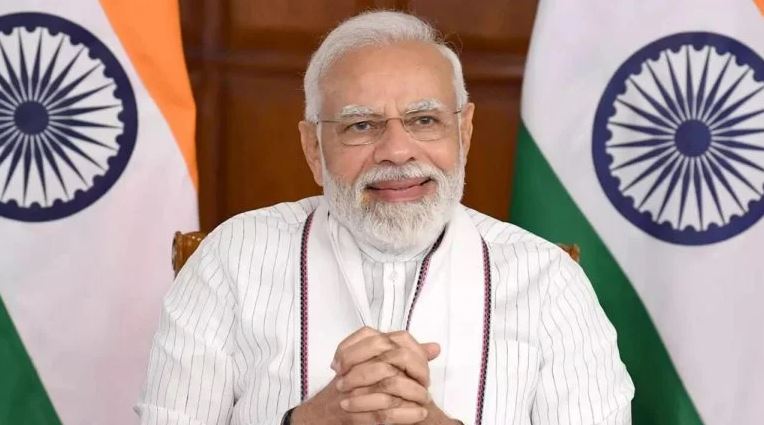
Narendra Modi on Wednesday became India's longest continuously serving elected Prime Minister, completing 4,399 unbroken days in office and surpassing the record held by the country's first Prime Minister, Jawaharlal Nehru. The milestone lands on a date that carries its own political weight: June 10 marks exactly 12 years and 15 days since Modi first took the oath of office.
This is not merely a numerical record. It reflects something harder to manufacture: three consecutive democratic mandates from the world's largest electorate.
How the Record Was Set
Modi took oath as Prime Minister for the first time on May 26, 2014, returned for a second term in 2019, and is currently serving his third consecutive stint following the 2024 general elections.
Key milestones in his tenure:
- First non-Congress leader to win a Lok Sabha majority.
- First Prime Minister born after India's independence.
- First non-Congress PM to complete two full terms and return for a third.
- Longest-serving Prime Minister from a non-Hindi speaking state, having previously served as Chief Minister of Gujarat from October 2001 to May 2014.
Nehru, who was first elected to the post in 1952, took the oath of office on May 13 and served until May 27, 1964, a tenure of 4,398 days. However, Nehru still holds the record for being India's overall longest-serving Prime Minister, with 16 years and 286 days between 1947 and 1964. Nehru's earlier stint from 1947 to 1952 was as head of an interim government, before elections were institutionalised.
Electoral Performance: Three Consecutive Electoral victories
2014 - First Term
- BJP won 282 seats in the Lok Sabha.
- Narendra Modi became Prime Minister on May 26, 2014.
- Became the first non-congress leader to win a parliamentary election.
2019 - Second Term
- BJP increased its majority to 303 seats compared to 2014.
- Modi returned to office with a stronger mandate on May 30, 2019.
2024 - Third Consecutive Term
- BJP emerged as the largest party in the Lok Sabha, winning 240 seats, while the NDA coalition secured a governing majority.
- Modi was sworn in for a third consecutive term on June 9, 2024.
Global Recognition and What It Signals
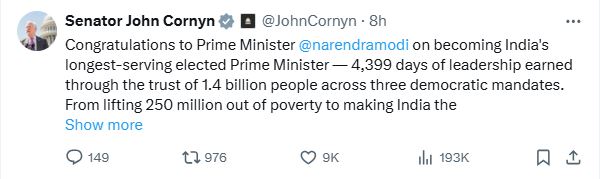
The milestone drew immediate international response. US Senator John Cornyn of Texas posted on X that Modi's 4,399 days of leadership were earned through the trust of 1.4 billion people across three democratic mandates, and credited his tenure with lifting 250 million out of poverty and making India the world's fastest-growing major economy.
Senator Bill Hagerty of Tennessee noted that under Modi's leadership, the US-India partnership has grown into a comprehensive, global, and strategic relationship.
For any political analyst, sustained foreign policy recognition across two American administrations is a signal worth noting. It points less to ideology and more to institutional continuity, something India has historically struggled to project abroad.
A Record Built on Years Before Delhi
What separates Modi's political biography from most of his predecessors is the depth of executive experience he carried into the Prime Minister's Office.
Modi first assumed office as Chief Minister of Gujarat on October 7, 2001, and continued in the role until May 21, 2014, leading the state for more than 13 years before moving to national politics.
Combining his tenure as Chief Minister of Gujarat and as Prime Minister, Modi has now completed 8,931 days as head of a government, surpassing former Sikkim Chief Minister Pawan Kumar Chamling's record of 8,930 days, making him the longest-serving elected head of government in India's history.
That context matters. He did not arrive in New Delhi as a parliamentary operator. He arrived as someone who had already run a state government for over a decade.