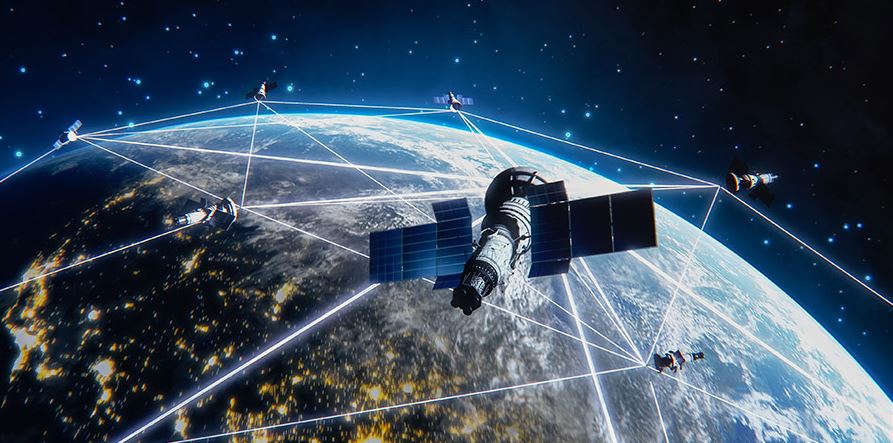
The first space race was about flags and footprints. The new one is about who controls global communication infrastructure. Thousands of satellites are already in orbit. Thousands more are launching. The prize is the internet connection of every person on Earth.
What Satellite Internet Actually Is?
Traditional internet travels through cables buried in the ground. It works in dense cities. It fails in remote mountains, open oceans, and thinly populated regions where ground infrastructure costs more than any operator can justify.
Satellite internet bypasses the ground entirely. A small rooftop terminal communicates directly with an overhead satellite. The satellite relays the signal to a ground station connected to the broader internet. No cable required.
For decades, satellite internet existed but was too slow and too expensive. A single geostationary satellite sitting 35,000 kilometers above Earth served wide areas but with latency so high that video calls failed and pages loaded slowly. Everything changed when engineers stopped building bigger satellites and started launching thousands of smaller ones closer to Earth.
Why Low Earth Orbit Changes Everything
Low Earth orbit sits between 160 and 2,000 kilometers above the surface. A satellite at 550 kilometers is 64 times closer to the ground than a geostationary satellite. Latency drops from 600 milliseconds at geostationary altitude to between 20 and 40 milliseconds at low Earth orbit. That matches many ground broadband connections.
The catch is coverage. One satellite at 550 kilometers only sees a small patch of Earth at any moment. To provide continuous global coverage, operators need hundreds or thousands of satellites spread across multiple orbital planes. That requires cheap, frequent launches. Reusable rocket technology made the economics work for the first time.
The Major Players
SpaceX Starlink is the market leader. SpaceX began launching in 2019 and by 2026 operates over 6,000 satellites serving millions of subscribers across more than 100 countries. Its advantage is vertical integration. SpaceX builds the rockets, builds the satellites, and sells the terminals directly. Starlink terminals are now compact, self-orienting, and require no technical setup.
Amazon Project Kuiper is Amazon's planned 3,200-satellite constellation. Amazon contracted multiple launch providers including United Launch Alliance, Arianespace, and Blue Origin. It distributes risk across providers and avoids relying on a competitor's rocket. Amazon's retail channels, Prime network, and AWS relationships give it commercial reach no pure space company can match.
OneWeb focuses on enterprise, government, and carrier customers rather than direct consumers. It sells connectivity wholesale to telecom operators who distribute it to end users. Following its 2020 bankruptcy and rescue by the UK government and Bharti Enterprises, it completed an initial constellation of over 600 satellites.
China's Guowang and SpaceSail represent the strategic alternative. Guowang has approval for over 12,000 satellites. SpaceSail is a separate commercial Chinese operator. Both target domestic connectivity independence and offer satellite internet to Belt and Road partner countries outside Western-controlled infrastructure.
Timeline of Satellite Internet
1962: Telstar 1 proves satellite communication is possible. One satellite. Limited coverage. The concept works but the scale does not yet exist.
1965: Early Bird launches as the first geostationary commercial satellite. Continuous coverage from 35,786 kilometers. This model dominates for five decades.
1997 to 2002: First LEO commercial attempts fail. Teledesic, backed by Bill Gates, never launches. Iridium and Globalstar go bankrupt. The concept is valid. The economics are broken.
2013 to 2015: Reusable Falcon 9 technology makes launch costs fall. SpaceX and OneWeb announce LEO constellation plans. Serious investment follows for the first time.
2019: SpaceX launches the first 60 operational Starlink satellites. The modern satellite internet era begins. Astronomers immediately raise concerns about sky brightness.
2020: OneWeb files for bankruptcy. Rescued by the UK government and Bharti. Starlink opens beta testing. Rural users report speeds matching suburban ground broadband.
2022: Russia invades Ukraine. SpaceX ships thousands of Starlink terminals to Ukraine within days. Starlink becomes critical military and civilian infrastructure. Governments worldwide recognise satellite internet as a strategic asset.
2024: Starlink surpasses five million subscribers across 80-plus countries. SpaceX launches direct-to-cell satellites that connect standard smartphones without any terminal. Amazon launches first production Kuiper satellites and begins orbital testing.
2025: Kuiper begins limited commercial beta. Starlink approaches 7,000 satellites. Global satellite internet revenue surpasses $10 billion annually for the first time.
2026: Multiple competing constellations operate simultaneously. The market has shifted from experimental to essential infrastructure in seven years.
The Global Connectivity Gap
Over 2.5 billion people lack reliable internet access. Most live in sub-Saharan Africa, South and Southeast Asia, remote island communities, and rural Latin America. Ground infrastructure costs too much to build for sparse populations. Governments have reached only a fraction of underserved communities.
Satellite internet changes the cost structure. Adding one more subscriber in a remote location costs only a terminal and a monthly fee. No cable. No tower. No power line.
For schools in rural Kenya, it means access to digital education. For fishing communities in Indonesia, it means weather data and emergency communication from open water. For clinics in the Amazon basin, it means telemedicine. For farmers in Bangladesh, it means financial services that mobile networks cannot reliably reach.
Challenges and Concerns
Space Debris: Low Earth orbit is filling fast. Satellites travel at 27,000 kilometers per hour. A collision generates debris that triggers further collisions, a scenario called the Kessler Syndrome. Current rules require satellites to deorbit within five years of end of service. Whether that is sufficient at the scale of tens of thousands of satellites remains an open question.
Light Pollution: Satellite trails appear in telescope images and contaminate astronomical observations. SpaceX developed darkening coatings that helped but did not eliminate the problem. With tens of thousands of satellites eventually in orbit, the impact on ground-based astronomy is permanent.
Terminal Cost: Consumer terminals still cost between $300 and $600. In countries where target users earn less than $5 per day, that is a prohibitive barrier. Reducing terminal cost below $100 is a stated goal for multiple operators. As of 2026, no provider has achieved it at commercial scale.
Geopolitical Control: The Ukraine conflict showed that a single private company can make decisions about which features military forces can access, without any government directing it and without any international framework governing it. As satellite internet becomes essential wartime infrastructure, the question of who controls access and under what conditions will define geopolitics for decades.
What Comes Next
Launch costs will keep falling as Starship reaches full cadence. Terminal costs will drop as manufacturing scales. Direct-to-cell connectivity will expand basic internet access to billions without the terminal barrier. China will push its constellations as alternatives for countries that do not want American-controlled infrastructure. Europe will debate strategic communication independence.
The coverage gap will effectively close within a decade. The affordability gap will not close by itself. Terminal cost, power access in off-grid communities, and digital literacy are barriers that satellites alone cannot solve. But for the first time in human history, the technical capacity to connect every person on Earth will exist. Whether the world acts on it is a political question, not a scientific one.