The world's largest meat and dairy companies have spent years filling sustainability reports and corporate websites with climate pledges. Some promise carbon neutrality by 2030. Others commit to net-zero emissions by 2040 or 2050. A few vow to eliminate deforestation from their supply chains entirely. The problem, according to a landmark peer-reviewed study published April 22, 2026, is that almost none of these promises hold up to scrutiny.
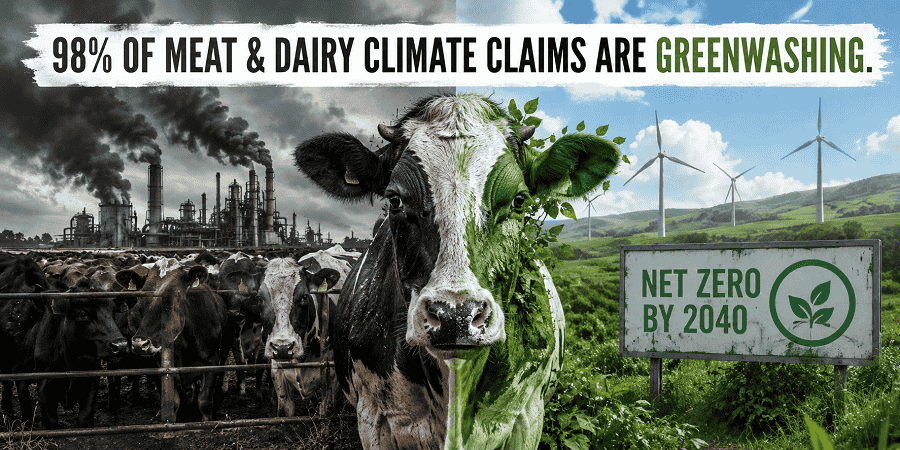
The vast majority of environmental claims from the animal agricultural industry are misleading greenwashing that relies on vague promises or projections, according to the study published in the open-access journal PLOS Climate by Maya Bach and Jennifer Jacquet from the University of Miami and colleagues. The numbers behind that finding are damning.
The Science Behind the 98 Percent Finding
A Systematic Analysis of 1,233 Corporate Claims
Researchers isolated environmental claims made in the most recent sustainability reports and websites, covering the period 2021 to 2024, of 33 of the world's largest meat and dairy companies. They identified 1,233 environmental claims, of which 68 percent were climate-related. Of the 1,233 claims, 38 percent were unverifiable future projections such as "achieve carbon neutrality by 2030" or "enable the restoration of 600 billion liters of water in water-stressed regions by 2030."
Using a greenwashing assessment framework developed in 2022, researchers found that 98 percent of claims examined fall under the category of greenwashing. Only 356, or 29 percent, of the claims were backed by any supporting evidence from sources like government bodies or trade organizations. Scholarly scientific evidence was provided to support only three of the claims, two of which were climate-related.
The scale and pattern of what researchers found matters as much as the headline number. Common greenwashing tactics identified in the analysis include:
- Unverifiable future targets with no current implementation roadmap.
- Vague language with no measurable metrics or baseline data.
- Claims relying on carbon offsetting rather than actual emissions reduction.
- References to pilot programs presented as systemic change.
- Commitments that push accountability decades into the future.
Greenwashing is especially concerning here because it creates the illusion of climate progress without meaningful action in companies that produce animal-based foods, which have disproportionately high emissions, according to Jennifer Jacquet, professor of Environmental Science and Policy at the University of Miami and corresponding author of the study.
The Emissions Footprint These Companies Are Obscuring
The stakes justify this level of scrutiny. Meat and dairy production are among the biggest contributors to global emissions. The production of meat for human and animal consumption is responsible for 57 percent of total global food production emissions, while the global dairy sector alone contributes to 4 percent of global emissions. The world's top five emitting companies, JBS, Marfrig, Tyson, Minerva, and Cargill, were responsible for an estimated 496 million tonnes of greenhouse gases in 2023, more than reported for Chevron, Shell, or BP.
That comparison is not rhetorical. It is a precise illustration of how significantly animal agriculture has been under-scrutinized relative to fossil fuel companies, despite producing comparable or greater climate damage.
Named Companies, Legal Settlements, and Broken Pledges
JBS, Tyson, Danone, and Cargill Under the Microscope
Greenwashing can include promises about the future, or future-washing, particularly when there is no clear effort to achieve such a promise. More than two-thirds of environmental claims lacked any evidence, making it difficult to assess their credibility. Some of the global companies included in the analysis were Perdue, Smithfield, Cargill, Nestle, Danone, and Hormel. The majority of the claims were related to climate, and Danone had a particularly high number at 106.
The legal system has also begun to respond. New York State Attorney General Letitia James confirmed that meatpacker JBS USA agreed to pay $1.1 million to settle allegations it misled the public with a pledge to achieve net-zero emissions by 2040. Tyson Foods, similarly, agreed to drop its own net-zero and climate-smart marketing claims in the face of legal scrutiny.
Tyson launched a line of climate-smart beef that claimed to generate 10 percent fewer greenhouse gas emissions than conventional beef. Consumers might reasonably have expected that Tyson put together a detailed plan on how it would achieve its bold net-zero pledges before announcing them. That was not the case.
On deforestation, the record is equally thin. Danone promised in 2023 that it would have no deforestation across its primary deforestation-linked commodities by 2025. Researchers found there was no proof it had done so, and that it was unclear how this would be measured or independently verified. In 2024, Danone had more difficulty than its competitors in tracing its suppliers in preparation for the European Union Deforestation Regulation.
Net-Zero Commitments Built on Offset Reliance
Of the 33 companies examined, 17 have now made net-zero commitments, compared to just 4 in 2020. But as with oil and gas companies, the commitments appear to rely on plans to offset carbon emissions rather than to decarbonize.
This is a crucial distinction that most corporate communications deliberately blur. Offsetting means funding external projects, such as tree planting or renewable energy credits, to theoretically compensate for emissions produced elsewhere. Decarbonization means eliminating the source of those emissions entirely. The former allows production to continue growing. The latter requires structural change.
The cycle of weak voluntary commitments, an over-reliance on market-inaccessible or ineffective technological fixes, and a lack of public regulation continues to hinder the urgent emissions reductions needed from this high-polluting sector. An analysis of the policy landscape in the 11 countries where the largest meat and dairy companies are headquartered found that nearly all national strategies lack mandatory requirements for agricultural emissions reductions, cuts in livestock production, or the inclusion of agriculture in any form of greenhouse gas pricing scheme.
What Accountability Looks Like and What Must Change
Regulatory Gaps That Enable Corporate Inaction
Despite their lack of climate reporting, major companies including JBS, Dairy Farmers of America, Tyson Foods, and WH Group will be required to report full-scope greenhouse gas emissions with limited assurance under the EU Corporate Sustainability Reporting Directive and California's climate-related disclosure rules once those go into effect in 2026. This scorecard by the Institute for Agriculture and Trade Policy uncovers that companies scoring above average on climate-related reporting plummet toward the bottom of the ranking when accounting for methane reporting.
The methane gap is particularly significant. Methane from livestock, primarily through enteric fermentation in cattle, is a potent short-lived climate forcer. Many companies issue extensive carbon dioxide accounting while barely acknowledging their methane output.
What meaningful reform requires:
- Mandatory, independently verified greenhouse gas reporting that includes full Scope 3 supply chain emissions.
- A legal prohibition on net-zero claims that rely on offset credits rather than verified emissions reduction.
- Regulatory inclusion of agriculture in greenhouse gas pricing mechanisms.
- Transparency requirements for deforestation-linked commodities with third-party verification.
- Removal of carbon-neutral and climate-smart product labels unless backed by peer-reviewed evidence.
Like the fossil fuel industry, which has used greenwashing over the last several decades to delay meaningful climate action, the meat and dairy industry may be misleading consumers and investors regarding whether and to what extent they are addressing environmental impacts, including climate change, with even less time to spare, according to the study's authors.
The parallel to fossil fuels is historically grounded. The same tactics that extended oil and gas production under a veneer of environmental responsibility, voluntary pledges, vague timelines, and offset substitution, are now being employed by the companies that collectively emit more greenhouse gases than some of the world's largest energy corporations. For journalists, researchers, regulators, and consumers who spent years scrutinizing fossil fuel greenwashing, this study confirms that the same playbook has been fully adopted by animal agriculture with very little equivalent accountability.