Amazon is building an internet from space. It is called Project Kuiper. And one of the rockets doing the heavy lifting is a 58-meter tall machine that has been flying since 2002. The Atlas V is old by rocket standards. But in the satellite internet race, reliability beats novelty every time.
What Is Project Kuiper
Project Kuiper is Amazon's answer to a simple but enormous question. Why do hundreds of millions of people still lack fast, affordable internet access? The answer the company is building involves thousands of satellites in low Earth orbit, a global ground infrastructure, and consumer terminals small enough to sit on a rooftop.
The constellation is designed to deliver high-speed broadband to homes, businesses, schools, and governments in places where fiber cables have never reached and mobile towers have never stood. It targets rural communities, remote islands, underserved regions in developing countries, and mobile users at sea and in the air.
Amazon has FCC approval for a constellation of over 3,200 satellites. That is not a small undertaking. It is one of the most ambitious infrastructure projects in corporate history, conducted entirely above the atmosphere.
The Atlas V Rocket
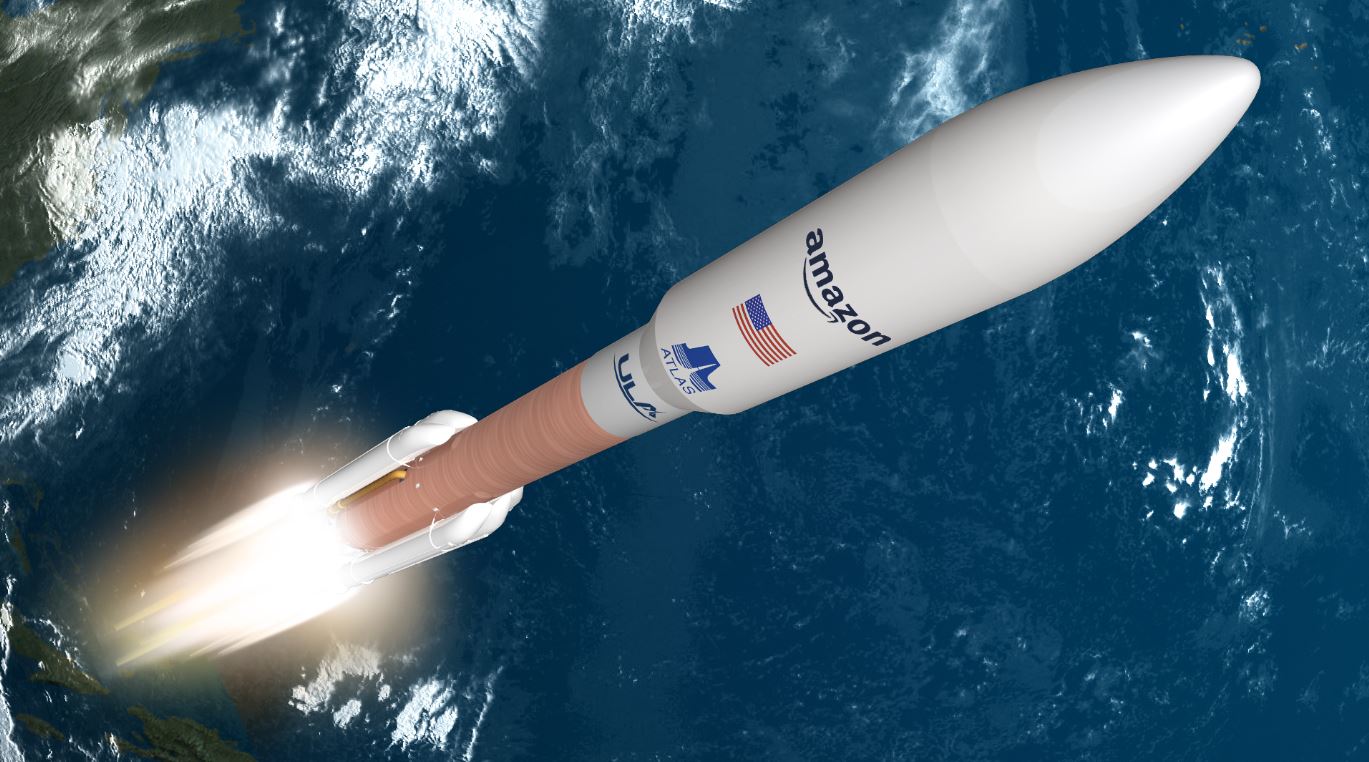
The Atlas V is built by United Launch Alliance, a joint venture between Boeing and Lockheed Martin. It has one of the most consistent safety records in American launch history. Since its first flight in 2002, it has completed over 90 missions without a single launch failure. That record matters enormously when the payload costs hundreds of millions of dollars.
The rocket uses a Russian-designed RD-180 engine on its first stage, a decision that became politically complicated following geopolitical tensions with Russia. ULA has been transitioning toward the Vulcan Centaur rocket as a domestic-engine replacement. But Atlas V continues to fly alongside it, completing existing manifest commitments.
For Project Kuiper, the Atlas V carries satellites in configurations that match the deployment altitude and orbital inclination Amazon requires. The Centaur upper stage, one of the most capable hydrogen-fueled upper stages ever built, delivers the satellites with precision. Altitude, velocity, and orbital plane must all be exactly right. The Centaur does that well.
Why Amazon Chose Multiple Launch Providers
Amazon did not bet on one rocket. It signed launch agreements with United Launch Alliance for Atlas V and Vulcan Centaur flights, with Arianespace for Ariane 6 missions, and with Blue Origin for its New Glenn rocket. That is a deliberate strategy. SpaceX built Starlink using exclusively Falcon 9 rockets, a vertical integration that cuts cost and increases launch cadence. Amazon chose the opposite approach.
The reasoning is risk distribution. If one rocket fleet is grounded, others continue flying. If one provider faces delays, others pick up the schedule. When you need hundreds of launches to build a full constellation, launch vehicle diversity is a form of supply chain insurance.
It also reflects competitive dynamics. Amazon does not want to rely on SpaceX's Falcon 9 to compete against SpaceX's Starlink. That would be strategically incoherent.
How Kuiper Satellites Work
Each Kuiper satellite operates in low Earth orbit, between approximately 590 and 630 kilometers above the surface. This altitude range is key. Lower orbits mean shorter signal travel distances. Shorter distances mean lower latency. Lower latency means the internet feels fast, responsive, and usable for video calls, gaming, and real-time applications that higher-orbit satellite systems handle poorly.
The satellites use phased array antennas to beam signals to ground terminals. The terminals use electronically steered antennas to track satellites as they pass overhead at roughly 27,000 kilometers per hour. A satellite crosses from horizon to horizon in around 10 minutes. The system hands off connections between satellites seamlessly, so the user experiences no interruption.
Amazon designed its consumer terminal to be compact, affordable to manufacture at scale, and simple to install. It does not require a technician. It requires a clear view of the sky.
The Competition with Starlink
SpaceX launched Starlink years before Kuiper satellites went into operational service. By mid-decade, Starlink had millions of subscribers across more than 100 countries. It serves homes, ships, aircraft, military forces, and disaster relief operations.
Kuiper enters a market that Starlink has already proven exists. That is actually an advantage. Amazon does not have to convince people that satellite broadband can work. Starlink already did that. Amazon needs to convince people that Kuiper is better, cheaper, or more accessible.
Amazon brings distribution infrastructure that SpaceX does not have. It has Prime logistics, AWS cloud computing, hardware manufacturing scale, and relationships with governments and businesses worldwide. The company can bundle Kuiper access with other Amazon services, sell terminals through its retail channels, and offer enterprise contracts through AWS.
The satellite broadband market is large enough for more than one player. But the race to complete full constellation deployment will shape which service reaches customers first, and first-mover advantages in broadband adoption tend to be durable.
Atlas V's Role in the Deployment Timeline
Each Atlas V mission carries multiple Kuiper satellites into orbit. The rocket's payload capacity to low Earth orbit exceeds 18,000 kilograms in its most capable configuration. That allows Amazon to stack and deploy a meaningful number of satellites per flight.
Launch cadence is everything in constellation building. The more satellites in orbit, the better the coverage. The better the coverage, the sooner Amazon can begin offering commercial service in each region. Atlas V contributes reliable, scheduled flights to a manifest that spans multiple providers and years.
ULA's launch teams operate from Cape Canaveral, Florida, with the precision that comes from decades of operating critical national security, scientific, and commercial missions. These are not improvised operations. They are among the most disciplined launch workflows in the industry.
What Orbital Broadband Means for the World
The practical stakes of this technology are large. According to global connectivity estimates, over 2.5 billion people lack reliable internet access. Most of them live in areas where terrestrial infrastructure is economically unfeasible to build. A satellite constellation covering the entire globe does not face that constraint. The signal reaches everywhere the sky does.
For students in remote villages, that means access to online education. For farmers in isolated regions, that means access to weather data, market prices, and agricultural guidance. For hospitals in underserved areas, that means telemedicine. For governments in developing nations, that means administrative connectivity that does not depend on fragile ground networks.
Broadband from orbit does not solve every digital divide problem. Terminals still cost money. Monthly service fees still apply. But the coverage barrier, the fundamental problem of the signal simply not reaching certain places, comes down.