Sumatra has lost more than half its lowland forest in 25 years. The Sumatran elephant lost its home at the same speed. Fewer than 2,400 remain. The species sits one category away from extinction in the wild.
What Is the Sumatran Elephant?
The Sumatran elephant is the smallest Asian elephant subspecies. It lives exclusively on Sumatra. It is a keystone species. It disperses seeds, shapes forests, and sustains biodiversity. When it disappears, the forest changes around it. Adults weigh up to 5,000 kilograms. They are highly social, cognitively complex, and irreplaceable.
Why Is This Happening?
Palm Oil Indonesia is the world's largest palm oil producer. Flat, fertile lowland forests, the exact terrain elephants need, are cleared and replanted with oil palm monocultures. A plantation supports almost no native wildlife. When a forest becomes a plantation, elephants fragment into shrinking patches with no corridor between them.
Logging and Pulp Large paper companies held government concessions to log the Sumatran forest for decades. Illegal logging has removed forests in areas officially listed as protected. By the time satellite imagery confirmed the clearing, the damage was permanent.
Roads and Settlement Roads built to service plantations fragment the habitat and bring poachers. Human communities followed agricultural expansion into the former forest. Elephants whose ranging areas now include farmland face daily, dangerous contact with people.
Timeline of Decline
Pre-1900: Tens of thousands of elephants range freely across the continuous Sumatran forest.
1900 to 1940: Dutch colonial plantations begin lowland forest clearance. First population declines recorded.
1950 to 1970: Government transmigration programs move millions from Java to Sumatra. Forest cover in accessible lowlands collapses.
1970 to 1985: Industrial logging concessions cleared millions of hectares. Elephant habitat shrinks by an estimated 30 percent.
1985: First formal survey estimates 2,800 to 4,800 elephants remain. Already a fraction of historical numbers.
1985 to 2007: Palm oil boom destroys approximately 12 million hectares of Sumatran forest. Elephant populations in Riau, Jambi, and South Sumatra collapse. Some local populations disappear entirely.
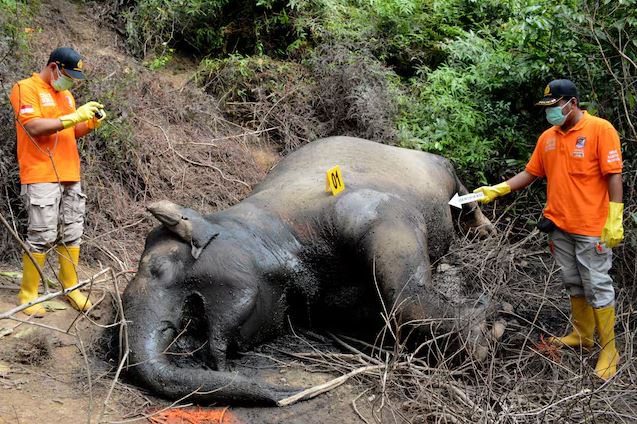
2000 to 2010: Human-elephant conflict deaths rise sharply. At least 100 confirmed elephant deaths from poisoning, electrocution, and retaliation killings. Actual numbers are believed significantly higher.
2008: IUCN upgrades Sumatran elephant to critically endangered based on a population decline exceeding 50 percent over three generations.
2012: WWF study confirms population dropped 69 percent in 25 years. Riau province lost over 80 percent of its forest in the same period.
2013 to 2018: Mass poisonings draw global attention. In 2013, 14 elephants were found dead in Aceh from confirmed poisoning. In 2017, a pregnant elephant and three herd members were killed in Riau. In 2018, an elephant was found alive with her feet cut off inside a palm oil concession. She died before rescue.
2019 to 2022: Catastrophic Indonesian peat fires destroyed the remaining peatland elephant habitat. By 2020, fewer than 1,700 elephants will remain outside Aceh. Populations are fragmented into at least 44 isolated groups.
2026: Total population estimated at 1,700 to 2,400. The Leuser Ecosystem in Aceh holds the last viable large population of 500 to 600 individuals.
How Many Sumatran Elephants Are Dead
From above 10,000 in the early twentieth century, the population has fallen by 75 to 83 percent. Over 400 elephant deaths from human causes are confirmed between 2000 and 2025. Researchers estimate actual mortality is two to three times higher. Elephant habitat has shrunk from 25 million hectares of forest in 1900 to fewer than 7 million hectares of intact forest today. That is a 70 percent loss in one century.
What Is Being Done
Way Kambas and Bukit Barisan Selatan national parks hold small monitored populations. Flying squad patrol units redirect wild elephants away from farmland without lethal force. Forest corridor restoration projects attempt to reconnect fragmented populations. Several major consumer goods companies have adopted no-deforestation commitments. On-the-ground outcomes do not yet match those commitments. The Leuser Ecosystem remains the last large intact forest refuge. If it falls, the species follows.