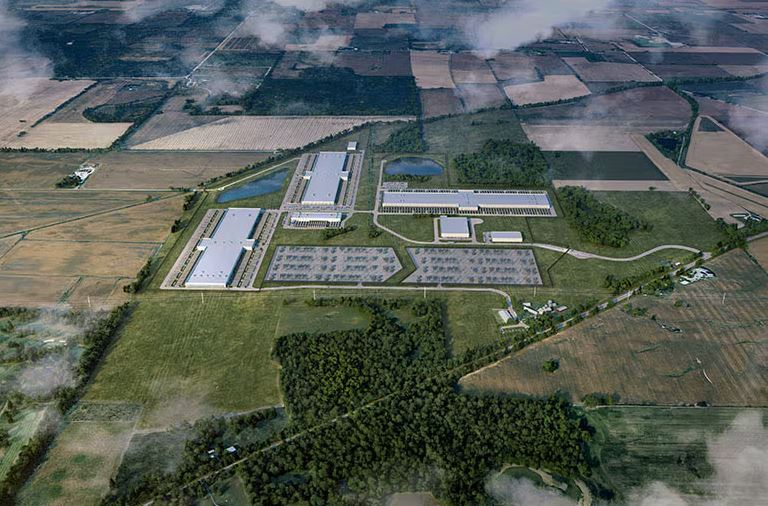
After months of stop-and-start negotiations and repeated standoffs between investors, banks, and local authorities, Related Digital has closed a $16 billion financing package for a massive Oracle-dedicated AI data center campus in Saline Township, Michigan. The deal marks one of the largest infrastructure financing transactions in the current AI buildout cycle, and the fact that it got done at all speaks volumes about the state of institutional appetite for AI-linked assets.
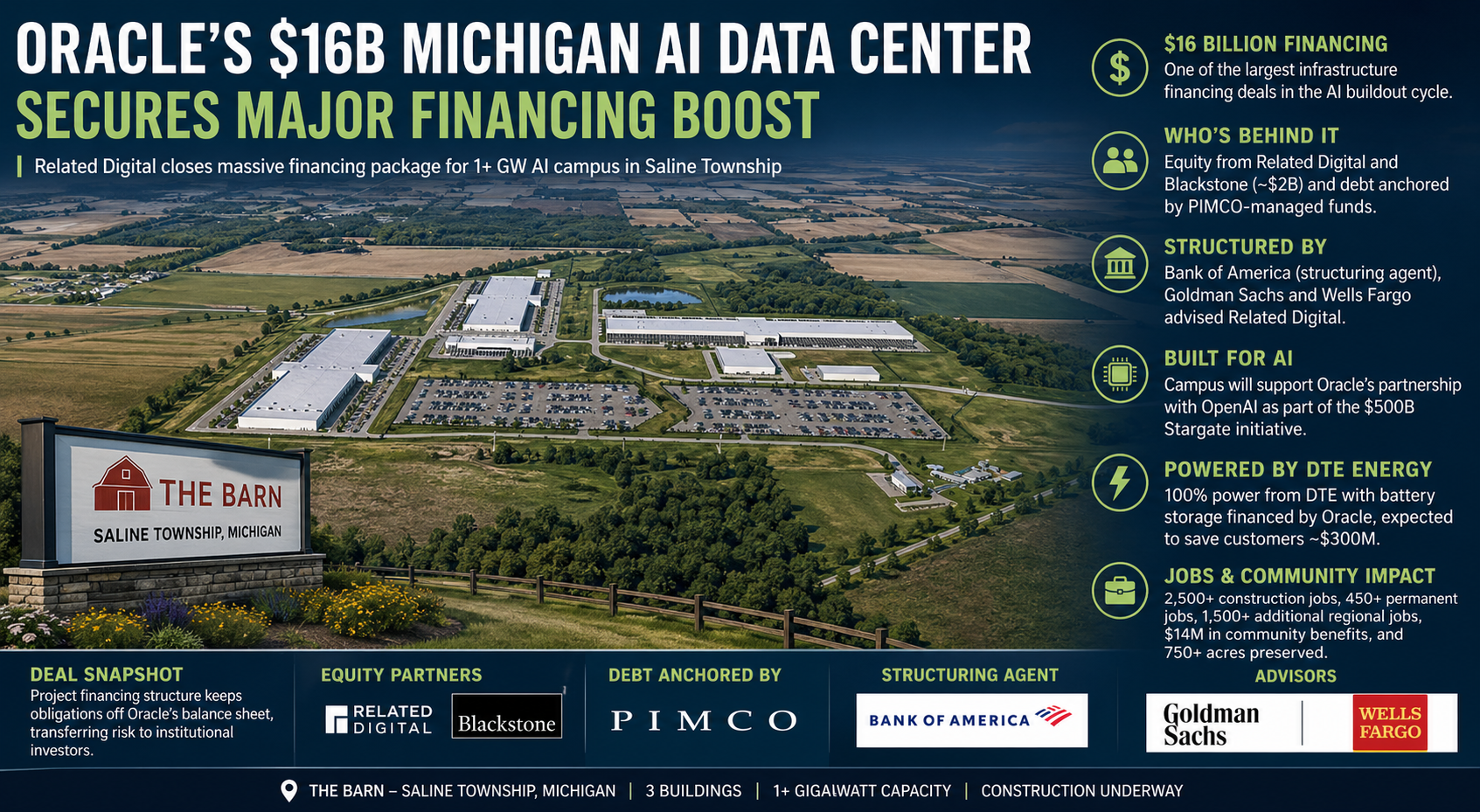
The campus, known as "The Barn," a nod to the historic red barn preserved at the entrance along Michigan Avenue, will house three single-story data center buildings exceeding one gigawatt of combined capacity. Construction on the first buildings is already underway and reportedly on schedule for delivery to Oracle.
Who put up the money and how the deal is structured
The financing combines equity from Related Digital and funds affiliated with Blackstone, alongside fixed-rate, long-term debt anchored by PIMCO-managed funds and accounts. Bank of America served as the structuring agent, with Goldman Sachs and Wells Fargo advising Related Digital through the process.
Notably, Blackstone's equity contribution came in at roughly $2 billion, considerably smaller than what had been discussed in earlier rounds. The remainder of the package leans heavily on the debt side, with the structure designed as project financing, meaning the obligations sit off Oracle's corporate balance sheet rather than on it.
What ultimately broke the deadlock, according to Bloomberg's reporting, was Oracle's willingness to tighten certain leasing terms, giving lenders greater confidence in the income stream underpinning the debt. Oracle's stronger-than-expected earnings reported in March 2026, driven by accelerating demand in its infrastructure business, also helped restore credibility with investors who had grown cautious.
Who is behind the project and why it matters
Who is Related Digital?
Related Digital is a vertically integrated data center development and investment platform, and this deal dramatically validates its strategy. CEO Jeff T. Blau framed the closing as confirmation of institutional support for a broader pipeline that now exceeds $45 billion across developments in Ontario, Wyoming, Michigan, Missouri, Illinois, and Texas. The company's five-gigawatt-plus development pipeline across North America now has the institutional backing to go with it.
Who is Oracle's end customer for the compute?
The campus is being built specifically to support Oracle's partnership with OpenAI. It is a key component of the Stargate initiative, the sweeping AI infrastructure plan involving SoftBank Group, OpenAI, and Oracle that was announced by President Trump in January 2025 and carries a total investment figure of up to $500 billion.
Who is handling the power supply?
DTE Energy will supply 100 percent of the campus's power, drawing on existing grid resources supplemented by new battery storage financed entirely by Oracle. This arrangement is projected to generate approximately $300 million in savings for DTE's existing customers by distributing fixed grid costs more broadly, an unusual community benefit embedded in the project's financial structure.
What the broader financing context tells us
The Michigan deal does not stand alone. It follows a $38 billion debt package assembled by banks for Oracle data centers in Texas and Wisconsin, and an $18 billion financing for a New Mexico site. Taken together, these transactions reveal that Oracle is building out a massive physical AI infrastructure footprint without burdening its own balance sheet, using project finance structures that transfer risk to institutional investors who believe in the long-run demand for AI compute.
The difficulty of closing the Michigan deal is itself instructive. The repeated negotiations and multi-party standoffs reflect a broader shift in how Wall Street is approaching AI-linked infrastructure. Demand signals are credible enough that deals get done, but lenders are now pressing for tighter terms, stronger lease structures, and more conservative assumptions about utilization. That is a healthy maturing of the market, even if it slows the pace.
What the campus means for Michigan
Beyond the headline financing figure, the project carries significant economic weight for the region. The campus is expected to create more than 2,500 union construction jobs, over 450 permanent onsite positions, and an additional 1,500 or more jobs county-wide from related economic activity. The development also includes $14 million in direct benefits to local fire departments and community programs, along with the preservation of more than 750 acres. The project will pursue LEED certification and uses a closed-loop cooling system, addressing the environmental footprint that has become a scrutiny point for large data center builds.