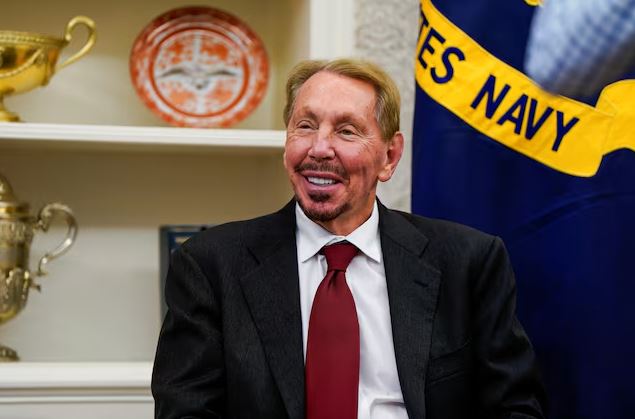
Few careers in technology are as defining as Larry Ellison's. Born on August 17, 1944, in the Bronx, New York, Ellison had a challenging early life marked by his adoption and the early loss of his adoptive mother. What followed was a five-decade arc from a South Side Chicago apartment to one of the largest technology empires ever built.
Early Life: Adoption, Disruption, and a Self-Made Path
When Ellison was nine months old, he came down with pneumonia, and his mother sent him to Chicago to be raised by her aunt and uncle, Lillian and Louis Ellison, who adopted him. His adoptive father reportedly believed Ellison would amount to nothing. That skepticism proved to be the wrong bet.
Key facts from Ellison's early years:
- Ellison attended high school on Chicago's middle-class South Side before enrolling at the University of Illinois at Urbana-Champaign.
- He dropped out in his second year after his adoptive mother died, then tried again at the University of Chicago but left after one semester.
- With his academic career at an end, a 22-year-old Ellison moved to Berkeley, California, right near the future Silicon Valley.
- He bounced through several programming roles, including a position on a pioneering team at Amdahl Corporation, which developed the first IBM-compatible mainframe computer.
These years were not wasted. Each role gave Ellison technical depth and a clear view of where the software industry was heading.
Founding Oracle: The risk That IBM Refused to Take
While at Ampex in the mid-1970s, Ellison first crossed paths with Bob Miner and Ed Oates. When he came across an IBM research paper by Edgar F. Codd describing the relational database model, a system that allowed businesses to store and retrieve data far more efficiently than before, he saw a commercial opportunity that IBM itself was reluctant to pursue.
In 1977, with just $2,000 of his own money and $1,200 from partners Bob Miner and Ed Oates, Ellison co-founded Software Development Laboratories, the precursor to Oracle. The company's first major break came when it won a contract to build a database system for the CIA, a project codenamed "Oracle."
The growth from that starting point was methodical:
- In a calculated marketing move, the founders launched their product as "Oracle Version 2" with no Version 1, on the theory that customers would be reluctant to buy an initial release.
- In 1981, IBM signed on to use Oracle, a game-changing deal that allowed the company's sales to double every year for the next seven years.
- By 1982, the firm had adopted the Oracle name and begun its rise to dominance in enterprise software. Oracle went public in 1986, making Ellison an instant multimillionaire.
- Crucially, the company never raised money from venture capital, which meant Ellison retained a dominant ownership stake that compounded into extraordinary wealth over decades.
The strategic insight at Oracle's core, that IBM had conceived a revolutionary idea but lacked the commercial urgency to exploit it, is the kind of market read that defines generational founders. IBM viewed Codd's relational database concept as an intellectual curiosity that could undermine their existing products, leaving the market open for Ellison to establish Oracle before IBM released its first commercial database product in 1981.
Oracle in 2026: From Legacy Database to AI Infrastructure Powerhouse
Oracle's transformation from a database vendor into an AI infrastructure company is the defining business story of Ellison's later career.
Oracle shares reached intraday peaks near $226 in early June 2026, fueled by demand for AI-driven cloud infrastructure, pushing Ellison past both Jeff Bezos and Sergey Brin in global wealth rankings.
The numbers behind Oracle's current position:
- In the third quarter of fiscal 2026, Oracle reported cloud infrastructure revenue growth of 84% year-over-year, supported by a staggering backlog of contracted revenue.
- Oracle's central role in President Trump's Stargate initiative, which channels $500 billion into AI infrastructure, has reinforced its standing as a foundational AI platform.
- Ellison owns approximately 1.16 billion Oracle shares, representing about 41% of the company's outstanding stock, and has sold only roughly $5.1 billion worth of shares over his entire career, a small fraction of his overall stake.
- In 2026, Oracle is being valued not only as an enterprise software company but as an AI infrastructure stock, with its cloud business providing computing power, databases, and data-center capacity for companies building and running AI systems.
In September 2025, Ellison's net worth briefly rose to around $400 billion, making him for part of that day the world's richest person, before Elon Musk reclaimed the top spot. His wealth remains concentrated in a single company he co-founded nearly 50 years ago, which is itself a statement about conviction and long-term thinking.
Beyond Oracle, Ellison owns approximately 98% of the Hawaiian island of Lanai, which he purchased in 2012 for around $300 million, and through the Lawrence Ellison Foundation he funds research into aging, global public health, and education reform.