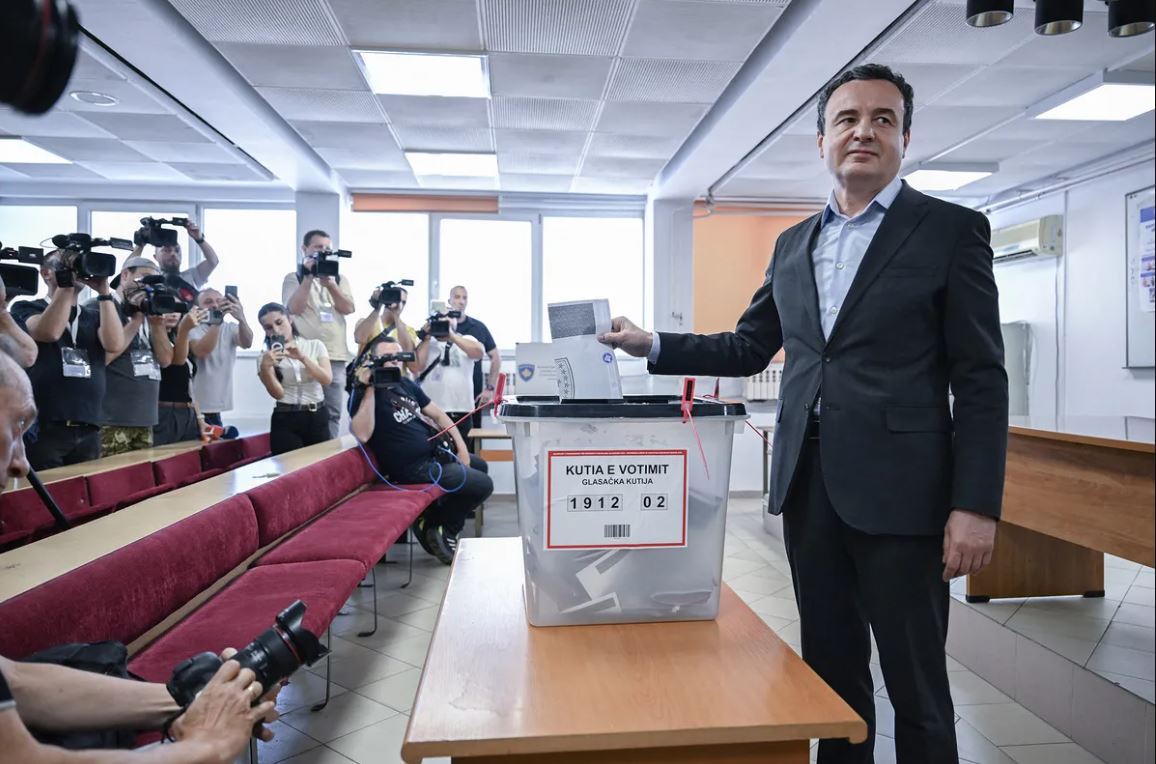
Kosovo Prime Minister Albin Kurti won a third election in 18 months, with his Self-Determination Movement taking 43.2 percent of the ballot with about 96 percent of polling stations counted. The result will not allow the party to form the next government on its own, indicating difficult coalition talks ahead.
Voter turnout stood at less than 37 percent, official figures confirmed, a drop that reflects deep frustration with repeated elections that have failed to resolve Kosovo's political deadlock.
June 2026 Election Results: Party Standings and Vote Share
Kurti's ruling Vetevendosje party won around 43 percent of the votes, followed by the Democratic Party of Kosovo with 21.7 percent and the Democratic League of Kosovo with 18 percent, according to state election authorities after counting nearly all ballots.
Key results at a glance:
- Vetevendosje (Kurti): 43.2 percent, the largest share but short of a governing majority.
- Democratic Party of Kosovo (PDK): 21.7 percent.
- Democratic League of Kosovo (LDK): 18 percent.
- Four other parties in total cleared the parliamentary threshold.
- Total voter turnout: 36.88 percent, roughly eight points lower than the December 2025 election.
Kurti declared the result a generational mandate, stating he believes this decade and beyond will belong to Vetevendosje's government.
Kosovo-Serbia Relations remain a key issue
Kosovo and Serbia relations are one of the most significant issues facing the next government. EU-mediated talks aimed at normalizing relations have produced limited progress and political instability in Kosovo could further complicate negotiations.
Why Kosovo Voted Again: The Political Crisis Explained
Three Elections in 18 Months
The June 7 vote was Kosovo's third election in less than 18 months. It was scheduled after the main political parties failed to agree by a March deadline on who should replace former President Vjosa Osmani.
The first inconclusive election in February 2025 left the country without a functioning government for much of last year, forcing a second election in December.
The Presidential Deadlock That Triggered This Vote
The first attempt to elect a new president on March 5, 2026 failed due to a lack of quorum, starting a 60-day constitutional deadline. After political deadlock, President Vjosa Osmani attempted to dissolve the Assembly on March 6, but the Constitutional Court suspended and later rejected the move, extending the deadline to April 28. After Osmani's term ended on April 4, Assembly Speaker Albulena Haxhiu became acting president.
Osmani Turns Opposition, EU Path Remains at Stake
Former President Osmani is running on the opposition LDK list in the election, having turned against Kurti after he refused to back her for a second term in office.
Kosovo is recognized by the United States and most EU countries, but not by Serbia, Russia, or China. Kosovo and Serbia have been told to improve bilateral relations as a precondition for advancing toward EU membership, and the ongoing political instability has slowed that process.
Economic Consequences of Prolonged Instability
The political stalemate has negatively affected Kosovo's economy, already hit hard by the global energy crisis and rising fuel prices. Kosovo remains one of the youngest and poorest countries in Europe.