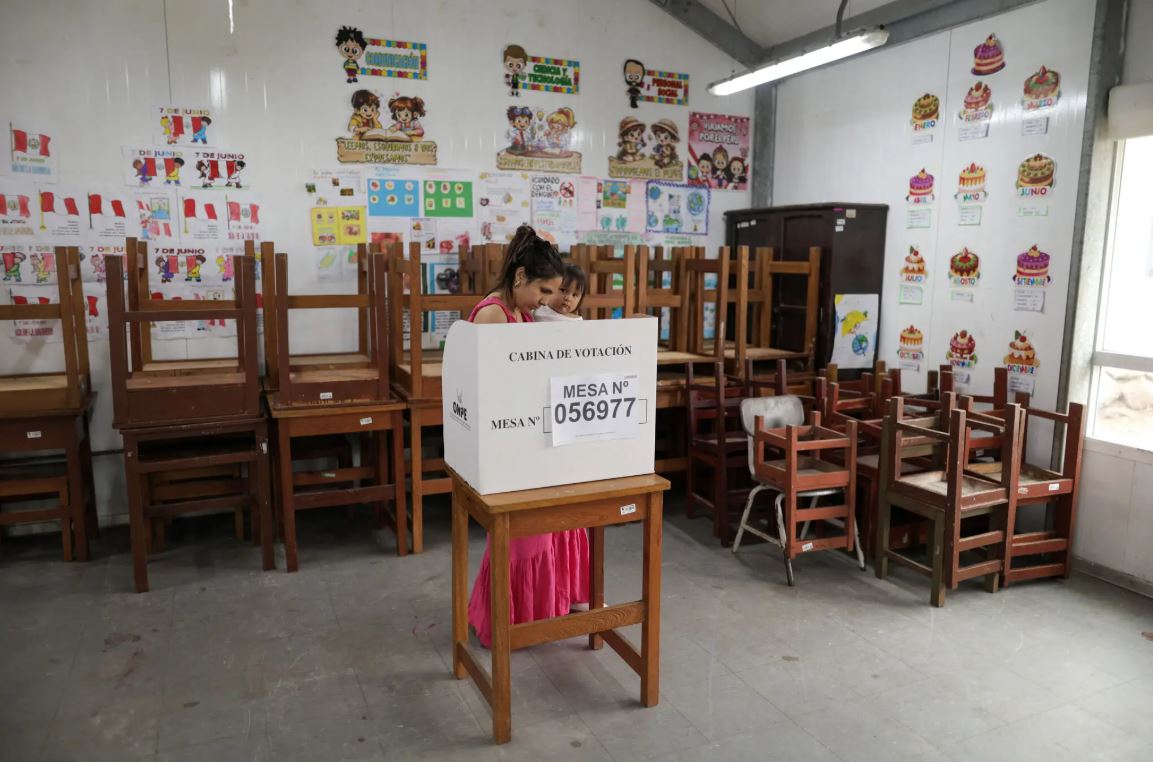
Exit polls in Peru's presidential runoff show a statistical tie, with Keiko Fujimori narrowly ahead of Roberto Sanchez as ONPE began its official count. With 56 percent of votes counted, Fujimori held 52.65 percent against Sanchez's 47.35 percent.
Roberto Sanchez did not concede. Speaking to supporters gathered in central Lima, he said the outcome now rested on poll watchers and urged them to stay vigilant and defend every vote as the official tally continued.
Regional Results: A Nation Split Down the Middle
The internal geography explains the deadlock. Exit polls showed Fujimori dominating Lima 66.1 percent to 33.9 percent, while Sanchez led the regions 56.1 percent to 43.9 percent. Fujimori carried the urban vote at 55.5 percent and the coast at 63 percent, while Sanchez swept the rural vote at 67.8 percent and the sierra at 68.7 percent. It is, in effect, two electorates pulling in opposite directions.
Key regional breakdown at a glance:
- Lima and coast: Fujimori took roughly 64 percent in Lima, dominating urban and northern coastal provinces.
- Southern and central Andes: Sanchez dominated, with one survey placing him above 53 percent in those regions.
- Rural vote: Sanchez won 67.8 percent, reflecting strong support in highland communities.
- Counting order factor: Tally sheets from Lima and the coast, where Fujimori is strong, are digitised quickly, while rural Andean areas backing Sanchez report more slowly, making early totals misleading.
Why this Election matters for Latin America
Peru is one of Latin America's largest mining economies and a major global copper producer. The election outcome could influence investment flows, trade relationships and regional political alignments across South America.
What Drove the Vote: Candidates, Campaigns, and Fault Lines
Fujimori's Fourth Presidential Run
The runoff vote was the fourth in a row for Keiko Fujimori, 51, after narrowly losing in 2011, 2016, and 2021. Many Peruvians accuse her of being a poor loser who for months refused to acknowledge her loss in 2016 and then made unfounded accusations of electoral fraud in 2021. They also blame her for using her Popular Force party to block corruption and organized crime investigations and to destabilize multiple governments, contributing to Peru's run of nine presidents in the last decade.
Sanchez and the Castillo Connection
Roberto Sanchez, a former trade and tourism minister and ally of ex-president Pedro Castillo, has emphasized political reform and social inclusion. His opponent, Keiko Fujimori, has campaigned on restoring order and combating crime.
Sanchez entered the runoff under a prosecutor's request for five years and four months in prison, while Fujimori carried three previous runoff defeats and entrenched anti-Fujimorismo sentiment into the campaign.
Economic Stakes and Market Signals
Peru produces close to 12 percent of the world's copper and holds a mining pipeline valued at roughly $64 billion. The sol and local bonds lagged regional peers as markets priced in runoff uncertainty, and the central bank's short-term expectations gauge turned negative for the first time in nearly two years after the first round. Sanchez moved to reassure the financial sector in the closing stretch, signaling he would retain central bank chief Julio Velarde, while Fujimori ran on private investment and a hard security line.
A Chaotic Path to the Runoff
A disorderly April 12 election day saw delayed delivery of electoral materials hold up voting across dozens of polling stations, leading to an unprecedented one-day extension at sites in Lima and abroad. The review of thousands of disputed vote tally sheets slowed the count further, and mounting backlash prompted the April 21 resignation of the head of the electoral agency.
The first round reflected deep fragmentation, with the top two candidates receiving less than one-third of the vote combined in a crowded field of 35 candidates.