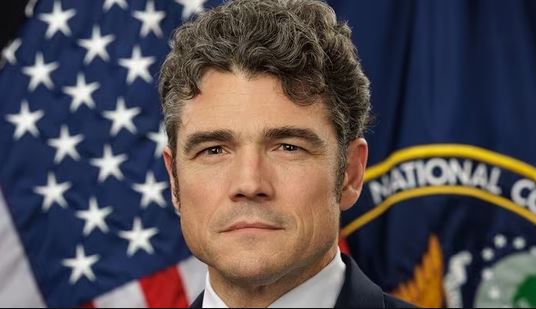
Joe Kent, one of the top counterterrorism officials in the United States, has resigned over his country's war against Iran, making him the highest-level official to leave the Trump administration over the president's decision to wage war on Iran. The resignation landed like a grenade inside an administration already under pressure from within its own ideological base. For an investigative reporter who has spent nearly two decades tracking intelligence failures and the corrosive relationship between foreign lobbying and American foreign policy, this story demands a closer examination of who Kent is, what he actually alleged, and what his departure reveals about the fractures inside the Trump White House.
Who Is Joe Kent?
Military Career and Personal Loss
Kent is a retired Green Beret who served in 11 combat tours and was nominated to the counterterrorism post in February 2025, before being confirmed in July 2025. Kent had previously been a US Army Ranger and member of the US Special Forces, serving 11 combat deployments in the Middle East. His wife was killed by an ISIL suicide bomber in Syria in 2019.
That personal history is not incidental context. In his resignation letter, Kent referenced his wife's death, saying she had been killed in a war manufactured by Israel. He wrote that he could not support sending the next generation off to fight and die in a war that serves no benefit to the American people nor justifies the cost of American lives.
Political Career and Controversial Record
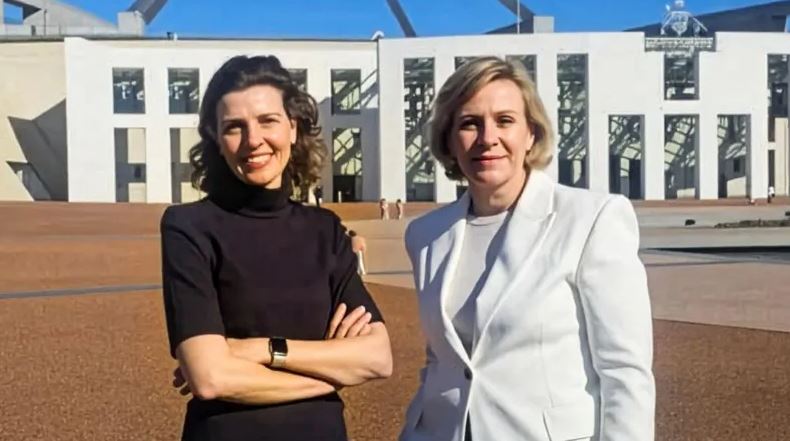
Kent ran for Congress in Washington as a Republican in 2022 and 2024, losing both races to Democratic Representative Marie Gluesenkamp Perez. He later served as Gabbard's acting chief of staff. Trump nominated Kent to lead the National Counterterrorism Center in February 2025, saying he would help keep America safe by eradicating all terrorism, from the jihadists around the world to the cartels in our backyard.
The Senate confirmed him to the position in July 2025, by a vote of 52 to 44, without Democratic support.
His confirmation was not without significant controversy. Two Democrats had opposed Kent's nomination, pointing to his past support of Trump's unfounded claims that the US election in 2020 was stolen and his characterisation of people arrested during the January 6, 2021, riot at the US Capitol as political prisoners. Senator Patty Murray highlighted his past ties to far-right figures, including Nick Fuentes, saying he had a track record of associating with white supremacists.
Kent has endorsed a number of conspiracy theories and taken controversial positions in the past. He has claimed the COVID vaccine was not a vaccine but rather an experimental gene therapy and has also said Anthony Fauci should face murder charges.
Intelligence Politicisation Allegations
Before his resignation, Kent had already generated significant institutional scrutiny. His nomination faced scrutiny when emails emerged showing that while he was chief of staff to Director of National Intelligence Tulsi Gabbard, he had pressed senior intelligence analysts to amend an assessment of links between the Venezuelan government and the criminal gang Tren de Aragua. In the emails, Kent pressed the analysts to align the assessment more closely with Trump administration policies and to include references that criticised Biden-era immigration programs.
He was accused of brazenly trying to politicise intelligence, allegedly ordering analysts to rewrite intelligence assessments to help the White House. GOP senators nevertheless confirmed Kent last summer. His tenure did not quite reach the eight-month mark.
Why Kent Resigned: The Full Argument
The Core Allegation: No Imminent Threat
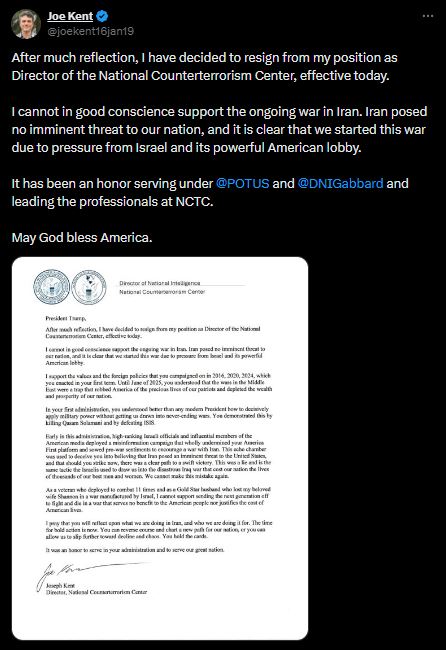
Kent published a copy of his resignation letter on the social media platform X, addressing his correspondence to US President Donald Trump, writing that Iran posed no imminent threat to the nation, and that it was clear the war started due to pressure from Israel and its powerful American lobby.
Kent's stinging rebuke argued that Trump had been misled about the threat posed by Iran. He blamed members of the media, as well as high-ranking Israeli officials and lobbyists, for prompting Trump to abandon his America First agenda. He stated that this echo chamber was used to deceive Trump into believing that Iran posed an imminent threat to the United States, and that if he struck now, there was a clear path to a swift victory. He called this a lie and said it was the same tactic the Israelis used to draw the US into the disastrous Iraq war.
The America First Contradiction
Central to Kent's argument is a charge that the Iran war represents a fundamental betrayal of the political identity Trump ran on. Kent wrote that until June 2025, Trump understood that the wars in the Middle East were a trap that robbed America of the precious lives of its patriots and depleted the wealth and prosperity of the nation. He praised Trump's past military actions, including the killing of General Qassem Soleimani, as examples of the president knowing how to decisively apply military power without getting drawn into never-ending wars.
Kent called on Trump to reflect upon what the US is doing in Iran, and who it is doing it for. He said Trump could reverse course and chart a new path for the nation, or allow it to slip further toward decline and chaos, writing that Trump holds the cards.
The White House Response
Trump's Public Dismissal
The administration moved quickly to discredit Kent and contain the political damage. Trump was asked about Kent's resignation during a meeting with the Irish prime minister. He told reporters in the Oval Office that he had read the statement and always thought Kent was a nice guy, but also always thought he was weak on security, very weak on security. Trump said that when he read Kent's statement, he realised it was a good thing Kent was out, because Kent said Iran was not a threat.
Karoline Leavitt and the Official Counter
Press Secretary Karoline Leavitt published a lengthy statement rejecting Kent's claim that Iran posed no imminent threat and called the idea that Israel goaded President Trump into action insulting and laughable.
Taylor Budowich, Trump's former deputy White House chief of staff and a political consultant, said in an X post that Kent was a crazed egomaniac who was often at the centre of national security leaks while rarely producing any actual work. He said the resignation was not a principled act but that Kent simply wanted to make a splash before getting fired.
Tulsi Gabbard's Carefully Calibrated Silence
Gabbard, who oversees the National Counterterrorism Center, issued a statement that did not mention Kent. She said that the president is responsible for determining what is and is not an imminent threat. She did not voice her views on the war or say the intelligence led her to any particular conclusions. An administration official said Kent was not involved in briefings on Iran and that Gabbard had been in touch with the White House since Kent's resignation.
The Fallout and What It Signals
The Tucker Carlson Factor
The Trump administration is bracing for an expected Tucker Carlson interview with Kent, according to three sources inside and outside the administration. Carlson has been one of the most vocal right-wing critics of both the war and the administration's posture toward Israel.
The MAGA Split on Iran
While Kent and influential figures like Carlson vociferously oppose the war in Iran, polling shows Republicans, and especially MAGA Republicans, are far more supportive of Trump's position. The resignation has thus exposed a genuine and potentially consequential fault line within the political coalition Trump depends on.
One White House official said they believed Kent's resignation could lead to a pattern of other administration officials stepping away from their roles in protest. Another White House senior official said they were shocked by the resignation and noted the rarity of a public resignation of this kind. A third White House official said Kent did not have power or influence despite being the director of the National Counterterrorism Center and encouraged other critics of the war to swiftly exit the administration. All three White House officials were granted anonymity to speak candidly about internal dynamics.
A Dangerous Institutional Vacuum
Kent's departure leaves the United States without a director of the National Counterterrorism Center during a war. That is not a procedural inconvenience. It is a structural failure of national security governance at precisely the moment when centralised, credible intelligence coordination is most critical.
The Democratic Response
Democratic Senator Mark Warner of Virginia called Kent's record deeply troubling but said he agreed with the resignation. Warner said he strongly disagreed with many of the positions Kent had espoused over the years, particularly those that risk politicising the intelligence community. But he said that on this point, Kent was right: there was no credible evidence of an imminent threat from Iran that would justify rushing the United States into another war of choice in the Middle East.
Why This Resignation Matters Beyond the Headlines
Joe Kent is not a straightforward hero of this story. His record includes documented attempts to pressure intelligence analysts, associations with far-right figures, and a history of promoting unfounded claims about elections and public health. Accountability journalism demands that both facts exist simultaneously.
What his resignation does unambiguously establish is this: the director of the National Counterterrorism Center, the president's own principal counterterrorism adviser, did not believe the intelligence case for war with Iran met the legal and strategic threshold of an imminent threat. That judgement was made by someone with 11 combat tours, direct experience of losing a family member to Middle East conflict, and access to the classified assessments that the public does not see.
Whether Kent's broader political claims about Israeli lobbying influence are accurate, overstated, or weaponised for another agenda is a question that journalists and investigators will be examining for months. What is not in dispute is that the most senior national security official to resign over this war did so because he believed the foundational justification for it was false.