Fraud Case Against Big Pharma What the Court Actually Decided and Why It Matters
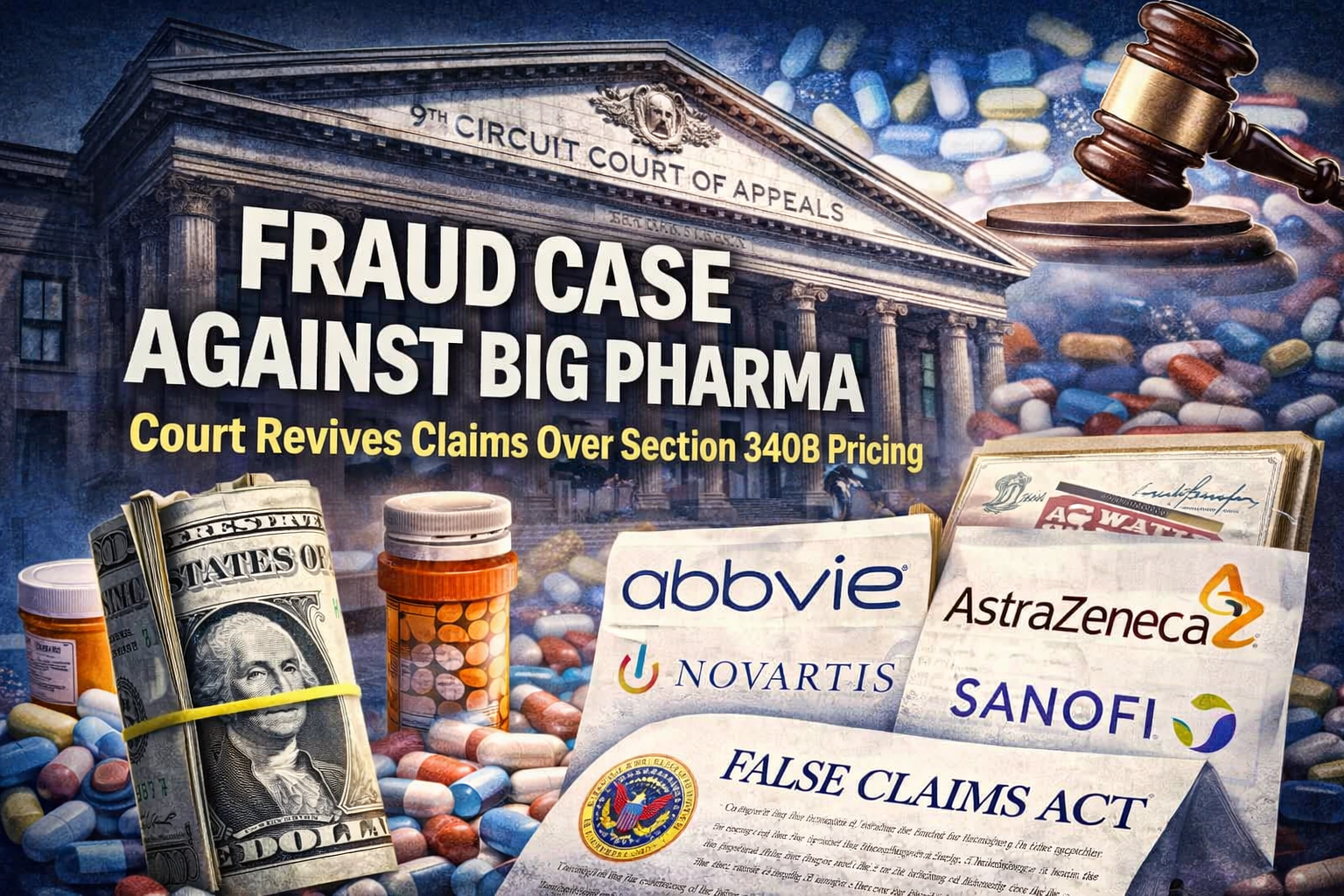
On March 17, 2026, the 9th U.S. Circuit Court of Appeals in Pasadena, California issued a unanimous 3-0 ruling that AbbVie, AstraZeneca, Novartis, and Sanofi must defend against claims they violated the federal False Claims Act through their involvement in the Section 340B Drug Pricing Program.
This was not a minor procedural development. It was a direct reversal of a 2024 dismissal that had effectively shielded four of the world's most powerful pharmaceutical companies from accountability. The case is now headed back to the district court in Los Angeles, and the financial consequences, if the allegations are proven, could reach into the hundreds of millions of dollars.
The ruling was written by Circuit Judge Roopali Desai. Desai held that while Section 340B does not give medical providers a private right to sue drugmakers for overcharges, they can pursue claims under the False Claims Act to recover damages for alleged fraud that causes financial loss to the government. In plain terms: a healthcare provider cannot sue a drugmaker directly for breaking 340B rules, but it can absolutely sue on the government's behalf if that rule-breaking cost taxpayers money.
That legal distinction is the key to understanding why this ruling is so significant, and why the pharmaceutical industry fought so hard to kill the case before it ever reached a jury.
The 340B Program: Designed for Charity, Allegedly Exploited for Profit
What Section 340B Actually Requires
The Section 340B program, established by Congress in 1992, enables certain healthcare providers to purchase drugs at reduced prices. In some cases, those prices can drop as low as one cent, a mechanism commonly referred to as penny pricing.
The program exists for a specific and urgent reason. Safety-net hospitals, federally qualified health centers, and clinics that serve low-income, uninsured, and underinsured populations operate on chronically thin margins. Congress created the 340B program to stretch those limited resources further, allowing covered entities to purchase medications at deep discounts and use the savings to fund broader patient care.
The 340B program requires pharmaceutical manufacturers to sell outpatient drugs at significantly discounted prices to eligible covered entities, mainly safety-net hospitals and clinics serving deprived populations.
In other words, participation in 340B is not a gift from the industry. It is a legal obligation that manufacturers accept in exchange for having their products covered by Medicaid and Medicare.
The Penny Pricing Mechanism at the Center of the Fraud Allegations
The statutory formula for calculating ceiling prices under 340B can, in certain circumstances, push allowable prices to or below zero. When the 340B statutory ceiling prices fall below zero, manufacturers must offer drugs at a nominal price of one cent per unit, a provision commonly referred to as penny pricing.
According to the lawsuit, the four named drugmakers were aware of when their statutory ceiling prices required penny pricing but continued charging far more. The alleged scheme persisted for years, and according to the plaintiff, only came to a halt after federal authorities stepped in.
In 2019, the U.S. Department of Health and Human Services began imposing significant civil penalties for violations of the 340B pricing rules, which the plaintiff said brought the alleged overcharging to a halt.
That timing is not incidental. It suggests the conduct did not stop because of internal compliance or corporate ethics. It stopped because the government finally attached a financial cost to getting caught.
Who Brought the Case and How the Law Works
The Whistleblower: Adventist Health System/West
The case was brought by Adventist Health System/West, a nonprofit healthcare provider based in Roseville, California, which operates more than 440 hospitals and clinics.
Adventist filed its complaint in May 2021 on behalf of the United States and California, among other states, asserting that the drugmakers engaged in a fraudulent scheme by signing up under the 340B program but charging unlawfully inflated prices.
Adventist claims it discovered the alleged fraud in January 2019, when the prices charged by the defendants appeared to drop sharply to one cent per unit after HHS issued a rule imposing civil penalties for non-compliance. The sudden drop in prices, rather than demonstrating compliance, actually suggested to Adventist that the companies had known all along what the correct price should have been.
How the False Claims Act Becomes the Legal Vehicle
The False Claims Act allows private individuals, often referred to as whistleblowers, to file lawsuits on behalf of the government and share in any financial recovery, a provision that has led to significant settlements in healthcare fraud cases.
Under the False Claims Act, defendants face liability of between $5,000 and $10,000 per false claim, plus treble damages. In a case involving years of alleged overcharges across hundreds of covered entities, the cumulative exposure could be staggering.
The pharmaceutical companies tried to argue that Adventist had no standing to bring the case at all. Their position was that disputes over 340B pricing belong in administrative channels with HHS, not in federal court. The pharma companies argued that Adventist had no right of action because disputes over 340B payments should be pursued under administrative procedures with federal and state governments, and that it was going beyond its position by effectively suing to enforce 340B.
The 9th Circuit rejected that argument entirely.
The Lower Court Dismissal That the Appeals Court Reversed
What the District Court Got Wrong
On March 18, 2024, Senior District Court Judge Dale Fischer of the Central District of California granted the drugmakers' motion to dismiss, citing the 2010 Supreme Court decision in Astra USA Inc. v. Santa Clara County, which held that a provider may not bring claims to enforce ceiling price contracts between manufacturers and HHS, as Congress only provided for administrative review.
Fischer concluded that the False Claims Act added nothing substantive to a direct enforcement action under the 340B statute. That reasoning, while logical on its face, overlooked a critical distinction: Adventist was not suing to enforce 340B for its own benefit. It was suing on behalf of the government to recover taxpayer money lost to fraud.
Why the 9th Circuit Disagreed
The 9th Circuit reversed, concluding that the absence of a private right of action under the 340B statute does not preclude False Claims Act claims based on alleged overcharges.
Judge Desai's opinion identified three separate reasons why dismissal was an error, all centered on the principle that blocking whistleblower claims of this nature would fundamentally undermine the purpose of the False Claims Act itself.
The court stated that barring Adventist's claims would undermine the False Claims Act, a statute that courts interpret broadly and that does not exempt qui tam actions by covered entities for alleged fraud against the government from the Section 340B Program.
The Broader Industry Pattern This Case Reflects
This lawsuit does not exist in isolation. It is one front in a years-long battle between the pharmaceutical industry and the regulatory framework built around 340B. Manufacturers have repeatedly challenged, restricted, and litigated against the program's requirements, often with considerable legal success.
Section 340B has become a focal point for drug pricing-related litigation in the United States, with a series of challenges attempting to block an HHS pilot scheme seeking to implement a new rebate model that covered entities argue will cause harm and could force some to close.
The same companies named in this lawsuit, AbbVie, AstraZeneca, and Novartis, have separately moved to intervene in litigation challenging a proposed rebate model that would have fundamentally changed how 340B discounts are delivered. In December 2025, a federal court in Maine issued a nationwide preliminary injunction blocking the government's implementation of the 340B Rebate Model Pilot Program, after determining that the Health Resources and Services Administration likely violated the Administrative Procedure Act during the rebate program's rollout.
The pattern is consistent: litigation as a tool to delay, limit, or eliminate the obligations that 340B places on manufacturers.
What Happens Next
The appeals court has sent the case back to U.S. District Judge Dale Fischer in Los Angeles for further proceedings. The appeals court found that while providers cannot sue drugmakers directly under the 340B statute, they can pursue claims under the False Claims Act if alleged overcharges caused financial loss to the government, and overturned the March 2024 ruling dismissing the case.
The four named companies, AbbVie, AstraZeneca, Novartis, and Sanofi, have all declined to comment on the ruling. The silence is telling. Companies that believe they have done nothing wrong typically say so. Companies with significant legal exposure typically say nothing at all.