Japan's Viral Baby Monkey Punch On March 17, 2026, it was reported that Punch the monkey found a girlfriend named Momo-chan, and the internet collectively lost its mind in the best possible way. For the millions of people who followed his heartbreaking early story, this update is more than just a feel-good moment. It is a real-world demonstration of how primate social development, attachment behaviour, and resilience actually work, and why scientists find Punch's journey so scientifically significant.
Who Is Punch the Monkey?
Punch, known in Japanese as Panchi-kun, is a baby Japanese macaque, also called a snow monkey, born on July 26, 2025, at the Ichikawa City Zoo in Japan. He was named after Monkey Punch, the manga artist who authored Lupin the Third.
He was abandoned by his mother, who lacked interest in raising him. Alison Behie, a primatology expert at Australian National University, attributed age, health, and inexperience as potential factors in mothers abandoning their offspring. Zookeepers also suggested that Punch was born during a heatwave, which is a high-stress environment for mothers giving birth, and they may prioritise their own health and future reproduction rather than continuing to raise a newborn.
To ensure his survival, zookeepers stepped in to hand-rear the primate. To help him socialise and build muscle, zoo officials gave Punch a Djungelskog orangutan plushie from IKEA, which he began clinging to and treating as a surrogate mother.
How Punch Became a Global Viral Sensation
On February 5, 2026, the zoo made an online post about Punch's backstory, which became an overnight sensation. More images of Punch with the orangutan plushie soon went viral in Japan and abroad, and the hashtag HangInTherePunch began circulating online. Nicknames were also given to the plushie itself, such as Oran-Mama or Oran-Mother.
Long queues began forming at the Ichikawa City Zoo, which zoo officials considered unprecedented, causing them to apologise for delays in entry. The number of visitors to the zoo in February 2026 doubled from the previous year.
In March, Blackpink member Lisa visited Punch herself and posted an Instagram story of her own orangutan plushie from IKEA. Oscar winner Christian Bale also drew comparisons between Punch and his own Frankenstein monster character.
On February 17, IKEA representatives visited the Ichikawa City Zoo and donated 33 stuffed toys to Punch. Sales of the Djungelskog orangutan plushie heavily increased, selling out in the majority of IKEA locations.
The Science of Maternal Abandonment in Japanese Macaques
Understanding why Punch was abandoned requires a brief look at what primatology research tells us about Japanese macaque maternal behaviour.
Japanese macaques, or Macaca fuscata, are highly social animals that live in large troops with complex dominance hierarchies. Mother-infant bonding is central to a juvenile macaque's early development, providing not only nutrition but also social learning, emotional regulation, and protection from adult aggression.
When that bond is absent from birth, the consequences are well-documented in the scientific literature. Infants raised without maternal contact show elevated cortisol levels, heightened anxiety responses, and significant difficulties in reading and responding to the social cues of other group members. Punch's early reliance on his IKEA plushie is not simply endearing. It is a textbook example of what researchers call a contact comfort substitute, a concept first described in the landmark experiments of psychologist Harry Harlow in the 1950s.
Harlow's work demonstrated that infant primates separated from their mothers would cling to soft surrogate objects when stressed, deriving measurable psychological calming from physical contact even with an inanimate object. Punch's behaviour with Oran-Mama maps precisely onto this well-established mechanism.
Was Punch Actually Being Bullied? What Zookeepers and Scientists Said
One of the most widely shared chapters of Punch's story was the concern that he was being bullied by other monkeys in the troop, a narrative that spread rapidly online in February 2026.
After the zoo posted on X last month that Punch had been scolded many times by other monkeys, videos showing him being chased by members of the troop were spread online, alongside claims that he was being bullied.
The uproar online prompted the zoo to issue a statement on X. The adult monkey that dragged Punch is probably the mother of the monkey with whom Punch tried to communicate, the statement read. She probably felt that her baby was annoyed by Punch and got upset, expressing do not be mean.
Punch's zookeeper Shunpei Miyakoshi told CNN that the seemingly rough videos that alarmed Punch's global legions of fans are just part of growing up for the seven-month-old macaque. He also said widely shared videos capturing rough encounters only account for a few minutes of Punch's day.
This is consistent with what behavioural primatologists describe as social learning through correction. In macaque troops, juvenile animals are regularly disciplined by adult members as part of the process of learning acceptable social behaviour. What reads to human viewers as bullying is, in many cases, the normal mechanism through which young primates learn the boundaries of social interaction within a troop.
Punch Meets Momo-chan: The Girlfriend Update Explained
Who Is Momo-chan?
Punch has been pictured and videoed playing affectionately with a female macaque named Momo-chan, also referred to in some reports as Moe. According to zoo keepers at Ichikawa City Zoo, the two have grown close and are regularly seen together.
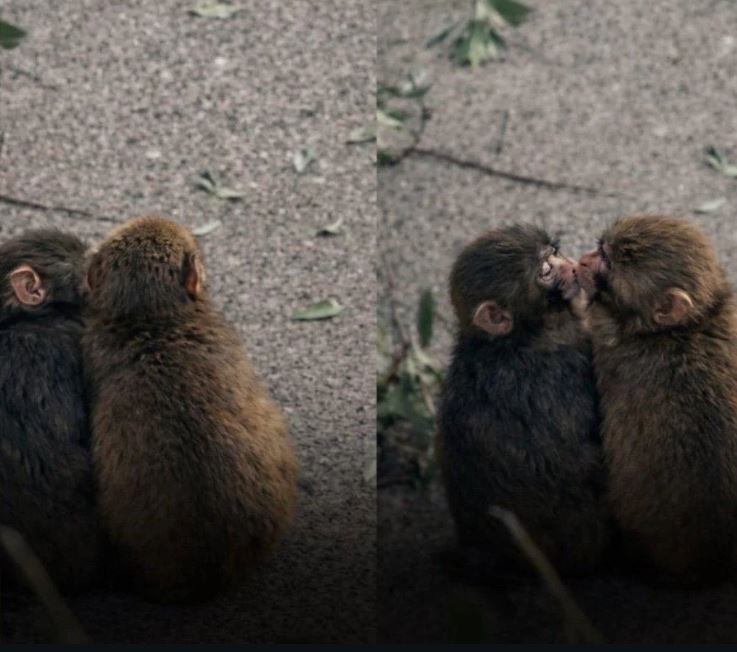
On March 16, visitors shared footage from the zoo showing the pair sitting closely together, grooming and playing like typical baby monkeys. One viral image shows the two sitting side by side before turning toward each other and appearing to share what fans have jokingly called a kiss.
There is even a video that shows Moe playfully tugging at Punch's tail while the pair sit together, before Punch turns around and wraps his arms around her.
Why the Colour Connection Matters Scientifically
Perhaps the most scientifically interesting detail in this update is the observation that Momo-chan shares the same warm colouring as Punch's beloved plushie, Oran-Mama.
People online have noted that Punch loves his new companion so much because she is the same colour as his beloved plush toy. His new companion turned out to be the same colour as the plush mom he used to carry everywhere.
Whether this is coincidence or reflects a genuine imprinting-related preference is an open question, but it is one worth taking seriously. Research on early attachment and imprinting in primates has shown that young animals can develop persistent aesthetic or physical preferences based on the characteristics of their early attachment figures, whether those figures are biological mothers or inanimate surrogates. If Punch has formed a preference for companions that resemble his orange plushie, that would be a genuinely notable real-world example of surrogate imprinting influencing later social bonding.
What Grooming Behaviour Tells Us
The grooming behaviour observed between Punch and Momo-chan is more scientifically significant than casual observers might assume. In primates, mutual grooming, known formally as allogrooming, is the primary mechanism through which social bonds are formed and maintained. It triggers the release of endorphins and oxytocin in both participants, reinforcing the social connection and reducing stress.
For Punch specifically, the shift from clinging to an inanimate object for emotional regulation to engaging in reciprocal grooming with a living companion represents a meaningful developmental milestone. It suggests his stress response and attachment systems are beginning to function in a socially adaptive way.
Punch's Ongoing Social Integration
The Road to Full Integration
The road to full integration remains long. During CNN's recent visit to the zoo, the baby monkey was spending most of his time alone. Videos popping up on social media occasionally show hairy moments.
He still uses his plushie when he feels it is necessary, like when he is going to sleep, or when he has been disciplined by an adult monkey and feels a bit down. He goes to it to calm himself down, said zookeeper Shunpei Miyakoshi.
This is entirely consistent with how attachment objects function in animal psychology. They serve as a secure base to which the animal returns when stressed, while gradually becoming less central as new social relationships provide the same regulatory function.
A Breakthrough Milestone
In a dramatic turn of events that captured the attention of animal lovers worldwide, Punch reached a major milestone in his journey toward social integration. On Thursday, visitors and staff at the Ichikawa Zoological and Botanical Garden witnessed a breakthrough: Punch was seen cuddling with and hitching a ride on the back of a fellow macaque.
The baby monkey's bond with Momo-chan marks a significant step for Punch, who spent months being rejected by the troop and even getting into scuffles with his fellow primates.
As of February 23, 2026, the Ichikawa City Zoo reported that Punch was playing with other monkeys and able to eat without requiring help from a caretaker.
The Broader Scientific Context: Why Punch's Story Resonates
Nasser Hashem, from the US, planned a trip to Japan with his sister just to see Punch. He said he thinks we all could relate to him in some sense, being in an unfamiliar environment, not knowing the people around you, and then just trying to fit in as much as we can.
That instinct is not merely sentimental. It reflects a genuine biological commonality. The neuroscience of social exclusion, attachment, and belonging is largely conserved across mammalian species. The brain circuits activated in Punch when he clings to his plushie after being scolded, and the circuits now activated when he grooms with Momo-chan, are the same circuits that govern human social pain and social reward.
This is precisely why viral animal stories like Punch's land with such force. They are not distractions from science. They are windows into it.