What Is Exercise Dweep Shakti and Why Does It Matter Now
From March 24 to 28, 2026, India conducted Exercise Dweep Shakti, a high-intensity tri-service drill designed to demonstrate the nation's enhanced capacity for rapid and coordinated defence operations in coastal and island territories. The name itself, drawn from Sanskrit, translates to "Island Power," and that is precisely the strategic signal New Delhi is transmitting to the region.
For those tracking power dynamics in the Indo-Pacific, this exercise is not simply a routine military rehearsal. It is a carefully calibrated demonstration of force readiness at one of the most geopolitically sensitive archipelagos on earth. The Andaman and Nicobar Islands sit at the mouth of the Strait of Malacca, the world's busiest maritime chokepoint, through which an estimated 90 percent of global trade transits. Anyone who controls, or credibly threatens to deny access to, this corridor holds enormous leverage over regional and global commerce.
The timing of Dweep Shakti 2026 is deliberate. It arrives at a moment when Chinese naval activity in the Bay of Bengal and surrounding waters has intensified. India is undertaking a major military and infrastructure buildup in the Andaman and Nicobar Islands as concerns grow over China's activities in the strategic region, which sits approximately 1,200 kilometers from the Indian mainland but just 150 kilometers from Indonesia and 55 kilometers from a Chinese-linked military outpost on Myanmar's Coco Islands. Exercises like Dweep Shakti are India's answer in kinetic, visible terms.
Who Conducted Exercise Dweep Shakti 2026 and How It Was Organised
The Andaman and Nicobar Command successfully executed Exercise Dweep Shakti 2026, a comprehensive joint military drill held from March 29 in Sri Vijaya Puram, bringing together assets from the Indian Army, Indian Navy, Indian Air Force, and Indian Coast Guard, alongside contingents from formations across the nation.
The exercise was conducted under the aegis of the Andaman and Nicobar Command, India's only theatre command, utilising the strategic geography of the Andaman and Nicobar archipelago. That last point deserves emphasis. India has only one tri-service theatre command, and it is located precisely here, at the maritime gateway between two oceans. The Andaman and Nicobar Command's very existence as a unified command structure, rather than separate single-service commands, reflects how seriously India treats island and maritime defence as a joint warfighting domain.
Vice Admiral Ajay Kochhar, Commander-in-Chief of the Andaman and Nicobar Command, personally witnessed the exercise and commended participating troops from various formations for their professionalism and the successful conduct of operations. Senior leadership observing an exercise in person is a standard signal that the drill carries institutional weight beyond training value alone.
What Specific Military Capabilities Were Tested During the Drill
This is where the operational substance of Dweep Shakti becomes analytically significant. The exercise was not a static display. It stress-tested real warfighting procedures under conditions designed to mimic actual conflict scenarios in island and littoral environments.
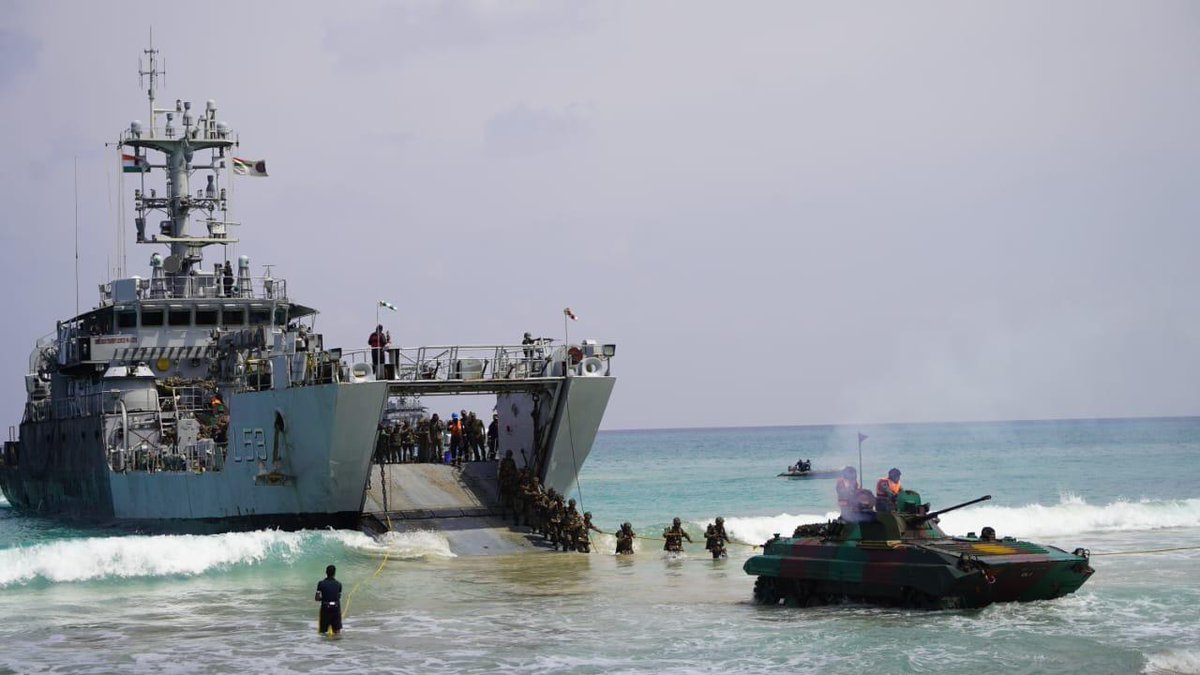
The Indian Army, Navy, and Air Force executed coordinated amphibious assaults, maritime dominance operations, and complex beach landing drills, employing next-generation equipment and drones, reaffirming precision, jointness, and mission-ready interoperability.
Each of these components carries distinct strategic value. Amphibious assault capability means the ability to project power from the sea onto a hostile shore, a core requirement in any scenario involving island capture or recovery. Maritime dominance operations relate to controlling sea lanes and denying adversarial naval freedom of movement. Beach landing drills refine the logistical and tactical mechanics of the most dangerous phase of any amphibious campaign, the moment of transition from ship to shore.
The exercise featured integration of advanced technologies including UAVs, real-time coordination between land, sea, and air forces, and validation of rapid deployment capabilities in coastal scenarios. Drone integration in particular reflects the lessons absorbed from recent conflicts globally, where unmanned systems have reshaped both surveillance and strike calculations at the tactical level.
Deployment of Army, Navy, and Air assets across the islands, along with the activation of key operational and support mechanisms in coordination with the local civil administration of the Andaman and Nicobar Islands, formed a vital component of the exercise. Civil-military coordination is often overlooked in public analysis but is operationally critical. In island environments with limited infrastructure, military effectiveness depends on civilian logistical networks for supply, communications, and local knowledge.
Where Does Dweep Shakti Fit Within India's Broader Strategic Posture
To understand why this exercise matters beyond its immediate operational context, one must situate it within India's evolving Indo-Pacific strategy.
As China expands its presence in the Indian Ocean through its String of Pearls strategy, establishing ports and bases in Sri Lanka, Pakistan, Myanmar, and Djibouti, India has responded by enhancing the Andaman and Nicobar Command's military capabilities, including surveillance drones, P-8I maritime patrol aircraft, expanded naval bases, and strategic partnerships with Indo-Pacific allies.
The Ten Degree Channel within India's exclusive economic zone is the world's busiest shipping trade route, connecting to the narrow Strait of Malacca and the Singapore Strait. This route is considered the world's biggest strategic chokepoint, and India and its allies could potentially impose a blockade in case of a dispute with China, whose economy significantly depends on export trade through this route.
That is the strategic geography underlying every soldier, sailor, and airman who participated in Dweep Shakti 2026. The Andaman and Nicobar Islands are not just territory to be defended. They are a lever of potential economic coercion in any future confrontation with Beijing.
Exercise Dweep Shakti 2026 reinforces India's unwavering commitment to regional peace and security, particularly in the Indo-Pacific theatre where the Andaman and Nicobar Islands hold pivotal geostrategic importance, and serves as a benchmark for future tri-service collaborations, enhancing India's deterrence capabilities against potential adversaries.
How Dweep Shakti Advances India's Jointness Doctrine
Dweep Shakti reflects India's shift towards integrated warfare. Modern conflicts demand seamless coordination across land, sea, and air domains. The exercise helped refine joint tactics and procedures while improving response time in complex scenarios and demonstrated India's ability to operate in multi-domain environments, including littoral and island regions.
India's defence establishment has long grappled with inter-service coordination gaps. The creation of the Chief of Defence Staff post in 2020 and the push toward theatre commands have been designed precisely to eliminate the kind of operational silos that have historically hampered joint responses. Dweep Shakti is both a test of how far that transformation has progressed and a public demonstration that integration is no longer aspirational. It is operational.
The primary objective was to refine multi-domain joint warfighting capabilities and standard operating procedures, with participants focused on boosting interoperability and operational synergy essential for coordinated responses in complex scenarios. Elements from the Andaman and Nicobar Command's Army, Navy, Air Force, and Coast Guard components played central roles, augmented by Special Forces and reinforcement units from all three services.
The inclusion of Special Forces is strategically notable. Unconventional capabilities embedded within a conventional tri-service exercise suggest India is preparing for a full spectrum of contingencies in the island theatre, from high-intensity conventional conflict to surgical, precision-based operations.