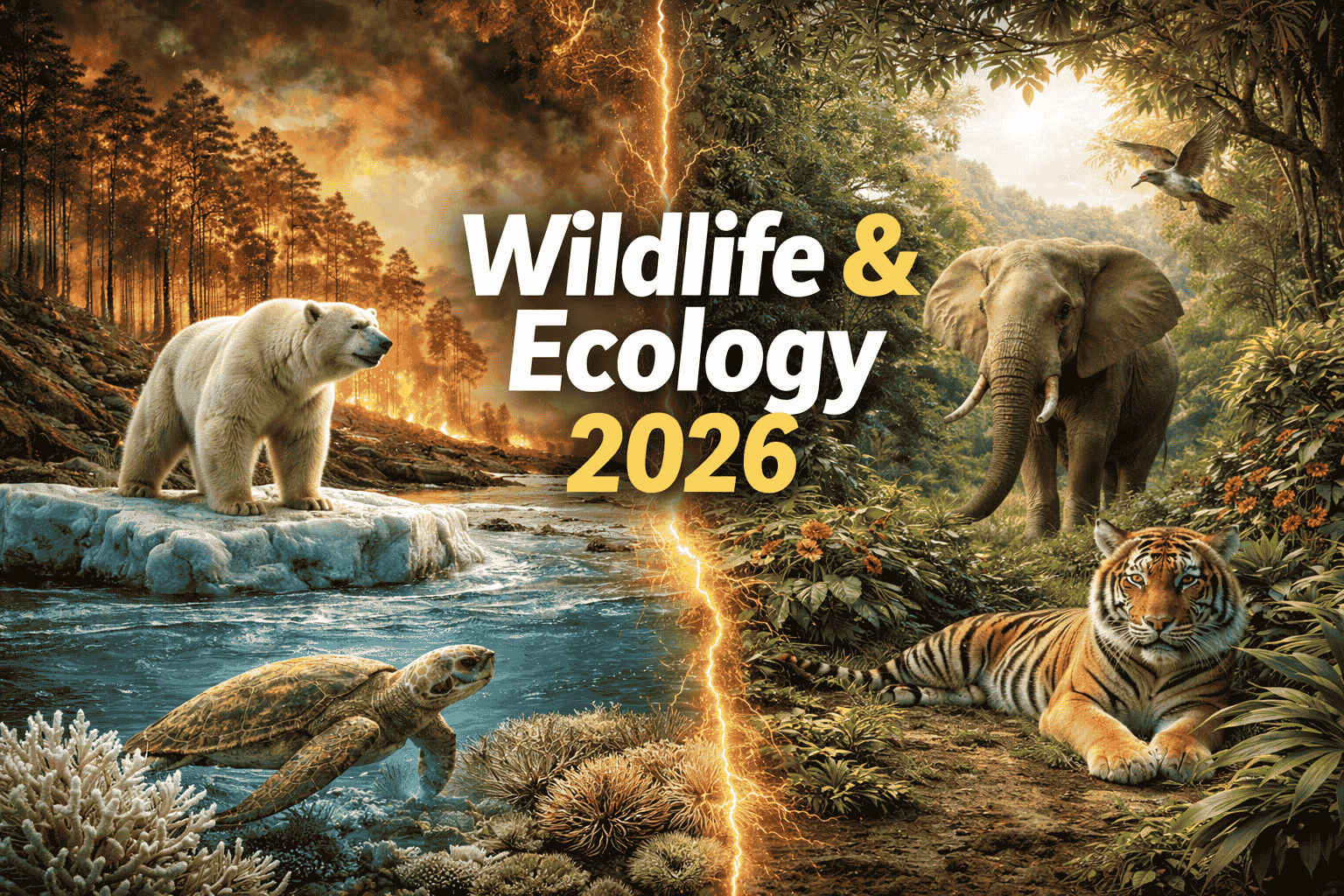
The natural world in 2026 is sending signals that science can no longer afford to treat as background noise. From the bleached skeletons of coral reefs to the shrinking ranges of polar species, the ecological consequences of a warming planet are arriving faster and with greater intensity than most models predicted a decade ago. At the same time, new research is revealing something equally important: some species are adapting, some ecosystems are resilient, and conservation science now has tools it never had before. The story of wildlife and ecology in 2026 is not simply one of loss. It is one of the urgent, unfinished reckonings.
Who Is Most Threatened by Climate Change in 2026
The Species on the Sharpest Edge
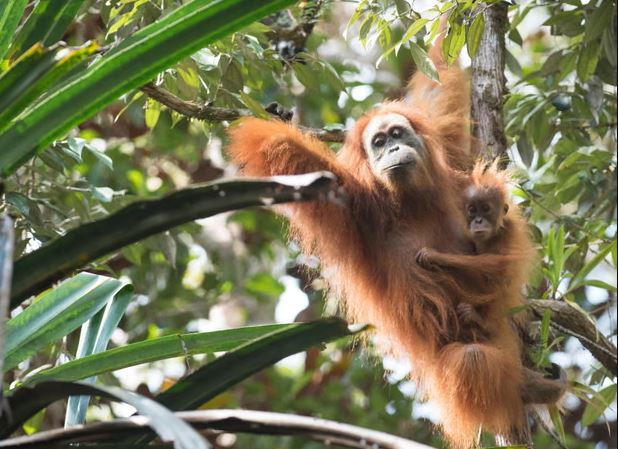
The IUCN Red List now tracks over 44,000 threatened species, a figure that has risen 10% since 2020. Amphibians lead all groups, with 41% at risk, followed by mammals at 26%. The drivers are well documented: habitat destruction, climate shifts, poaching, and invasive species, and they rarely act alone.
The most critically endangered animals in 2026 include the vaquita porpoise, with fewer than 10 individuals remaining, the Javan rhinoceros, with under 75 left in a single national park in Indonesia, and the saola of the Annamite Mountains in Vietnam and Laos, which has recorded no confirmed sightings in recent years. Each of these species represents a system failure: not a single cause, but a convergence of illegal trade, habitat loss, and climate pressure that has narrowed the window for recovery to almost nothing.
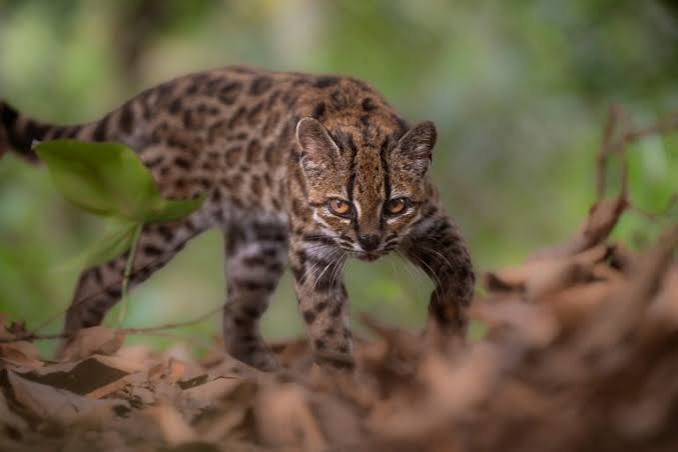
Fauna and Flora's 2026 Species to Watch list identifies the clouded leopard, wild tulip species of Central Asia, and the Utila spiny-tailed iguana of Honduras among the animals facing the most acute pressures this year. The Utila iguana, confined entirely to a single island's mangrove forests, has seen its estimated population grow from 3,000 to 6,000 individuals to an encouraging 7,000 to 14,000, thanks to targeted conservation work. That number matters because it demonstrates what focused intervention can accomplish even under extreme constraint.
Who Is Bearing the Weight of Habitat Destruction
Habitat destruction remains the single greatest threat to wildlife worldwide. In 2026, forest area equivalent to several football fields is being lost every minute globally, and wetlands, grasslands, and other critical ecosystems face parallel pressure from agriculture, urban expansion, and infrastructure development.
The Brazilian Amazon lost 6,288 square kilometers of forest between August 2023 and July 2024, a 30.6% drop from the prior year and the lowest deforestation rate in nine years. That reduction is meaningful, but it still represents an area roughly the size of Delaware cleared from the world's most biodiverse forest in a single year. The neighboring Cerrado savanna continues to face conversion to soy and cattle ranching at scale. Tropical forests house over half of all terrestrial species, making losses in these regions disproportionately consequential for global biodiversity.
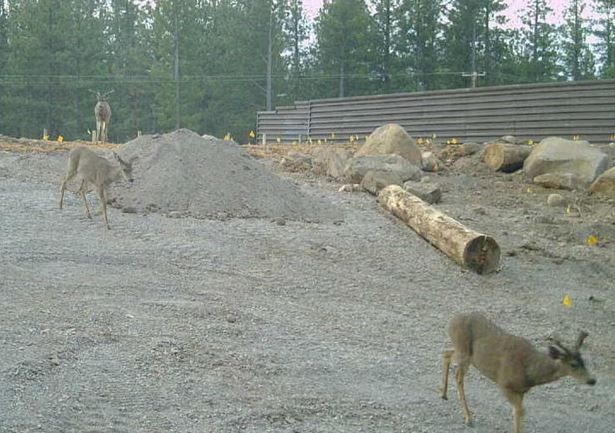
Fragmentation compounds the crisis. When large habitats are divided into smaller, isolated patches, populations become genetically isolated, reducing resilience and increasing extinction risk. Small, separated populations face heightened vulnerability to disease, natural disasters, and inbreeding, even when individual habitat patches remain intact.
Who Is Studying How Species Are Adapting
The Science of Phenological Change
A major international meta-study published in Nature Communications in early 2026, led by scientists from the Leibniz Institute for Zoo and Wildlife Research, James Cook University, and University College Cork, analyzed 213 scientific studies covering 73 vertebrate species across more than 60 research institutions. The findings are both reassuring and cautionary.
The research confirmed that phenological traits, including breeding timing, migration schedules, and egg-laying dates, are shifting in response to warming temperatures. Critically, many of these shifts are proving adaptive. Species are not simply being disrupted by climate change; in a substantial number of documented cases, they are adjusting behaviors in ways that maintain or even improve population health. In some bird species, the onset of nesting has shifted nearly two weeks earlier over a few decades, aligning with changes in peak food availability.
However, the study's authors were careful to note the limits of this encouraging picture. Plasticity, the ability to adjust behavior within a lifetime rather than through genetic evolution, has a ceiling. As Dr. Tom Reed of University College Cork noted, the effect of warming on phenology is clear but the implications for wildlife are heterogeneous. Assuming that adaptability is unlimited would be a scientific and policy mistake. Species living at higher latitudes, closer to the poles, showed greater sensitivity to temperature change, making them among the most vulnerable as warming continues.
Who Is Losing the Race Against Ocean Warming
Marine ecosystems are experiencing some of the most visible and rapid ecological shifts on the planet. As of early 2026, more than half of the world's coral reefs are affected by bleaching. The current global bleaching event, which began in 2023, has now affected reef areas in at least 83 countries and territories. Conservative projections suggest mass bleaching could hit the majority of the world's reefs every single year by 2050 if current warming trajectories continue.
The consequences extend far beyond the reef itself. Coral reefs occupy less than 1% of the ocean floor but support roughly 25% of all marine species. Global coverage of living coral has declined by half since the 1950s, and at least 63% of coral-reef-associated biodiversity has declined alongside that loss. Catches of coral-reef-associated fish peaked in 2002 and have been falling since, despite increasing fishing effort. Coastal communities across the tropics that depend on reef fisheries for food security and income are absorbing these losses in real time.
A striking counterpoint emerged from deep-sea research in 2026: scientists discovered a thriving reef ecosystem in deeper, cooler waters that appears largely insulated from the surface temperature extremes devastating shallow warm-water reefs. Its ecosystem is teeming with crustaceans, sea anemones, octopuses, and sharks. The discovery does not offset the scale of shallow reef loss, but it does expand scientific understanding of where marine biodiversity may find refuge as conditions continue to change.
Who Is Leading Conservation Efforts in 2026
Technology as a Conservation Tool
Conservation in 2026 is increasingly technology-driven. Drones are monitoring deforestation in the Amazon in real time, allowing intervention before clearing is complete. AI algorithms are analyzing camera trap data, acoustic recordings, and environmental DNA samples at a speed and scale that would have been impossible a decade ago. The Global Biodiversity Information Facility now adds hundreds of millions of species records annually, drawn from birdwatching apps, museum collections, and automated environmental sensors.
Environmental DNA, which allows researchers to detect species from traces left in soil or water, is enabling detection of populations that camera traps and field surveys would miss entirely. Acoustic monitoring combined with machine-learning identification is capturing entire soundscapes, building ecological baselines that conservation managers can track over time.
Who Is Funding the Fight for Biodiversity
The Brazil-led Tropical Forests Forever Facility, launched in late 2025, aims to raise a $125 billion fund to reward tropical countries for keeping deforestation low. Participating countries would receive annual payments based on measurable performance, with penalties for forest loss or fire damage. The fund is designed to give greater financial agency to the Global South, with a required minimum of 20% of funds directed to Indigenous peoples and local communities, who are recognized as among the most effective frontline guardians of intact ecosystems.
Community-driven conservation is showing measurable results. Programs led by the Wildlife Conservation Society in Africa and Southeast Asia have employed local communities in habitat protection and species monitoring, resulting in a reported 46% decrease in poaching activities in targeted areas, according to WWF data. Empowering communities financially and institutionally is proving not just ethically sound, but operationally effective.
What the Ecological Data Is Telling Scientists
Nearly 90% of North America's insect and arachnid species have no formal conservation assessment, according to a study published in March 2026. A separate analysis of over 2,000 insect species found that many may be far less capable of coping with rising temperatures than previously estimated. Insects underpin terrestrial food webs in ways that make their decline a structural threat to ecosystem function, not merely a biodiversity statistic.
The data landscape itself is changing. Global biodiversity databases are richer than ever, but researchers writing in the Proceedings of the National Academies of Science in 2026 identified nine critical gaps that must be addressed to translate that data into conservation decisions. More information is being collected, but it is not yet being converted into effective action at the pace the ecological crisis demands.