When Finance Minister Nirmala Sitharaman rose in Parliament on February 1, 2025, she presented a budget built on two competing demands: the ambition to accelerate India toward Viksit Bharat by 2047, and the fiscal discipline required to earn a sovereign rating upgrade. The government is estimated to spend Rs 50,65,345 crore in 2025-26, which is 7.4% higher than the revised estimate of 2024-25. What follows is a data-driven breakdown of where that money goes, which sectors win, and what the structural choices signal for India's economic trajectory.
What Is the Total Expenditure in India's Union Budget 2025-26?
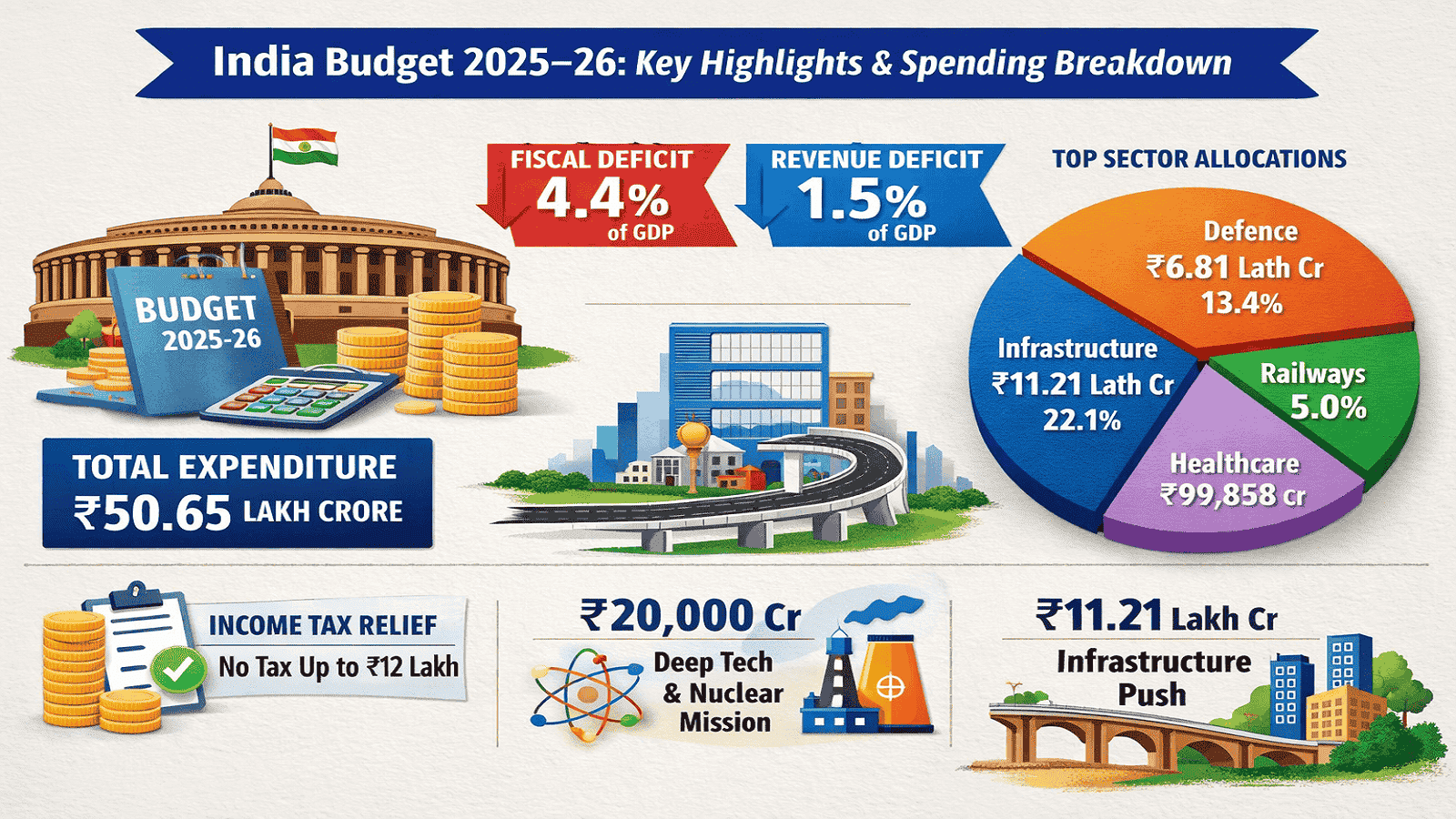
Total expenditure for 2025-26 is estimated at Rs 50,65,345 crore. Revenue expenditure is estimated to increase by 6.7% and capital expenditure by 10.1% over the revised estimate of 2024-25.
Receipts other than borrowings are estimated at Rs 34,96,409 crore, about 11.1% higher than the revised estimate of 2024-25. Tax revenue, which forms the major part of receipts, is also expected to increase by 11% over the revised estimate for 2024-25.
The fiscal deficit in 2025-26 is targeted at 4.4% of GDP, lower than the revised estimate of 4.8% of GDP in 2024-25. The revenue deficit is targeted at 1.5% of GDP, down from 1.9% in 2024-25.
Interest payments account for 25% of total expenditure and 37% of revenue receipts. That structural drag is the quiet story no minister highlights from the podium. The central government aims to reduce its outstanding liabilities to around 50% of GDP by March 2031.
Which Ministry Received the Highest Budget Allocation in 2025-26?
The Ministry of Defence has the highest allocation in 2025-26, at Rs 6,81,210 crore, accounting for 13.4% of the total budgeted expenditure of the central government. Other ministries with high allocations include Road Transport and Highways at 5.7% of total expenditure, Railways at 5.0%, and Consumer Affairs, Food and Public Distribution at 4.3%.
This allocation is 9.53% more than the budgetary estimate of FY 2024-25. Out of this, Rs 1,80,000 crore, which is 26.43% of total allocation, will be spent on capital outlay on defence services.
One major focus of this budget is boosting domestic defence production, wherein 75% of capital procurement is allocated to local suppliers. The budgetary allocation to DRDO has been increased to Rs 26,816.82 crore in FY 2025-26 from Rs 23,855.61 crore in FY 2024-25, which is 12.41% higher than the budgetary estimate of 2024-25.
How Much Has India Allocated for Infrastructure in Budget 2025-26?
Budget 2025-26 allocates Rs 11.21 lakh crore for the infrastructure sector, which is core to the vision of Viksit Bharat at 2047.
An outlay of Rs 1.5 lakh crore has been proposed for 50-year interest-free loans to states for capital expenditure and incentives for reforms. An Urban Challenge Fund of Rs 1 lakh crore has been announced to implement proposals for Cities as Growth Hubs, Creative Redevelopment of Cities, and Water and Sanitation, with an allocation of Rs 10,000 crore proposed for 2025-26.
A Maritime Development Fund with a corpus of Rs 25,000 crore has been set up, with up to 49% contribution by the government and the balance from ports and the private sector. Infrastructure-related ministries have also been directed to prepare a three-year pipeline of projects in PPP mode.
What Are the Key Highlights of the Agriculture Sector in Budget 2025-26?
Rather than a blanket spending increase, the agriculture strategy in this budget is structural and district-specific. The budget announced the Prime Minister Dhan-Dhaanya Krishi Yojana in partnership with states, covering 100 districts to increase productivity, adopt crop diversification, augment post-harvest storage, improve irrigation facilities, and facilitate availability of credit.
A Mission for Aatmanirbharta in Pulses spanning six years focuses on Tur, Urad, and Masoor, with NAFED and NCCF mandated to procure these pulses from farmers during the next four years.
What Income Tax Changes Were Announced in Budget 2025-26?
No personal income tax is payable on income up to Rs 12 lakh, which is an average income of Rs 1 lakh per month other than special rate income such as capital gains, under the new regime. Salaried individuals effectively reach zero liability at Rs 12.75 lakh when the standard deduction is included.
A new income tax bill was also announced to replace the 60-year-old Income Tax Act of 1961, promising a leaner, more readable statute.
How Much Has India Allocated for Healthcare in Budget 2025-26?
The government has allocated approximately USD 11.5 billion, which is Rs 99,858 crore, in FY26 for the development, maintenance, and enhancement of India's healthcare system as well as research, marking an increase of about 9.5% over the current fiscal.
Gig workers will receive identity cards, registration on the e-Shram portal, and healthcare under PM Jan Arogya Yojana. Broadband connectivity will be provided to all government secondary schools and primary health centres in rural areas under the BharatNet project.
What Are the Key Innovation and Energy Bets in Budget 2025-26?
An allocation of Rs 20,000 crore has been made to implement a private sector-driven research, development, and innovation initiative. A Deep Tech Fund of Funds will be explored to back next-generation startups.
A Nuclear Energy Mission for research and development of Small Modular Reactors with an outlay of Rs 20,000 crore has been set up, with five indigenously developed SMRs targeted to be operational by 2033. The Atomic Energy Act and the Civil Liability for Nuclear Damage Act will be amended to allow private sector partnerships for the development of nuclear energy.
The total outlay for PLI schemes for FY26 stands at roughly Rs 19,482.58 crore, an increase of more than 100% over FY25. The maximum increase has been in textiles, battery cell and storage technology, and automobiles.
The FDI limit for the insurance sector has been raised from 74% to 100% for those companies that invest the entire premium in India.