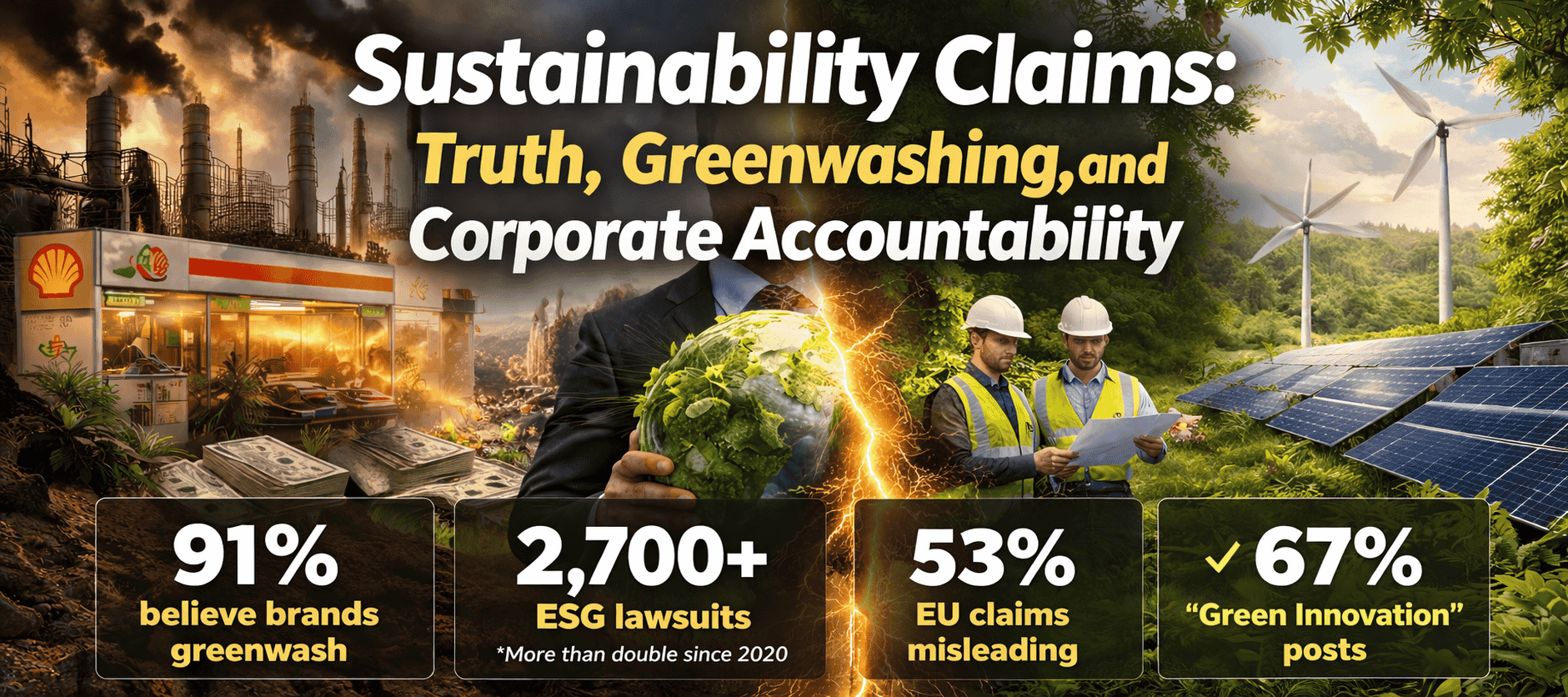
When Shell spent 81% of its advertising budget on sustainability messaging while directing 80% of its capital investment toward oil and gas, it offered a near-perfect illustration of what greenwashing actually looks like at scale. It is not always the clumsy marketing of a single eco-friendly product. More often, it is a systemic architecture of language, image, and omission designed to satisfy a public hungry for environmental accountability without requiring any of the hard trade-offs that genuine accountability demands.
That architecture is now being systematically dismantled. Across the European Union, the United States, Australia, and the United Kingdom, regulators and courts are moving with new urgency to hold corporations legally liable for what they claim, what they omit, and what they imply about their environmental performance. The message has shifted from a gentle nudge to a formal imperative: sustainability is no longer a communications exercise. It is a legal document.
What greenwashing actually means in 2026
The term "greenwashing" was coined decades ago, but its practical definition has grown far more precise under modern regulatory frameworks. The United Nations identifies several distinct forms of greenwashing, each designed to create a misleading impression without making outright false statements.
These include claiming net-zero alignment without any credible implementation plan, using vague labels such as "eco-friendly" or "green" that carry no standard definition, emphasizing a single environmental improvement while ignoring broader harmful impacts, and presenting compliance with minimum legal standards as exceptional environmental leadership. A 2020 EU study found that 53% of the environmental claims examined were vague, misleading, or unfounded, while 40% were entirely unsubstantiated by data.
"High-emission firms are significantly more likely to disclose ESG information, often driven by regulatory and reputational pressures. However, evidence of greenwashing emerges as disclosure does not always reflect substantive performance." - ScienceDirect, January 2026
That last finding is the most structurally significant. Research published in January 2026 using a dataset of US firms from 2013 to 2022 confirmed that regulatory changes improve ESG disclosure volume without fully eliminating symbolic reporting. The disclosure is increasing. The credibility of that disclosure is not keeping pace.
Who is most exposed and why
Oil, gas, and energy
The oil and gas sector accounts for 14% of greenwashing incidents tracked in 2024, making it the most frequently implicated industry. This is not incidental. The sector faces the sharpest divergence between its long-term business model and the expectations of climate-conscious investors, regulators, and consumers. The five largest publicly traded oil and gas majors collectively invested over $1 billion in shareholder funds on climate-related branding and lobbying, according to InfluenceMap, while continuing to expand fossil fuel production.
Shell and Drax-Sustainability-Linked Loans under scrutiny
Both Shell and Drax secured sustainability-linked loans tied to vague or non-binding environmental metrics while continuing high-pollution activities. In April 2025, the Royal Bank of Canada publicly abandoned its sustainable finance goals, citing the absence of clear definitions and accountability mechanisms within the sustainability-linked loan framework. These cases intensified regulatory calls for science-based eligibility criteria and mandatory third-party auditing in green finance products.
Fashion and fast fashion
The fashion industry is responsible for between 2% and 8% of global carbon emissions, a range that encompasses the full lifecycle from raw material extraction through disposal. Despite this, 60% of sustainability claims by European fashion companies have been found unsubstantiated and misleading. H&M was identified as having 96% of its sustainability claims fail independent scrutiny, according to a 2021 report by the Changing Markets Foundation.
In 2025 and 2026, enforcement reached fast fashion's newest players. An Italian court fined Shein's European operator 1 million euros after regulators found that its sustainability messaging across multiple branded campaigns was vague, generic, and in some cases contradicted by the company's own emissions data, which showed increases in 2023 and 2024 despite its stated reduction targets of 25% by 2030.
Aviation and financial services
The UK Advertising Standards Authority banned two HSBC advertisements that promoted the bank's environmental commitments while omitting reference to its ongoing financing of fossil fuel projects. This was the first ASA ruling against a bank for greenwashing and set a direct precedent in financial services advertising. In aviation, Luton Airport's claim that expansion would be halted if environmental limits were breached was ruled misleading after regulators found the airport had failed to include flight emissions in its own environmental accounting.
The regulatory architecture taking shape
For most of the past decade, sustainability disclosure was largely voluntary, and enforcement was inconsistent. That is changing with considerable speed on both sides of the Atlantic.
The European Union's Greenwashing Directive, which EU member states must enforce from September 27, 2026, prohibits vague environmental claims that cannot be substantiated, bans the use of unreliable sustainability labels, and prohibits false claims about the environmental credentials of any product or asset. The directive applies specifically to business-to-consumer communications, meaning that claims migrated from sustainability reports into advertising are fully in scope. Companies face a hard deadline with no transition period for existing packaging and claims already in the distribution chain.
The EU's Corporate Sustainability Reporting Directive, combined with the Sustainable Finance Disclosure Regulation and the EU Taxonomy, creates a layered framework that raises the bar for what companies must verify before making public environmental assertions. The CSRD's granularity, covering emissions data, supply chain practices, and social outcomes, creates both greater transparency and, as researchers have noted, greater temptation to present selective data in the most favorable framing.
In the United States, the landscape is fractured but active. The Securities and Exchange Commission's federal climate disclosure rules stalled in 2025, but state-level legislation has accelerated in response. California's SB 253 requires annual reporting of Scope 1 and 2 greenhouse gas emissions by 2026 and Scope 3 by 2027, applying to all public and private companies with over $1 billion in revenue doing business in the state, with penalties up to $500,000 for non-compliance. New York, Colorado, New Jersey, and Illinois have proposed parallel frameworks. California's SB 343, the Truth in Labeling law, carries a compliance deadline of October 4, 2026.
In 2024, the EU recorded a 20% decline in greenwashing incidents overall, while simultaneously seeing a 27% increase in high-severity cases. Fewer incidents, but more damaging ones. The threshold for what constitutes actionable greenwashing is rising.
How verification and technology are changing the calculus
Third-party assurance has emerged as the primary market mechanism for building credibility into sustainability disclosure. Research confirms that sustainability assurance has a statistically significant inhibitory effect on greenwashing and is valued by capital markets, reflected in lower equity capital costs for companies with independently verified disclosures. However, the effectiveness of assurance is not uniform: it depends heavily on the strength of the national legal environment and the specificity of the regulatory framework in which a company operates.
Beyond traditional auditing, satellite imaging, blockchain-based supply chain tracking, and AI-powered monitoring tools are being deployed by governments, investors, and watchdog organizations to detect discrepancies between what companies report and what they actually do. In 2026, leading legal and sustainability teams are adopting AI systems to automate compliance and cross-reference marketing claims against real-time supply chain data before publication, a process that was previously conducted manually and inconsistently.
The convergence of global reporting frameworks including the International Sustainability Standards Board, the EU's CSRD, and state-level US standards is moving toward standardization that will enable direct comparisons across companies and sectors for the first time. This is a structural shift. Companies that have benefited from the opacity of inconsistent reporting standards will find it progressively harder to present a selective picture.
What genuine corporate accountability looks like
The distinction between credible sustainability practice and greenwashing is ultimately empirical. Credible commitments are specific, time-bound, independently verified, and include full lifecycle accounting including Scope 3 emissions across supply chains. They disclose negative impacts alongside positive ones. They define terms precisely rather than relying on undefined phrases like "green," "sustainable," or "eco-friendly." They do not present compliance with minimum legal standards as leadership.
The UN High-Level Expert Group's "Integrity Matters" report outlines ten recommendations for credible net-zero pledges, emphasizing that companies must have a credible transition plan before claiming net-zero alignment, not after. The Secretary-General's Recognition and Accountability Framework is designed to operationalize these standards and improve the transparency of climate pledges.
Stakeholder engagement is also functioning as an enforcement mechanism independent of formal regulation. Investors, media organizations, and nongovernmental organizations are functioning as active watchdogs, inspecting corporate conduct, demanding evidence, and using competitive and reputational pressure to enforce accountability standards that regulation alone cannot reach quickly enough.