What Is the 2026 Kerala Assembly Election and Why Does It Matter
The 2026 Kerala Legislative Assembly election is scheduled to be held on April 9, 2026, to elect 140 members to the Kerala Legislative Assembly. Votes will be counted and results declared on May 4, 2026, with the tenure of the current Assembly set to end on May 23, 2026.
This election carries extraordinary weight. The LDF is eyeing a historic third consecutive term under Chief Minister Pinarayi Vijayan, while the UDF, buoyed after thumping victories in the recently held local body elections, is eyeing a grand return to power. For the BJP-led NDA, the contest represents a real test of whether years of organisational investment in Kerala have translated into a genuine electoral footprint.
The stakes go beyond a simple change of guard. Kerala's election is a barometer of welfare politics versus anti-incumbency sentiment, of minority vote consolidation versus communal polarisation, and of whether a traditionally bipolar state has permanently shifted into a three-cornered contest.
Who Are the Main Candidates and Alliances in Kerala Election 2026
The Left Democratic Front (LDF)
The LDF, led by CPI(M), includes Kerala Congress (M), Janata Dal (Secular), NCP, INL, Congress (S), Kerala Congress (B), and Loktantrik Janata Dal. Chief Minister Pinarayi Vijayan anchors the campaign with a governance-heavy narrative. The ruling LDF, which currently holds 99 seats in the 140-member Assembly, is seeking an unprecedented consecutive third term on the strength of its welfare record and governance plank.
The United Democratic Front (UDF)
The UDF comprises INC, IUML, Kerala Congress (Joseph), RSP, and Kerala Congress (Jacob). At the heart of the UDF campaign is a welfare-heavy manifesto combined with a governance critique of the incumbent LDF. Key promises include free bus travel for women, Rs 3,000 social welfare pensions, Rs 25 lakh health insurance coverage, Rs 5 lakh interest-free loans for youth, and five lakh houses for the homeless. Congress leader Rahul Gandhi has amplified the campaign with a notable call for Kerala's first woman Chief Minister.
The National Democratic Alliance (NDA)
The NDA includes BJP, BDJS, Kerala Congress (Thomas), Janata Dal (United), and Twenty20. The BJP-led NDA released their campaign slogan "Marathathu Ini Marum" meaning "What Never Changed Will Change Now," with Prime Minister Narendra Modi launching the BJP's official campaign from Kochi on March 11, 2026.
Candidate Lists Released
The CPI released the first list of 25 candidates on March 15, 2026. INC released the first list of 55 candidates on March 17, followed by a second list of 37 on March 19. BJP released the first list of 47 candidates on March 16 and a second list of 39 on March 19. IUML released the first list of 25 candidates on March 17.
When Is the Kerala Election 2026: Full Poll Schedule
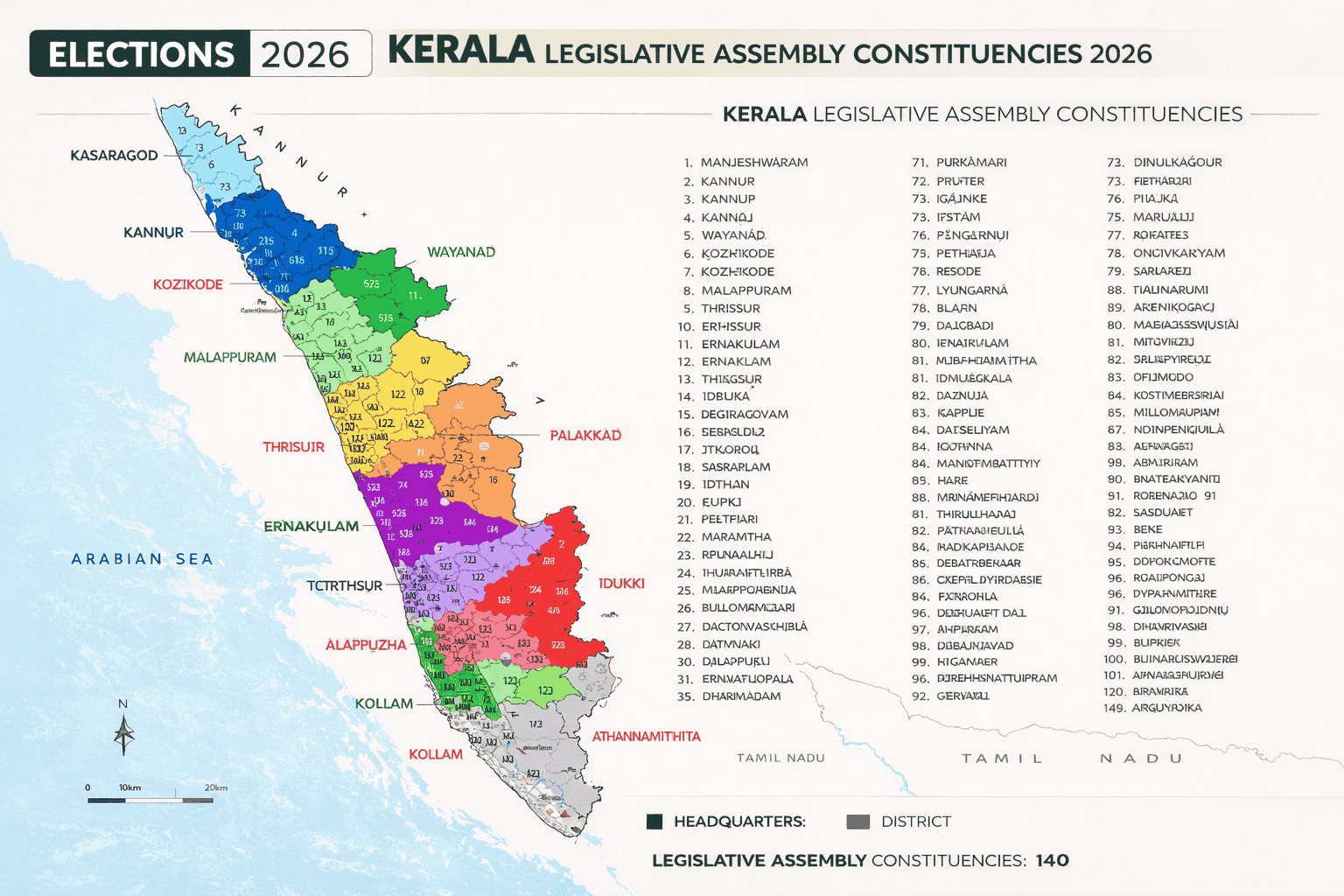
The Election Commission of India announced the schedule for the Kerala Legislative Assembly election on March 15, 2026. The election will be conducted across all 140 Assembly constituencies in a single phase, in line with the state's established electoral practice. Counting of votes begins at 8:00 AM IST on counting day.
The key dates are as follows:
- Nomination last date: March 23, 2026
- Polling date: April 9, 2026
- Counting and results: May 4, 2026
- Assembly tenure ends: May 23, 2026
How Many Voters Are Eligible in Kerala Election 2026
According to the Election Commission of India, 26,953,644 voters are eligible to vote in the assembly elections in Kerala. This includes 13,126,048 male voters, 13,827,319 female voters, and 277 transgender voters. The higher share of women voters makes gender-focused campaign promises a particularly calculated political move by all three major alliances.
What Are the Key Issues Driving the 2026 Kerala Election
Anti-Incumbency vs. Welfare Delivery
Issues on the ground include unemployment, economic stress, and governance concerns, which the UDF keeps highlighting in their campaign. Meanwhile, the LDF retains credibility from welfare delivery and crisis management strategies. Analysts note this is creating a competitive vote split rather than a sweeping wave in either direction. For voters who desire change, the UDF stands to benefit. For voters satisfied with welfare schemes, the LDF holds the advantage.
Minority Vote Consolidation
A central theme of the election is the intense battle for minority votes, as the LDF attempts to make further inroads into the UDF's historical "fixed deposit" of Muslim and Christian support by framing itself as the sole protector against communal polarisation. This shifting landscape has triggered heated debates over tactical alliances, including persistent allegations of a CPM-BJP deal in constituencies like Nemom.
Allegations of Deal Politics
The campaign has been marked by sharp exchanges over alleged deal politics, with rival fronts accusing each other of covert understandings to manipulate outcomes. These claims have added a layer of intrigue, particularly among undecided voters, even as debates around anti-incumbency continue to dominate political discourse.
The Sabarimala Factor
The resurfacing of the Sabarimala issue ahead of polling has further sharpened the contest, with both the UDF and NDA seeking to tap into its emotional resonance, while the LDF has responded cautiously.
Where Does the NDA Stand in Kerala 2026: A Third Force Emerges
For decades, Kerala's political landscape has been dominated by a predictable, bipolar contest between the LDF and UDF. However, the latest opinion polls reveal that this traditional rivalry is facing unprecedented disruption, with the BJP-led NDA emerging as a structurally disruptive force in approximately 40 strategic seats.
In constituencies like Kasargod, Thrissur, Irinjalakkuda, and Attingal, the NDA is projected to finish second, pushing either the LDF or the UDF into third place. The BJP's campaign highlights development-driven politics under the motto "Viksit Keralam," alongside women empowerment initiatives. However, according to analysts, the BJP still lacks the broad social coalition needed for statewide power. Its impact is more likely to be decisive in select constituencies, potentially influencing close contests rather than winning them outright.
What Do Pre-Poll Surveys Say About Kerala Election 2026 Results
As Kerala moves closer to polling day, pre-poll surveys are pointing to an unusually tight contest. Almost every major pollster is signalling a close fight between the UDF and LDF, with neither side enjoying a decisive advantage.
The Manorama News-C Voter mega survey, based on responses from 89,693 participants collected between December 1 and March 26, projects the UDF to win 69 to 81 seats, with the LDF dropping to 57 to 69 seats and the NDA improving to 1 to 5 seats. The survey points to a more competitive political landscape, with visible vote erosion for the LDF and a broad-based UDF recovery.
The UDF is seen hovering between 39 percent and 45 percent vote share, while the LDF trails by only a few percentage points in most surveys. The NDA's vote share varies widely across agencies, but in some projections it rises high enough to impact outcomes in marginal constituencies, suggesting that even small swings could alter the result in dozens of seats.
Which Constituencies Are the Key Battlegrounds in 2026
Nemom remains the most nationally watched seat. It is the only Assembly constituency the BJP has ever won in Kerala. It was recaptured by CPI(M)'s education minister V. Sivankutty in 2021 by just 3,949 votes, turning it into a razor-thin three-cornered fight. All three fronts have again fielded heavyweight names, and the result will be read nationally as a verdict on whether the BJP's Kerala experiment has real legs.
Vattiyoorkavu has become a high-profile battleground, pitting CPI(M)'s young, high-visibility MLA V.K. Prasanth against Congress veteran K. Muraleedharan, with the BJP fielding a heavyweight urban face. The BJP sees this seat as a test of its ability to convert Lok Sabha leads and middle-class, government-employee discontent into an Assembly foothold.
Dharmadam, Chief Minister Pinarayi Vijayan's own constituency, was specifically targeted by the Kerala BJP, which organised a mega public interaction there on March 6, 2026, signalling the front's intent to challenge the Chief Minister's personal political stronghold.