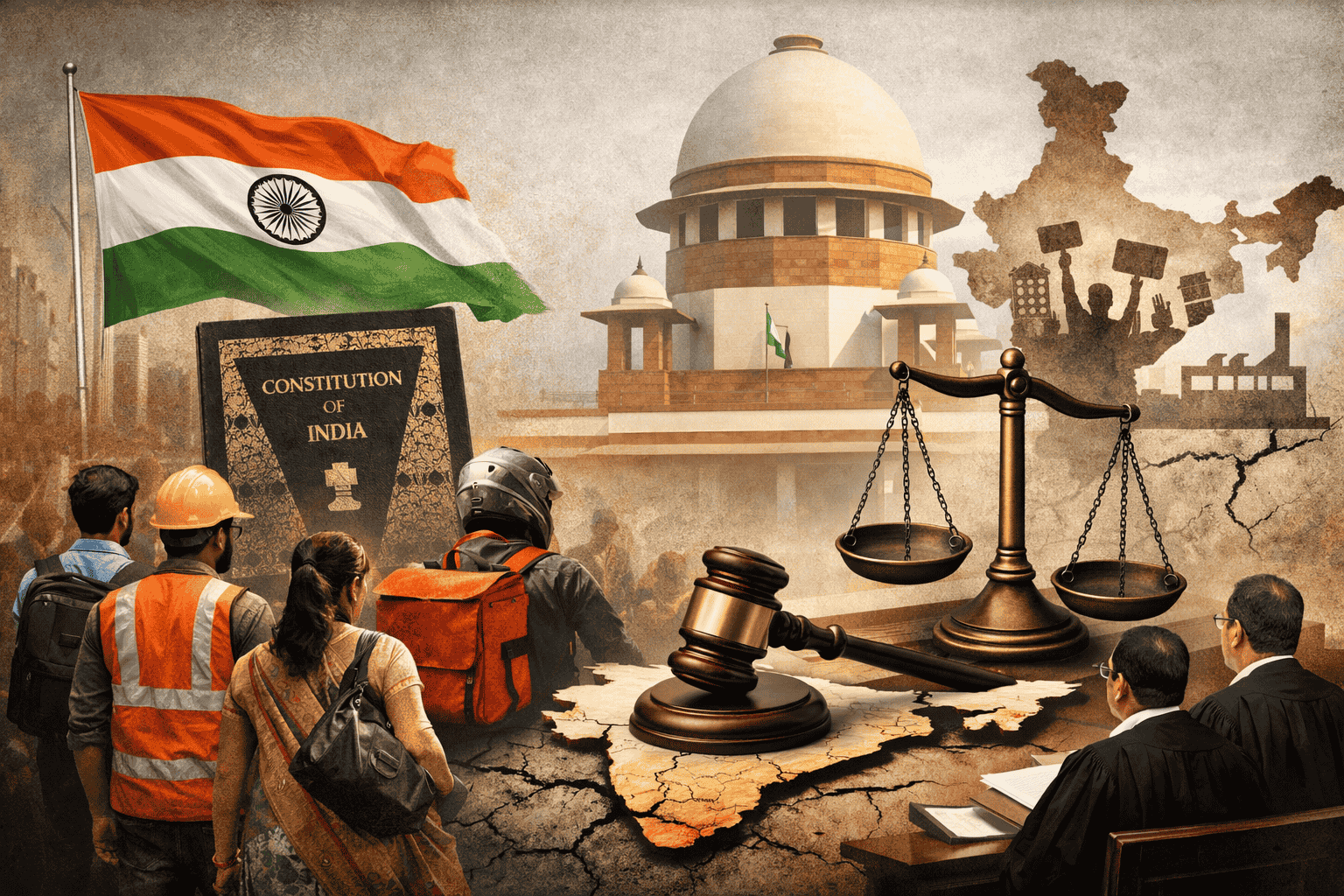
On November 21, 2025, the Government of India did something it had been promising for nearly a decade. It formally implemented four Labour Codes that consolidate 29 central statutes into a single, rationalised framework governing wages, industrial relations, social security, and occupational safety for an estimated 500 million workers. The government called it a historic modernisation. Critics called it a constitutional time bomb. Both characterisations now appear, in significant measure, to be correct.
Four months after implementation, India's labour law landscape is entering what legal scholars are calling a litigation era, as courts are asked to rule on whether the new framework respects the constitutional rights of workers, the federal autonomy of states, and the separation of powers between Parliament and the executive. The answers will shape industrial relations in the world's most populous nation for a generation.
What Are the Four Labour Codes and Why Do They Matter
The four codes are the Code on Wages 2019, the Industrial Relations Code 2020, the Code on Social Security 2020, and the Occupational Safety, Health and Working Conditions Code 2020. Together, they replace a patchwork of legislation dating back to the colonial era, including the Trade Unions Act of 1926 and the Payment of Wages Act of 1936.
The stated goals are not without merit. India's previous regime was a labyrinth of 29 separate laws with overlapping definitions, inconsistent enforcement authorities, and compliance requirements that small businesses frequently found impossible to navigate. The codes aim to bring uniformity, expand the scope of social security to gig and platform workers for the first time, and modernise dispute resolution through industrial tribunals. Supreme Court Justice Manmohan, speaking at a legal conference in December 2025, noted that laws must continuously adapt to economic realities, pointing specifically to the rise of aggregator platforms and their millions of workers who existed entirely beyond the legal pale.
The wage redefinition alone carries sweeping implications. Under the new framework, if the combined value of allowances such as house rent allowance, conveyance, and overtime exceeds 50 percent of total remuneration, the excess is added back into the statutory wage base. This is not a minor accounting adjustment. It invalidates salary structures that thousands of companies have relied upon for years, and it opens a three-year window for workers to raise retrospective claims.
Where the Constitutional Fault Lines Run
Articles 14, 19, and 21
The most legally significant challenges to the codes cluster around three constitutional provisions. Article 14 guarantees equality before the law. Constitutional concerns have been raised over differential treatment of workers based on establishment size, described as potentially arbitrary, over Article 19(1)(c) regarding restrictions on forming associations and unions, and over Article 21 concerning dignity and security of livelihood.
Article 19(1)(c) guarantees the right to form associations and unions. The Industrial Relations Code introduces stricter conditions for trade union recognition, including thresholds that make it harder for smaller or fragmented workforces to secure collective bargaining rights. It has been the undivided opinion of all central trade unions, including the RSS-affiliated Bharatiya Mazdoor Sangh, that the Union government did not effectively consult workers' representatives before enacting the codes, contrary to India's obligations under ILO Convention No. 144 on tripartite consultation.
Article 21, which has been interpreted by the Supreme Court to include the right to livelihood and dignified working conditions, is invoked in challenges against provisions that decriminalise non-payment of wages. Under the existing Minimum Wages Act 1948, non-payment of minimum wages was a criminal offence punishable with imprisonment. Under the new codes, this offence can now be settled with a monetary fine. Retired Supreme Court and High Court judges argue this contradicts decades of judicial precedent equating wage non-payment with forced labour under Article 23.
The Federal Question
Labour is a Concurrent List subject under India's Constitution, meaning both Parliament and state legislatures have the power to legislate on it. Rather than advancing the constitutional value of the Concurrent List arrangement, which allowed states to legislate higher standards and better conditions for workers, the codes open space for states to do the reverse, competing with each other for longer working hours and weaker protections in a race to the bottom.
The Delhi High Court noted in December 2025 that the Industrial Relations Code 2020 was brought into force without repealing the three predecessor laws it was intended to replace, namely the Trade Unions Act 1926, the Industrial Disputes Act 1947, and the Industrial Employment Act 1946. The legal implications of that procedural overlap remain unsettled.
Who Is Challenging the Codes and On What Grounds
The opposition comes from an unusual coalition. All central trade unions have objected on substantive grounds. Constitutional lawyers have raised procedural and rights-based challenges. Retired judges have publicly criticised provisions they regard as inconsistent with social justice guarantees. And even business-side observers have noted that ambiguity in wage definitions is producing precisely the compliance uncertainty the codes were designed to eliminate.
The mandatory linkage of social security registration to Aadhaar-based identification has attracted specific constitutional challenge, as it conditions access to statutory benefits on possession of a document that millions of migrant workers and informally employed persons lack. The Supreme Court's earlier privacy rulings have set limits on compulsory Aadhaar linkage, and extending those requirements into social security entitlements is legally contested territory.
For gig workers, formal inclusion in the Social Security Code is a step forward in name. However, the substantive welfare provisions are left almost entirely to future executive schemes, a skeletal drafting approach that shifts real decision-making power from Parliament to the executive, a delegation problem that constitutional scholars describe as significant.
What the Government Says
The Ministry of Labour and Employment has defended the codes as the most ambitious labour reform in independent India's history. Officials point to employment growth rising from 47.5 crore workers in 2017-18 to 64.33 crore in 2023-24, and the unemployment rate declining from 6.0 percent to 3.2 percent during the same period. The government's position is that the old regime's fragmentation was the primary obstacle to enforcement, and that consolidation gives workers clearer, more enforceable rights than the nominal protections of unenforced legacy statutes.
Draft central rules were published in an official gazette on December 30, 2025, with a 30-day consultation window for industrial relations rules and a 45-day window for the remaining three codes. Final state-level rules are expected on a rolling basis through 2026.
What the Courts Will Ultimately Decide
The central legal question before the courts is not whether reform was needed. It plainly was. The codes' erosion of inspection powers, transfer of law-making to executive notifications, and failure to guarantee a living wage raise serious constitutional questions under Articles 14, 19, 21, and the Directive Principles of State Policy. Trade unions and civil society have strong grounds to challenge them in the High Courts and the Supreme Court, which has taken suo motu cognizance of legislative overreach before.
For the 500 million workers whose livelihoods depend on how these questions are answered, the constitutional showdown is not an abstract jurisprudential exercise. It is a determination of whether the promise of dignified work embedded in the Directive Principles of State Policy will be honoured, or whether the language of modernisation will serve as cover for a structural transfer of power from labour to capital.