Who Controls Tamil Nadu's Electoral Math in 2026?
Tamil Nadu goes to the polls on April 23, 2026, with 234 assembly seats at stake and approximately six crore voters deciding the political fate of the state. What makes this election structurally different from every cycle before it is not just the candidates or the manifestos. It is the fundamental rewiring of alliance architecture that has taken place since 2023, and what the data reveals when you model what those shifts actually mean on the ground.
For over five decades, Tamil Nadu's politics followed a near-clockwork pattern. DMK and AIADMK traded power in alternating cycles, with national parties serving as alliance anchors rather than primary forces. That duopoly is now under simultaneous pressure from three directions: a reunited AIADMK-BJP front that reversed a bitter separation, a fragmented third space led by actor Vijay's Tamilaga Vettri Kazhagam (TVK), and a DMK government navigating genuine anti-incumbency for the first time in years.
This is a data story about what those shifts mean in numbers.
How Did the Alliance Map Break and Rebuild Between 2021 and 2026?
The 2021 Baseline That Everyone Is Working From
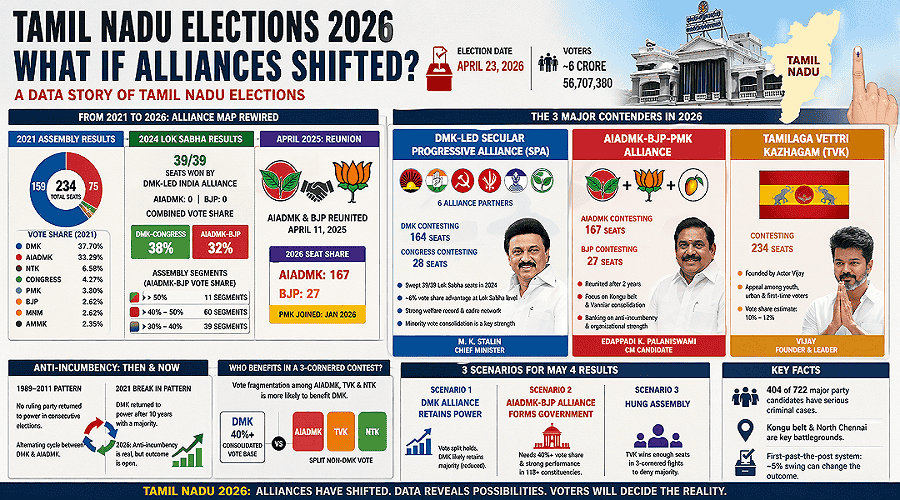
The 2021 assembly election produced a decisive result on the surface. The DMK-led Secular Progressive Alliance won 159 of 234 seats, with the DMK alone taking 133 constituencies. The AIADMK-BJP combine under the NDA banner secured 75 seats, with the AIADMK holding 66 of those. On vote share, the numbers told a closer story: DMK at 37.70 percent, AIADMK at 33.29 percent, NTK at 6.58 percent, Congress at 4.27 percent, PMK at 3.80 percent, BJP at 2.62 percent, MNM at 2.62 percent, and AMMK at 2.35 percent.
The gap between vote share and seat count was significant. The DMK's 37.70 percent translated into 133 seats. The AIADMK's 33.29 percent produced only 66. That seven-percentage-point difference in vote share generated a 67-seat gap in assembly representation, which is precisely why alliance arithmetic in Tamil Nadu is not arithmetic at all. It is geometry.
What the 2024 Lok Sabha Results Told the Alliance Strategists
The 2024 Lok Sabha election was a watershed moment for reading alliance strength in Tamil Nadu. The DMK-led INDIA alliance swept all 39 seats. The AIADMK, which had broken away from the BJP-led NDA in September 2023 to contest independently, won zero seats, losing even the Theni seat it had held since 2019. The BJP, which had allied with smaller parties rather than the AIADMK, also won zero seats.
The combined AIADMK-BJP vote share across the 2024 Lok Sabha constituencies worked out to approximately 32 percent, against 38 percent for the DMK-Congress bloc. More granularly, analysts identified 11 assembly segments where the combined AIADMK-BJP vote share exceeded 50 percent, 60 segments where it fell between 40 and 50 percent, and 39 segments between 30 and 40 percent. That data point became the foundational argument for the AIADMK-BJP reunion that followed.
The April 2025 Reunion and What It Cost Both Parties
On April 11, 2025, the AIADMK and BJP formally reunited into a pre-poll alliance, with AIADMK General Secretary Edappadi K. Palaniswami declared the chief ministerial candidate. The PMK, led by Anbumani Ramadoss, formally joined the front in January 2026. In 2026, the AIADMK is contesting 167 seats and the BJP 27 seats in the assembly.
The reunion came with structural complications. BJP's Tamil Nadu unit chief K. Annamalai, who had driven the party's most significant vote share gains in recent memory and who had publicly opposed an alliance with the AIADMK, resigned and was replaced by Nainar Nagenthran. The BJP's growth strategy under Annamalai had been built on independent Dravidian-alternative messaging. That message is now difficult to sustain within an AIADMK-led front.
Where Does the DMK's Structural Advantage Actually Come From?
Who Are the Six Parties in the Secular Progressive Alliance?
The DMK-led SPA enters 2026 with six core partners: the Indian National Congress, Communist Party of India (Marxist), Communist Party of India, Marumalarchi Dravida Munnetra Kazhagam, Viduthalai Chiruthaigal Katchi, and the late addition of Desiya Murpokku Dravida Kazhagam in February 2026. The DMK itself is contesting 164 of the 234 seats, with Congress fielding candidates in 28 constituencies.
The alliance swept all 39 Lok Sabha seats in 2024 and carried a combined vote share advantage of six percentage points over the AIADMK-BJP combine at the Lok Sabha level. The SPA's organizational depth in welfare delivery, cadre network density, and its lock on minority votes represent structural advantages that translate more reliably into assembly seat outcomes than opinion poll numbers.
Why the Minority Vote Bank Matters More Than Raw Percentages
Tamil Nadu's minority voter consolidation, primarily Muslim and Christian communities, has historically operated as a swing-amplifier for whichever Dravidian party holds that vote. The DMK has systematically framed the 2026 election as a contest between Dravidian secular politics and BJP-aligned governance. The AIADMK-BJP alliance, by its very composition, makes that framing credible to minority voters regardless of ground-level campaign messaging. The data consequence is that minority vote consolidation behind the DMK acts as a vote-share floor that is difficult to erode regardless of anti-incumbency sentiment.
What Does TVK's Solo Campaign Actually Mean in Vote-Share Mathematics?
Who Is Vijay and Why Does TVK's Entry Matter to the Data?
Actor Vijay launched Tamilaga Vettri Kazhagam in February 2024 and announced on March 18, 2026, that TVK would contest all 234 constituencies independently, with no alliance with either the DMK-led SPA or the AIADMK-led front. Vijay himself is contesting from Perambur constituency in Chennai.
The TVK's appeal is demonstrably concentrated among youth voters, urban constituencies, and first-time voters. His rallies have drawn significant crowds across the state. The critical data question is not how large the crowds are. It is how many crowd members are eligible voters in that specific constituency, how many of them are already committed DMK or AIADMK voters, and how many represent genuinely transferable votes.
Why Fan Popularity Does Not Translate Linearly Into Votes
Tamil Nadu's history with actor-politicians is instructive. MGR succeeded because he combined film popularity with deep organizational infrastructure, pro-poor policy credibility built over years, and a second-rung leadership network across all 234 constituencies. Every actor-politician who attempted to replicate that formula without the organizational depth failed to convert crowd size into seat count.
Vijay lacks a deep cadre network and established second-rung leadership at the constituency level. Research on Tamil Nadu voting behavior consistently shows that a swing of approximately five percent in vote share is sufficient to convert a losing party into a winning one in a first-past-the-post system. TVK's plausible vote share range under favorable conditions is estimated in the low double digits. A 10 to 15 percent combined vote share for TVK and NTK would represent meaningful disruption but not a governing mandate.
Who Does TVK Hurt More: DMK or AIADMK?
This is the most consequential data question for the 2026 result. Analysts are divided, but the structural logic points in a specific direction. TVK's voter base draws from dissatisfied DMK voters, politically engaged youth who are skeptical of Dravidian party governance, and Vijay's cinematic fan base, which spans caste and regional lines. Voters firmly aligned with AIADMK's Kongu belt organizational network are less likely to shift toward a debutant party with no assembly track record.
The evidence-based conclusion is that in a fragmented three-cornered contest, vote splitting among the opposition parties, meaning AIADMK, TVK, and NTK all competing for the non-DMK vote, is structurally more likely to benefit the DMK than to damage it. The DMK's consolidated 40-plus percent block is harder to dislodge when opposition votes are divided across three or more parties than when they are pooled into a single challenger alliance.
How Has Tamil Nadu's Anti-Incumbency Pattern Changed Over Time?
What Does the Historical Data Show About Ruling Party Survival?
For the period from 1989 to 2011, Tamil Nadu's data showed an almost unbroken anti-incumbency pattern. No ruling party returned to power in consecutive elections. DMK won in 1989, lost in 1991. AIADMK won in 1991, lost in 1996. DMK won in 1996, lost in 2001. AIADMK won in 2001, lost in 2006. DMK won in 2006, lost in 2011. AIADMK won in 2011, held in 2016 under Jayalalithaa, then lost in 2021 after leadership vacuum.
The 2021 result was the first genuine break in that pattern, where the DMK returned to power after 10 years rather than five, and did so with a majority. Researchers have identified a relaxation of the strict anti-incumbency cycle, attributing it to welfare delivery infrastructure becoming more sophisticated, the absence of charismatic AIADMK leadership post-Jayalalithaa, and generational shifts in voter behavior.
Why the 2026 Anti-Incumbency Question Is Genuinely Open
The DMK government under CM M. K. Stalin is facing a measurably different reception than what exit poll data showed in 2021. Reports from campaign trails indicate that DMK leaders are receiving mixed responses, and the drug menace, law and order concerns, and corruption allegations have become consistent opposition talking points with traction beyond BJP and AIADMK base voters.
The welfare delivery record, including monthly financial assistance to 1.15 crore women, free bus travel, and GSDP growth of 11.19 percent, the highest in India in 2024-25, provides the DMK with a counter-narrative. However, the perception-versus-delivery gap in ground-level reporting suggests that anti-incumbency sentiment is real even if it does not yet constitute a commanding electoral wave.
Which Constituencies Hold the Key to Who Forms the Government?
What Does the Bellwether Constituency Data Show?
Historical analysis of Tamil Nadu assembly elections identifies certain constituencies that have consistently predicted state-level outcomes regardless of regional factors. Constituencies in the Kongu belt covering districts such as Coimbatore, Erode, Salem, and Tiruppur have traditionally been competitive and serve as leading indicators of AIADMK-BJP combine performance. The northern Chennai constituencies and Delta region constituencies tend to track DMK-alliance strength.
The AIADMK-BJP alliance's most credible geographic argument is the Kongu belt, where PMK's caste-consolidation among Vanniars adds meaningful vote share to the AIADMK's organizational base. PMK secured 3.80 percent of the total vote in 2021, but that vote is geographically concentrated in specific northern Tamil Nadu constituencies where it can represent the margin of victory.
How Candidate Criminality Data Affects the 2026 Race
According to a report by the Association for Democratic Reforms, 404 out of 722 contesting candidates from major parties in 2026 have serious criminal cases pending. That figure represents a structural issue that cuts across alliance lines. Tamil Nadu's voters have historically shown willingness to elect candidates with pending cases when party loyalty is strong, but it creates an opposition messaging opportunity that TVK in particular has attempted to exploit through its anti-corruption, clean-politics positioning.
What Are the Three Scenarios the Data Supports for May 4 Results?
Scenario One: DMK Alliance Retains Power With Reduced Majority
If vote splitting among AIADMK, TVK, and NTK holds at projected levels, with TVK securing approximately 10 to 12 percent of the vote spread across 234 constituencies, the DMK-SPA alliance is likely to retain a majority, though potentially reduced from its 2021 high of 159 seats. The DMK's organizational network, welfare delivery credibility, and minority vote consolidation provide a structural floor that is difficult to breach in a first-past-the-post system when opposition votes are fragmented.
Scenario Two: AIADMK-BJP Alliance Forms Government
This scenario requires the combined AIADMK-BJP-PMK vote share to clear 40 percent with geographic concentration in 118 or more constituencies simultaneously. It is possible given that there were 11 assembly segments in 2024 Lok Sabha data where the combined AIADMK-BJP vote exceeded 50 percent. The gap-closer variables include Palaniswami's personal organizational credibility in western constituencies, PMK's Vanniar consolidation, and genuine anti-incumbency translation into ballot behavior.
Scenario Three: Hung Assembly
The hung assembly scenario requires TVK to win enough seats in three-cornered contests to deny both alliances a majority. This requires TVK to convert its approximately 10 to 15 percent estimated vote share into actual seat wins, which in a first-past-the-post system demands geographic concentration rather than statewide diffusion. Given TVK's lack of grassroots organizational infrastructure, converting a nationally spread fan-base vote share into a concentrated seat count in 118-plus constituencies presents a structural challenge that the data does not currently support at probability-weighted levels.