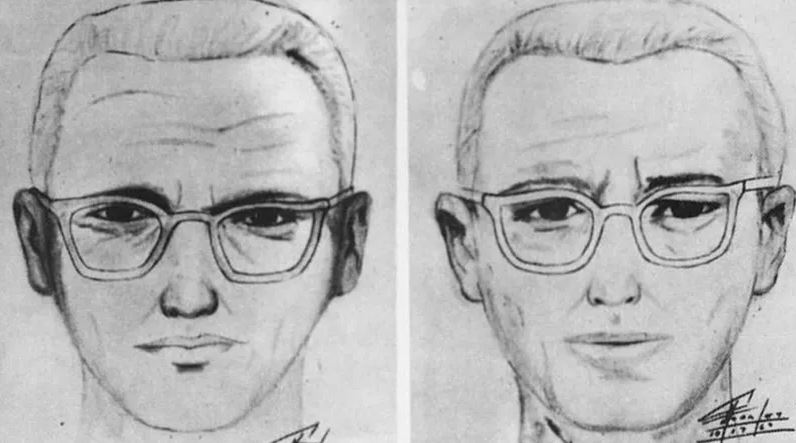
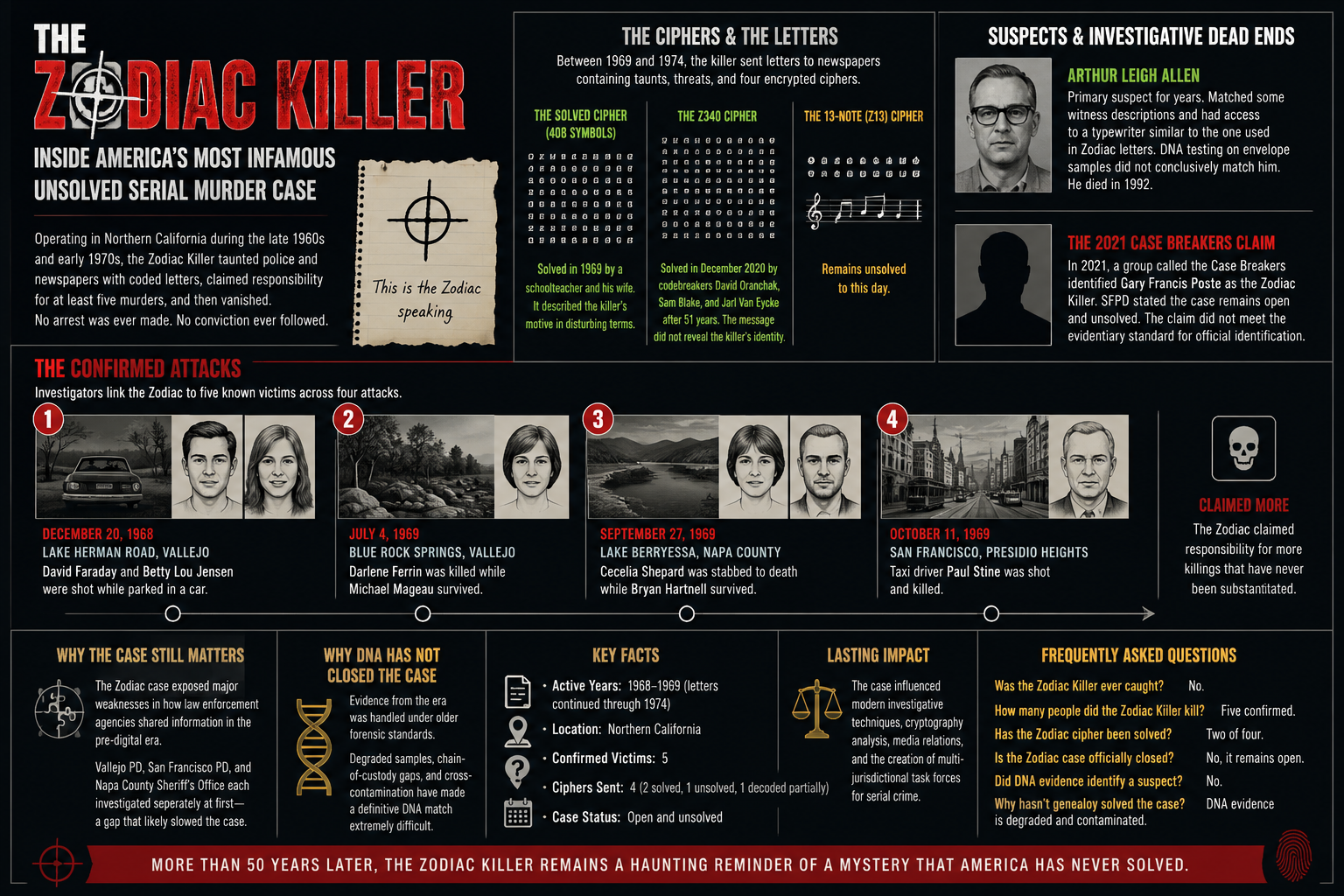
More than five decades after the first confirmed attack, the Zodiac Killer remains the single most studied unsolved serial murder case in American history. The killer taunted police departments and newspapers with coded letters, claimed responsibility for at least five murders, and then vanished from public record. No arrest was ever made. No conviction ever followed.
This report examines what is verified, what remains disputed, and why the case continues to resist closure.
Who Was the Zodiac Killer
The Zodiac Killer is the name adopted by an unidentified individual responsible for a string of murders in Northern California between December 1968 and October 1969. The killer sent a series of letters to the San Francisco Chronicle and other outlets, several containing encrypted ciphers, boasting about the killings and threatening further violence.
Confirmed Attacks
Investigators formally link the Zodiac to five known victims across four attacks:
- Lake Herman Road (December 1968) — David Faraday and Betty Lou Jensen were shot near Vallejo.
- Blue Rock Springs (July 1969) — Darlene Ferrin was killed and Michael Mageau survived.
- Lake Berryessa (September 1969) — Cecelia Shepard was stabbed to death; Bryan Hartnell survived.
- San Francisco (October 1969) — Taxi driver Paul Stine was shot and killed in the Presidio Heights neighborhood.
Several other unsolved murders across California have been proposed as possible Zodiac attacks, though none carry the same level of corroborating evidence.
The Ciphers and the Letters
What separated this case from other unsolved homicides was the killer's direct communication with the press. Between 1969 and 1974, letters arrived at newspaper offices containing threats, taunts, and four encoded ciphers.
The Solved Cipher
The 408-character cipher mailed in August 1969 was solved within weeks by a schoolteacher and his wife. It described the killer's motive in disturbing terms, framing the murders as a form of trophy hunting.
The Z340 Breakthrough
For 51 years, a second cipher known as Z340 defied every attempt at decryption, including efforts by the FBI and NSA. In December 2020, a team of independent codebreakers, David Oranchak, Sam Blake, and Jarl Van Eycke, cracked the cipher using custom software. The message did not reveal the killer's identity, but it confirmed the cipher's structure and renewed public interest in the case.
A final cipher, known as the 13-note or Z13, remains unsolved to this day.
Suspects and Investigative Dead Ends
Multiple law enforcement agencies investigated the case for decades, and dozens of names have surfaced publicly.
Arthur Leigh Allen
Allen was the primary suspect for San Francisco police for years. He matched some witness descriptions and had access to a typewriter similar to the one used for Zodiac letters. DNA testing on envelope samples in the 2000s did not conclusively match him, and he died in 1992 without being charged.
The 2021 Case Breakers Claim
In 2021, a group calling itself the Case Breakers announced they had identified Gary Francis Poste as the Zodiac Killer, citing circumstantial photographic and forensic analysis. The San Francisco Police Department publicly stated the case remained open and unsolved, and the claim did not meet the evidentiary standard required for an official identification.
Why DNA Has Not Closed the Case
Physical evidence from the era was handled under forensic standards that predate modern DNA protocols. Degraded samples, chain-of-custody gaps, and cross-contamination across decades of evidence storage have made a definitive genetic match difficult, even with modern genealogical techniques that have solved other cold cases.
Why the Case Still Matters
The Zodiac case exposed real weaknesses in how law enforcement agencies across jurisdictions shared information during the pre-digital era. Vallejo Police, San Francisco Police, and Napa County Sheriff's Office each investigated separate attacks without a unified task force in the early stages, a structural failure that likely slowed the investigation.
That gap helped shape how multi-jurisdictional task forces are built for modern serial crime investigations.