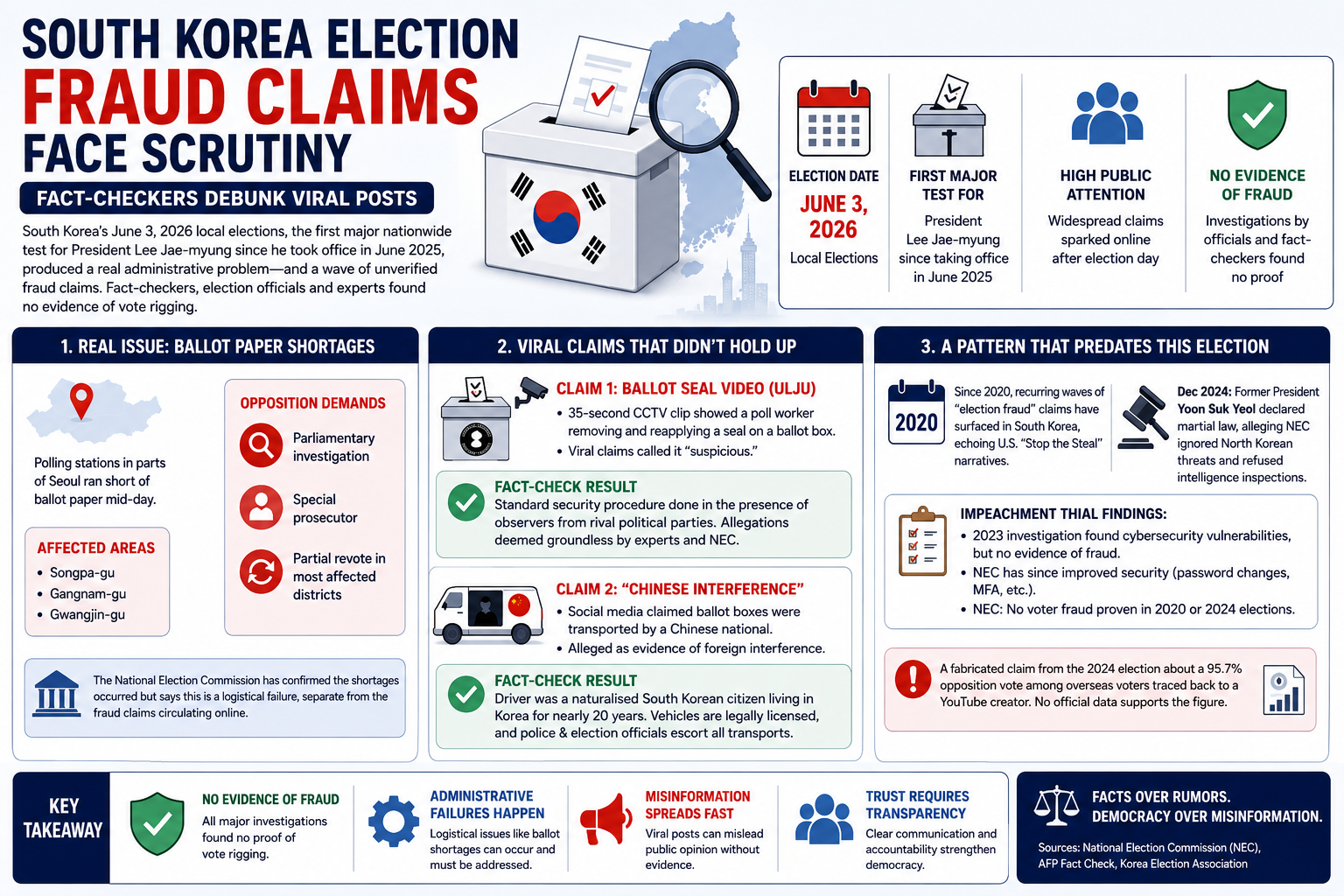
South Korea's June 3, 2026 local elections, the first major nationwide test for President Lee Jae-myung since he took office in June 2025, produced a genuine administrative problem and a wave of unverified fraud claims that fact-checkers have since taken apart piece by piece. Ballot paper shortages at polling stations in parts of Seoul are under real scrutiny from election officials. Separately, viral videos claiming to show vote rigging have been examined by the National Election Commission, independent election experts, and AFP's fact-check team, and none have held up.
A Vote Marked by Real Logistics Problems
The administrative trouble was not invented. Polling stations in Songpa-gu, Gangnam-gu, and Gwangjin-gu, all central Seoul districts, ran short of ballot paper in the middle of voting day. The shortage affected established urban precincts rather than remote areas, which fed public frustration regardless of political affiliation.
The opposition People Power Party, along with allied parties, has responded by demanding:
- A parliamentary investigation into the paper shortages.
- The appointment of a special prosecutor.
- A partial revote in the districts most affected.
What Election Officials Have Said
The National Election Commission has not disputed that the shortages occurred. Officials have treated the paper supply issue as a logistical failure separate from the fraud claims that spread online, a distinction that has not always come through clearly on social media, where the two stories have often been merged into one narrative of a compromised vote.
The Viral Claims That Didn't Hold Up
Two specific claims gained the most traction after election day, and both were directly investigated by fact-checkers.
The Ballot Seal Video From Ulju
A 35-second CCTV clip showing a poll worker removing and reapplying a black seal on a ballot box began circulating on YouTube on June 3, with Korean-language text framing the act as suspicious. The video was said to have been filmed in Ulju, a county in southeastern South Korea.
The National Election Commission described the action as a standard security procedure, one that is monitored by observers sent from rival political parties. Kim Young-tak, director of the nonprofit Korea Election Association, called the fraud allegations against the workers groundless, noting that many polling station staff are not even NEC employees. They are often public servants or schoolteachers drafted for election day, and they work under constant observation from representatives of competing parties.
The "Chinese Interference" Ballot Transport Claim
A second claim spread during early voting, when social media users shared a Chinese-language post about the transport of ballot boxes as supposed evidence of foreign interference. The person driving the van was a naturalised South Korean citizen originally from China who had lived in the country for nearly two decades. He told AFP he had shared the video in the first place because he was proud to take part in the election process.
The National Election Commission rejected the claim outright, stating that allegations of fraud based solely on a driver's nationality are baseless. Officials confirmed that election authorities use commercially licensed vehicles that meet transport regulations and required insurance standards, and that police and election officials accompany all such transports regardless of who is driving.
A Pattern That Predates This Election
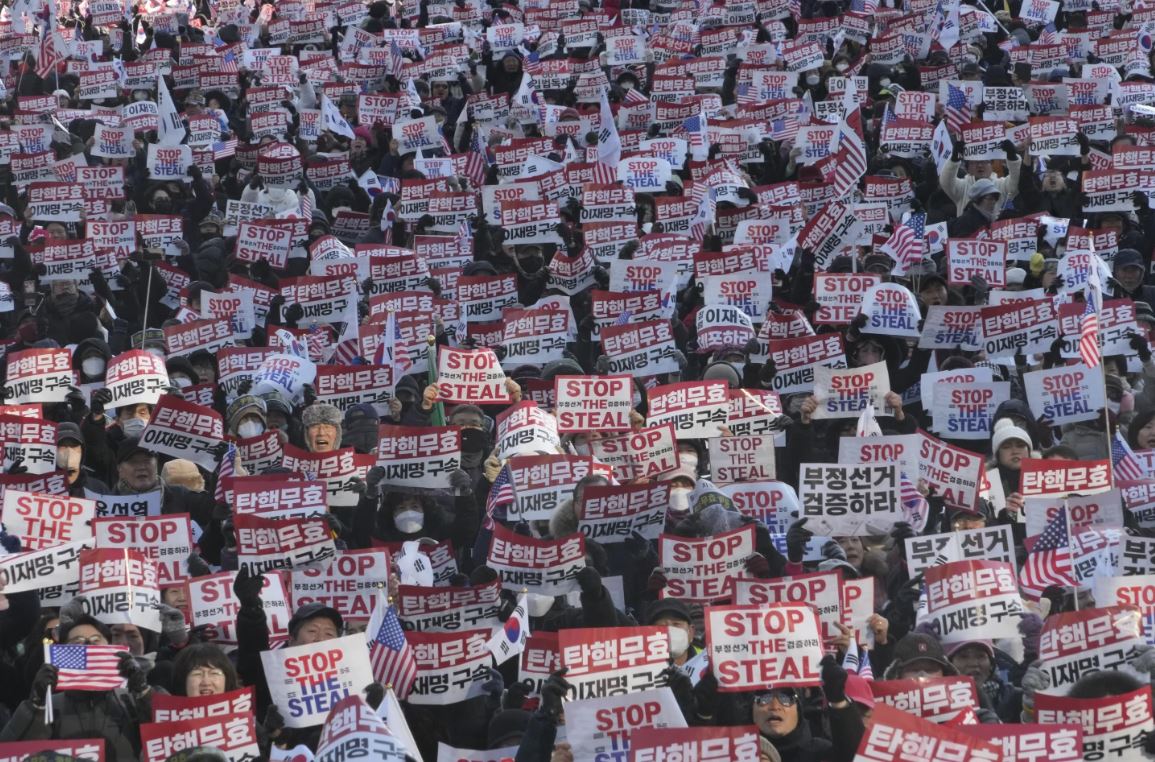
Neither claim emerged in isolation. South Korea has seen recurring waves of election fraud allegations since at least 2020, often echoing the "Stop the Steal" language popularised in the United States. The most intense period followed former President Yoon Suk Yeol's December 2024 martial law declaration, during which he argued the National Election Commission had ignored warnings about North Korean threats to voter data and had not fully cooperated with intelligence agency inspections.
That claim was tested directly during Yoon's impeachment trial. A former National Intelligence Service official testified that a 2023 probe had found cybersecurity vulnerabilities on NEC servers, but the investigation was limited to computer security and produced no findings of actual fraud. The NEC's secretary general told the hearing that the commission had since strengthened protections, including password changes and multi-factor authentication. The commission has stated plainly that no voter fraud was proven in either the 2020 or 2024 elections.
A separate fabricated claim from the 2024 election cycle, attributing a 95.7% opposition vote share among overseas voters to a leaked figure, traced back to a YouTube creator who had also pushed 2020 fraud allegations. AFP found no official data supporting the figure.