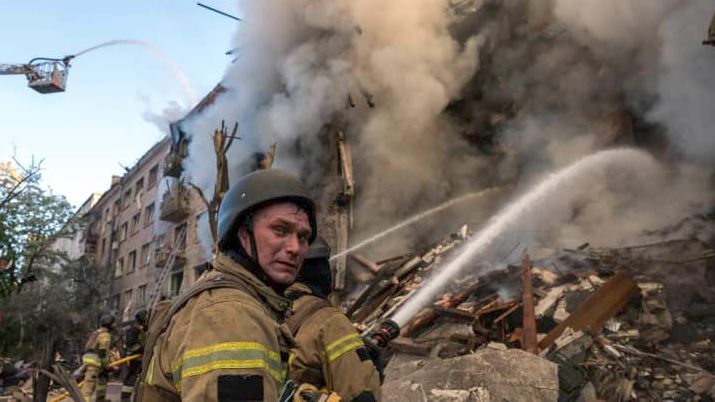
Russia pounded Kyiv and surrounding areas with hundreds of drones and missiles on Sunday in one of the heaviest bombardments of the city since the start of the four-year war. This was not a random escalation. It was a calculated, doctrine-driven strike designed to break civilian morale, strain air defense infrastructure, and send an unmistakable signal to both Kyiv and its Western partners.
What Happened: Scale, Weapons, and Immediate Casualties
Russia launched one of the largest combined missile and drone attacks of the war overnight, with Kyiv as the main target. Ukraine's State Emergency Service reported strikes at around 50 locations across all districts of the capital, hitting residential buildings, private homes, schools, shopping centers, a market, emergency service buildings, police facilities, and the National Chernobyl Museum.
Key facts from the attack:
- At least four people were killed and 83 people injured across Ukraine, according to Ukrainian officials.
- Kyiv Mayor Vitali Klitschko confirmed 56 people were wounded in the capital, 30 of whom were hospitalized.
- Ukrainian President Zelenskyy said Russia launched around 90 missiles of different types, many of them ballistic, along with nearly 600 drones in the assault.
- Dozens of residential buildings and several schools were damaged in the barrage.
- Zelenskyy said Russia had also targeted water-supply facilities, saying Moscow wanted to damage them before summer increased demand.
Zelenskyy described the attack as "severe," adding: "The most hits were in Kyiv, and Kyiv was the main target of this Russian attack." He said of Putin: "He's truly insane. It's important that this doesn't go unpunished for Russia."
The Oreshnik Factor: Russia's Nuclear-Capable Missile Enters the Equation
The single most strategically significant element of this strike was Moscow's deployment of the Oreshnik missile. Ukrainian President Zelenskyy confirmed that Russia used the powerful nuclear-capable Oreshnik medium-range missile in its overnight attack, alongside hundreds of drones and dozens of other missiles.
Military experts say the Oreshnik is designed to penetrate advanced air-defense systems at hypersonic speeds and is capable of carrying nuclear payloads. Russia reportedly first used the Oreshnik system against Ukraine in late 2024 before deploying it again in 2026, signaling a new phase in Moscow's evolving missile warfare strategy.
- Russia said it used Oreshnik, Iskander, Kinzhal, and Zircon missiles in the attack, framing it as retaliation for Kyiv's strikes on civilian targets in Russia.
- Russia's Defense Ministry described the overnight attacks as "massive" and a response to "Ukraine's terrorist attacks on civilian facilities within Russian territory," stating: "The objectives of the strike were achieved. All designated targets were hit."
From a strategic analysis standpoint, deploying the Oreshnik is not purely about battlefield effect. It is coercive signaling directed at NATO capitals. Moscow is deliberately demonstrating that it possesses systems capable of bypassing Western-supplied air defense platforms, a message intended to suppress further weapons deliveries to Kyiv.
Strategic and Geopolitical Implications
This attack carries weight far beyond its immediate death toll. Several dimensions demand serious assessment:
Russia's targeting logic shows deliberate civilian infrastructure pressure. Residential buildings, schools, shopping centers, and cultural institutions, including the National Chernobyl Museum were all struck. Targeting heritage and civilian sites is designed for psychological impact, not military utility.
The timing matters. The attack continued after sunrise, with more missiles and drones expected to hit Kyiv, indicating this was not a single-wave strike but a sustained, phased operation.
The scale is historically significant. Monitoring groups reported that more than 50 Russian missiles and upwards of 700 drones were launched towards Ukraine, almost entirely targeting Kyiv, marking one of the largest mass attacks over the last year.
Western response will define the next phase. Silence or delayed condemnation emboldens further escalation. The use of a nuclear-capable delivery system in a populated capital demands an immediate and unified NATO response, not just diplomatic statements.